Posts Tagged 'Pattern Bargaining'

Should teachers wear uniforms? Some thoughts on the PBA contract and the uniform pattern.

PBA now has a contract. The details are better than DC37’s, which has led to some questions and confusion amongst rank and file in the UFT. In this post, I analyze some of the details/implications, answering some questions I’ve seen circulating along the way.

  • Beating ‘the pattern.’ I’ll start with the question I’m hearing the most: if police officers beat the pattern, can we? The short answer is no. You see, police officers are grouped under what we call the ‘uniformed professions,’ who effectively get their own pattern. So, while NYFD may benefit from PBA’s negotiation, UFT will not. We’re stuck with the ‘non-uniformed’ or ‘civilian’ pattern, and that sub-inflation embarrassment was set by DC37 without any pushback from UFT leadership. Similarly, police officers will apparently get their retro settled right away – they won’t have to wait for years and years to be ‘made not quite whole,’ as UFT infamously did.
  • The gendered ‘pattern gap.’ The uniformed/civilian distinction sets an incredibly problematic double standard. Pattern bargaining already has the issue of ‘cementing’ old inequalities into eternity. All titles are subject to the same economic increases, so whatever inequalities were there at the beginning of pattern bargaining are doomed to be perpetuated ad infinitum. But the distinction between uniformed/civilian professions only further exacerbates inequalities. By ensuring that salaries even grow at a higher rate amongst male-dominated professions (e.g. police officers and firefighters) compared to female dominated professions (e.g. teachers and paraprofessionals), inequalities between the pay rates of each job actually increase over time.
  • There’s no substitute for real organizing. NYPD officers have a bit of a reputation for ‘stretching’ the Taylor Law and getting away with it. (Think: ‘blue flu’). But, PBA solidly negotiated this contract within the confines of New York public-sector bargaining laws. In other words, they did not strike. And it’s telling that police officers, despite predictably doing better than DC37 in terms of their pattern, still ended up with sub-inflation wage increases. Education workers in Los Angeles on the other hand, who held a three day strike, did beat inflation. So yes, NYPD will get better relative raises than the UFT, but the more militant Local SEIU 99 beat both out by a longshot.

So, yes, teachers and all other ‘civilian’ union members should at least get what ‘uniformed’ workers get. The inequality in our patterns exposes some of the most blatant absurdities of pattern bargaining, and should be immediately abolished. But to truly get what we deserve, we will need to push beyond what even uniformed unions are getting in post-Taylor, New York. To get what we really deserve, we will need to dramatically increase our scope of contract tactics to that of what we are seeing in L.A. and Chicago. It is organizing, and organizing alone, that can beat inflation.

DC37 Makes Sub-Inflation Pattern Official

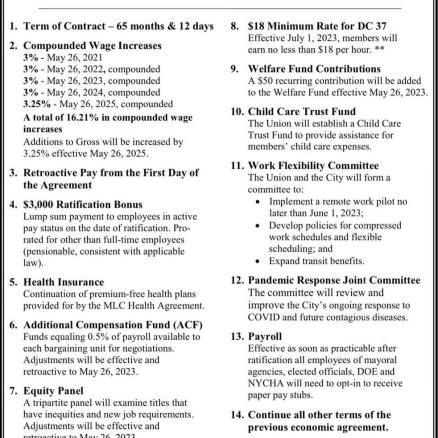
As expected, DC37 has voted overwhelmingly to ratify a new contract. This is important news for teachers, because the contract is pattern-setting. In other words, the economic details will also apply to the UFT. I hope the contract turns out to be a fair one that improves working conditions for our fellow unionists. But, we already know the economic details aren’t good.

The numbers come down to about 3% in annual wage increases, along with a $3,000 signing bonus. In the end, that will come to about 16.21% over 5.5 years. That might sound like a big number, but it’s less than inflation. It’s also less of a pay increase than what workers are getting on average across the United States – and most U.S. workers aren’t in labor unions. For a unionized comparison, in Los Angeles, where public sector workers have and exercise the right to strike, SEIU 99 just negotiated 30% raises. In New York, where labor leaders argue against even having the right to strike, DC37 just agreed to about half that.

Still, DC37 had access to the numbers and still voted in the contract. We don’t know the ins and outs of their negotiations and what led them to settle for less. We do know that DC37’s membership was strongly encouraged by their union leadership to take the deal. We also know that, other than the pertinent financials, DC37 members did not have much information about their contract. They didn’t receive a full copy with their ballots. All they had was this one pager. And, while I hope the document was accurate, we’ve also seen hidden appendixes get voted in before.

Speaking of hidden appendixes, we also know that healthcare is being negotiated in parallel to our contracts. So, we aren’t just looking at a disappointing pattern. We’re also facing the possibility of being switched off our health plans for something cheaper. And unless we are successful with our petition, we won’t even have a say in that decision. Some DC37 dissidents tried to urge a no vote based on healthcare uncertainty alone. However, DC37’s progressive opposition is smaller than the UFT’s, and their union is much larger and more difficult to organize without the advantage of leadership’s institutional resources.

There are still loose ends to uncover. Soon enough, we’ll learn the specifics of in-service healthcare changes. With time, the full DC37 contract will also become available for analysis, and we’ll have more detailed information about what their deal means for us. Once we know more, we’ll publish more. In the meantime, I hope DC37 maximized the improvements they were seeking.

UFT/DC37 Contract Watch – It Gets Worse 

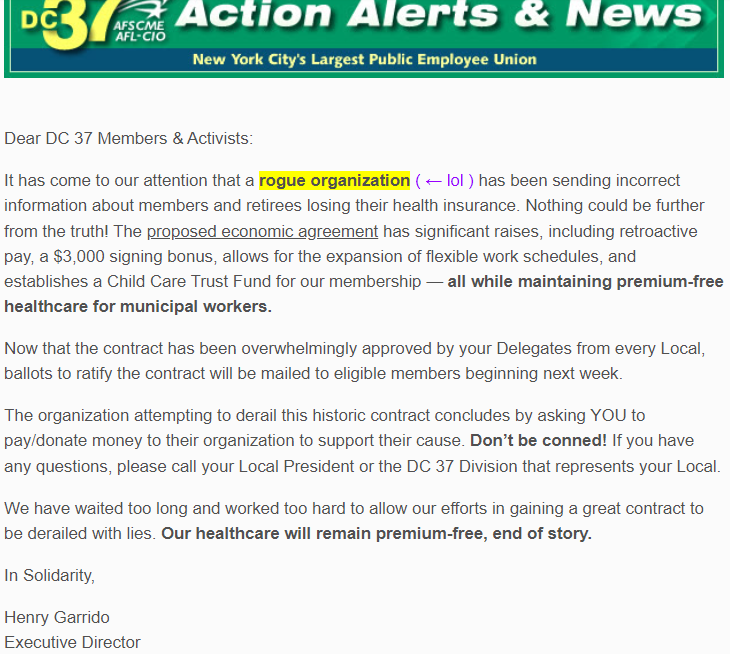
Surprise, surprise – it’s not looking good for the UFT’s next contract. In an exploitative misuse of pattern bargaining, Adams set up DC37 to vote in sub-inflation wage increases that other municipal unions will be ‘stuck with.’ But, rumor had it that DC37 rank-and-file were overwhelmingly happy about the deal. Many of them were expecting less than the 3% pittance being sold as a win. And some were happy about vague promises of more ‘flexible’ remote work policies even as they would be irrelevant to many DC37 members. (You can’t remotely tune in to cook school lunch). But even among the optimists, there were skeptics. Though the tentative contractual agreement was years late, it also paradoxically felt rushed. What was everyone missing? Most of us guessed healthcare.

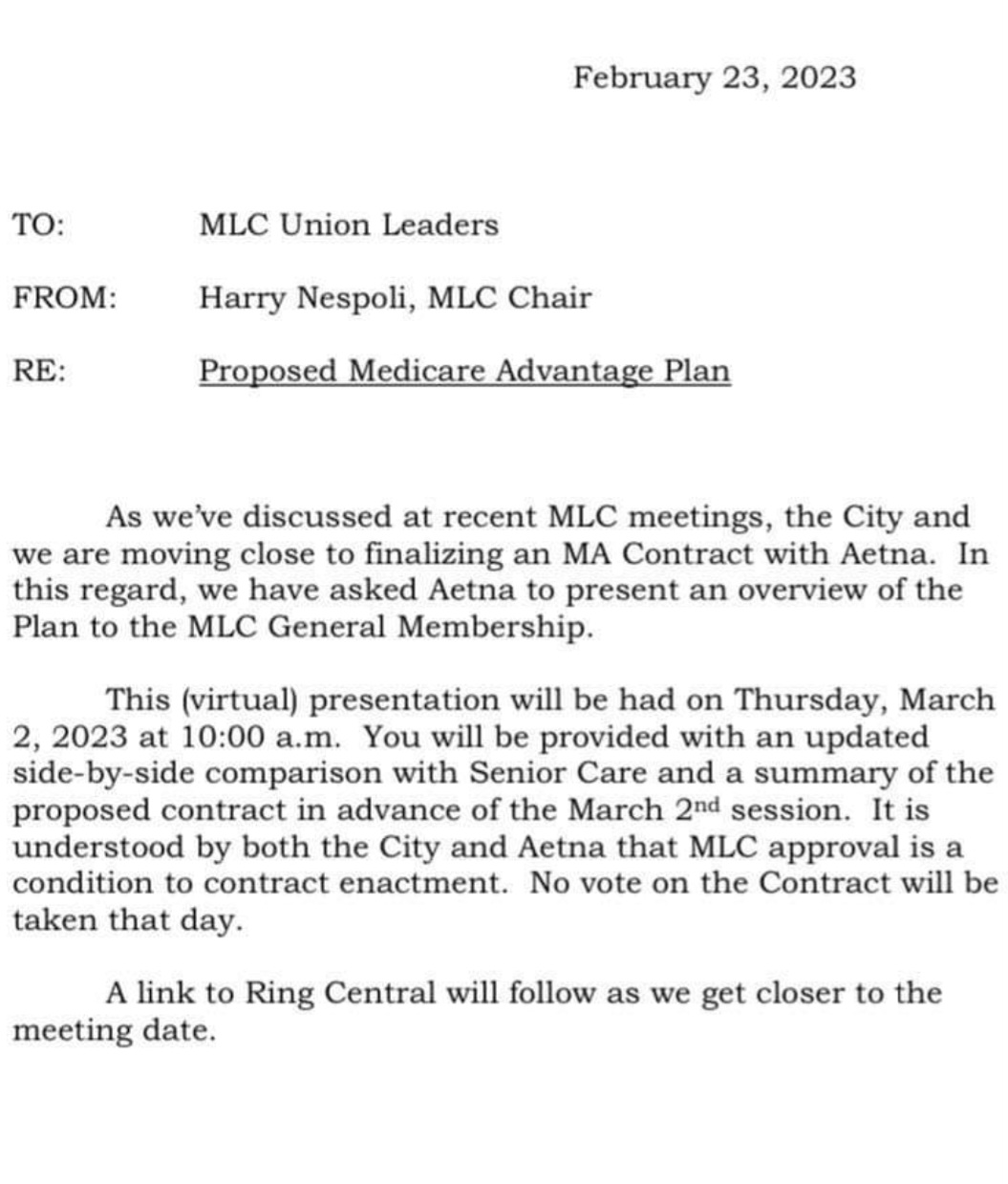
This leaked MLC memo suggests we were right. 

Translation: just as DC37 leadership is setting up to push out a sub-inflation pattern for all MLC unions, MLC leadership (predominately UFT and DC37) is gearing up to privatize our retirees’ Medicare. And with constant talk of a mysterious ‘RFP’ to replace GHI/HIP, we can expect further ‘cost savings’ to be dumped onto working municipal employees. In short, we were sadly right to predict that ‘3% could easily become -3%.’ 

The Role of Rank and File

Even before this news, teachers were picking up on our union leadership’s non-willingness to fight for something better. Earlier this week, on the ICE-UFT blog, James Eterno posted an anonymous teacher’s plea to NY’s City Council. This teacher, lacking any confidence in UFT leadership to get us wages anywhere close inflation, begged our City Council to write/pass legislation that would. This isn’t the first time a teacher has gone to politicians for help because our union leadership let us down. Think back to 12-126. Without the consent of membership, UFT leadership tried to organize us to get the City Council to erase our healthcare protections. Indeed, we now know that massive amounts of money were spent by our own union leadership to lobby against our healthcare interests. With union leadership working against us, members were left with no choice but to form their own massive grassroots response. In opposition to Mulgrew, New Action joined thousands of fired up municipal workers and retirees to petition against changing the code. We won that battle. City Council listened to rank-and-file members/retirees over the union leadership who was trying to sell us out. It was proof that rank-and-file could organize even when leadership was actively working against us. But, we all knew it wasn’t over. This leaked memo, with its suspicious timing right before a bad pattern is about to be set, shows the time is now.

These are the odd circumstances we’ve found ourselves in circa 2023. We are left with the need to use real union tactics like organizing members for no-votes and working together to lobby our employer for better pay/healthcare. But it isn’t our official union leadership who is doing this organizing. They, rather, are doing backroom deals and putting forth propaganda to get us to accept crappy wages and healthcare reductions. And yes, I’m sure in their minds, they think they’re doing the right thing. In the context of the Taylor Law, this might be the ‘best’ they can do while using traditional (i.e. legal) negotiating methods. Yes, it’s not a good deal, but it’s the ‘least bad’ deal they can get us.

If we simply go with Mulgrew and Garrido, all we’ll get is the ‘best possible reduction in wages/benefits.’ If we want more than managed decline, we have no choice but to organize ourselves. Short term, that means organizing around healthcare/the pattern. Long term, that means making massive changes to the Taylor Law, so that our unions can function like unions again. Bottom line is: we can’t just sulk and ‘wait for the inevitable.’ We need to be ready to fight. 


Learn more about

our UFT Caucus

Content Policy

Content of signed articles and comments represents the opinions of their authors. The views expressed in signed articles are not necessarily the views of New Action/UFT.
Follow New Action – UFT on WordPress.com
December 2025
M T W T F S S
1234567
891011121314
15161718192021
22232425262728
293031  

Blog Stats

  • 401,258 hits