Posts Tagged 'Medicare'

Some Initial Thoughts and Questions About the New Healthcare Proposal

UFT members received an email on August 28th alerting us to the fact that a tentative agreement has been reached with EmblemHealth/UnitedHealthcare to replace GHI-CBP, which covers about 730,000 participants when factoring in “active city workers, pre-65 retirees, and dependents.” This is obviously a matter of tremendous importance for many of us, as well as our families. 

In this document, we attempt to look at what is currently known about the proposal as even handedly as possible, and within the context of the larger healthcare agreements from which this proposal stems. As we’ll see, many aspects of the proposal look very good. For example, it seems as though there will be expanded access to healthcare providers outside of NYC for UFT and city employees who live further out. Still, other questions remain unresolved or are answered ambiguously in the FAQs.  Without delving into history, it’s a fact that we owe hundreds of millions of dollars in healthcare savings to the City. Those promised savings are going to color how many of us see this plan. Many of us, understandably, will have at least some skepticism. Indeed, some of our first questions, are not answered by the FAQ:

  1. What percentage of the promised savings are met through this agreement?
    1. How are those savings met and to what extent (if any) is that done by reducing quality/quantity of care? To what extent (if any) are the savings met by setting the conditions for potential reductions of quality/quantity of care down the line?
  2. What savings, if any, still need to be met to be in compliance?
    1. If the answer to the aforementioned question is anything more than 0, what does that mean for how care might change down the line?

So in addition to the obvious questions…

  1. Based on what we know, what is good about the plan?
  2. Based on what we know, what is not so good about the plan?
  3. What don’t we know about the plan that is either good or bad?

…without more information relating to questions 1 and 2, it is impossible to understand whether the new healthcare plan is the only healthcare news we’ll see over the next few months and years or whether new surprises might later transpire. Interestingly, we see some hints of that potential news in the FAQ, which can be accessed by clicking on the link at  the bottom of the August 28th email. So, without further ado, after reading the FAQ section (screenshots below), and without being accusatory, we have some thoughts and questions about the new healthcare proposal:
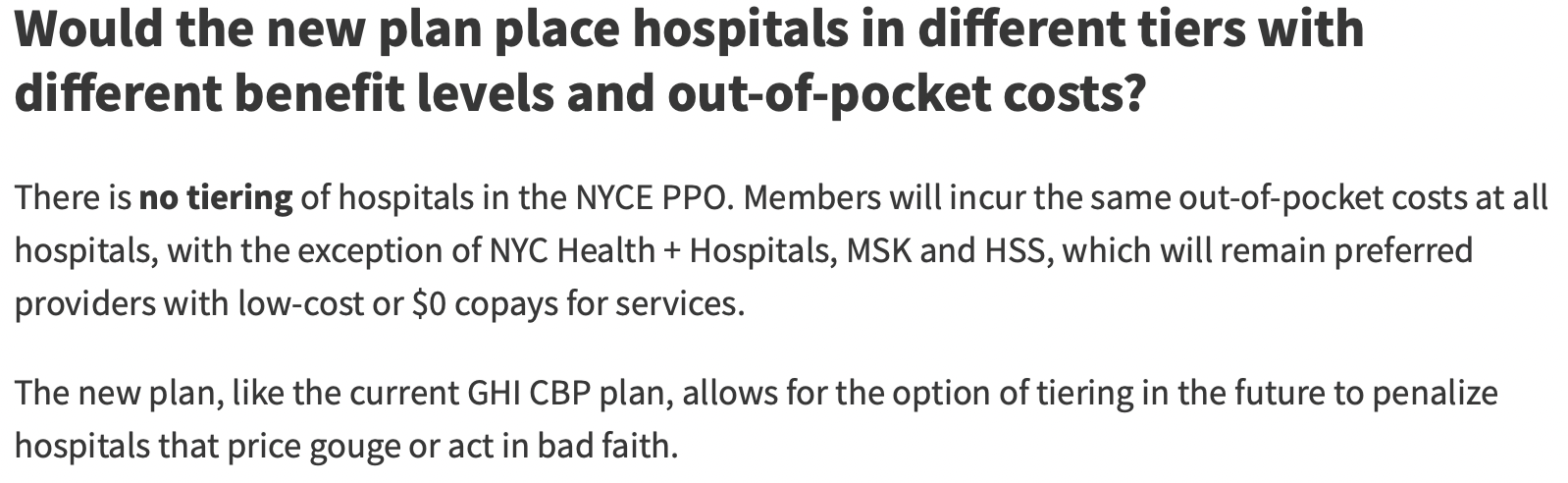
The possibility of tiered hospitals in the future should scare everybody. That would mean that the “better” hospitals would charge higher co-pays, forcing us and our families to go to mid-tier (which would still charge co-pays) or lower-tier (little or no co-pays) hospitals. Besides the obvious disadvantage of not getting the best treatment available, there is also the distinct possibility that the nearest hospital to your home is the one who will charge you an arm and a leg for medical care, should tiered hospitals be implemented down the line.
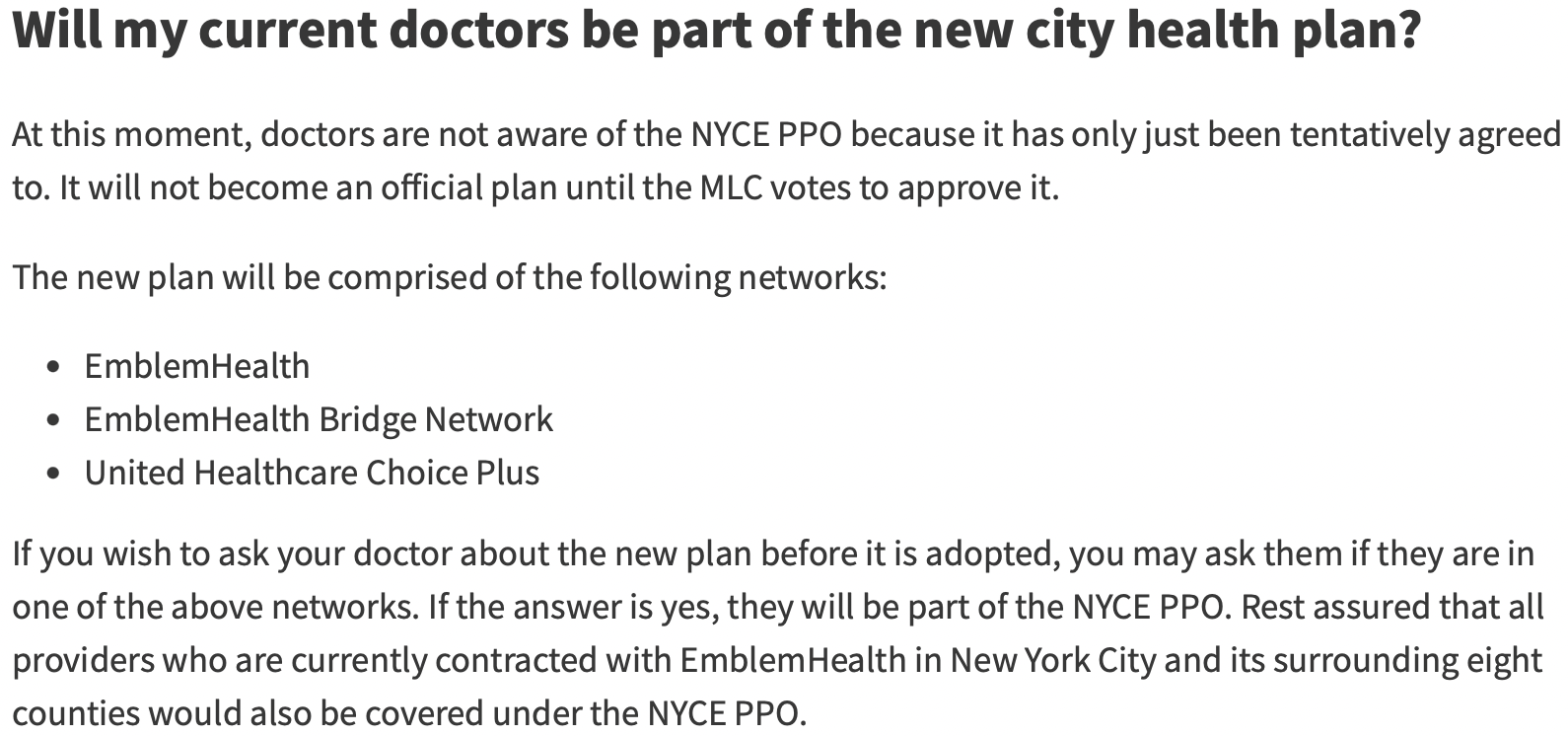
“We don’t really know if your current doctors will be part of the new city health plan. You should ask them… but they may not know either since they’re not aware of the NYCE PPO.” Perhaps everyone’s doctors will be in-network but this answer leaves a lot to be desired.
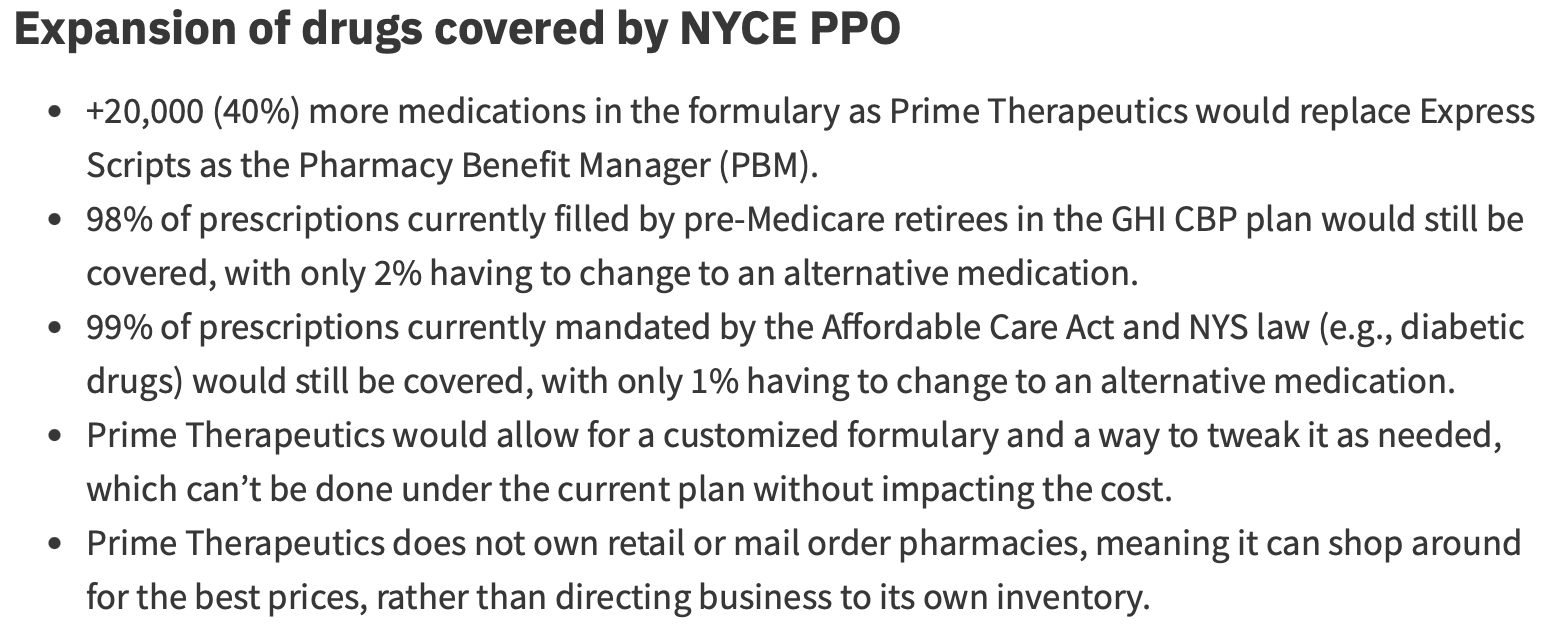
This doesn’t sound terrible, but we would like to know what 2% of prescriptions currently filled by pre-Medicare retirees will have to be changed to an alternative. Same goes for the 1% of prescriptions that are currently mandated by the ACA and NYS law. 

The words “not changing at this time” are never comforting, especially when it comes to cancer treatment and injectables. 
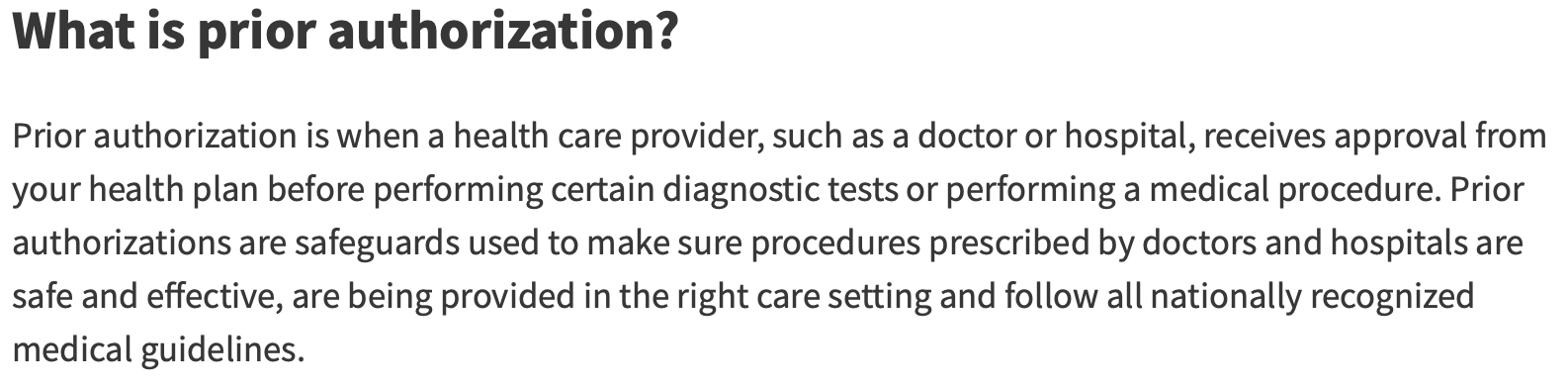
This is a carefully worded, soft-pedaled definition of prior authorization. What is not mentioned here is the fact that health insurance companies hold our collective fate in the palm of their hand. They can choose to delay or deny procedures on a whim because they profit heavily from doing so (procedures cost them money – if they authorize fewer procedures, they make more money). 
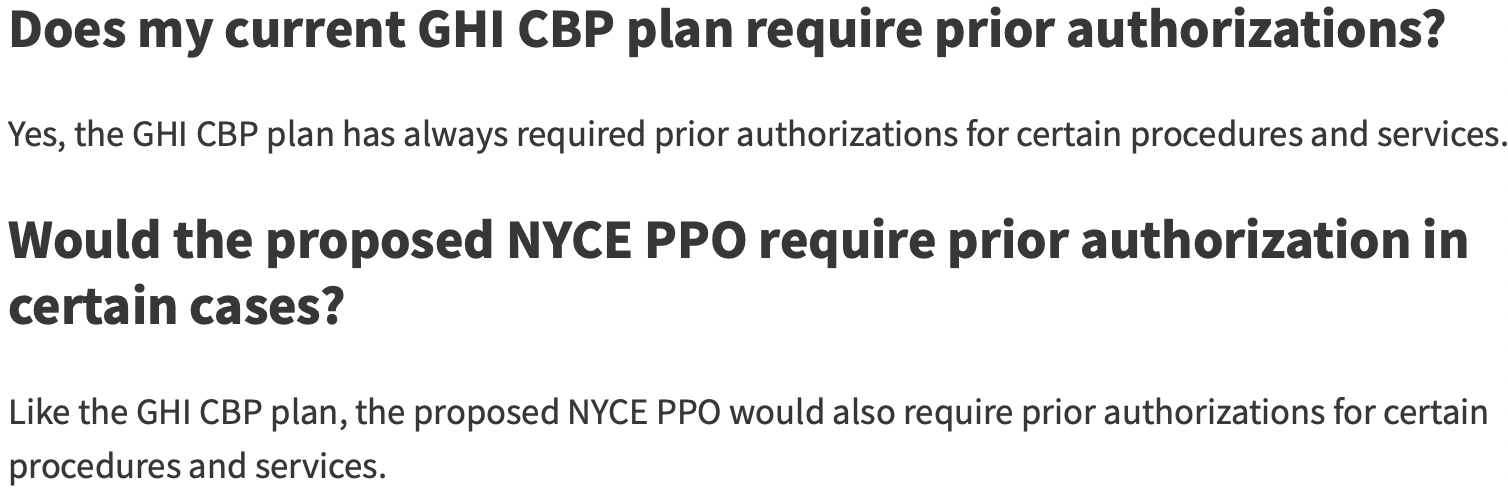
We would like some clarification on this. The information is technically not incorrect (i.e. GHI CBP requires prior authorizations for MRIs), but we would like to know, specifically, which procedures and services currently require prior authorizations under GHI CBP, and which procedures and services will require prior authorizations under the proposed NYCE PPO plan. 
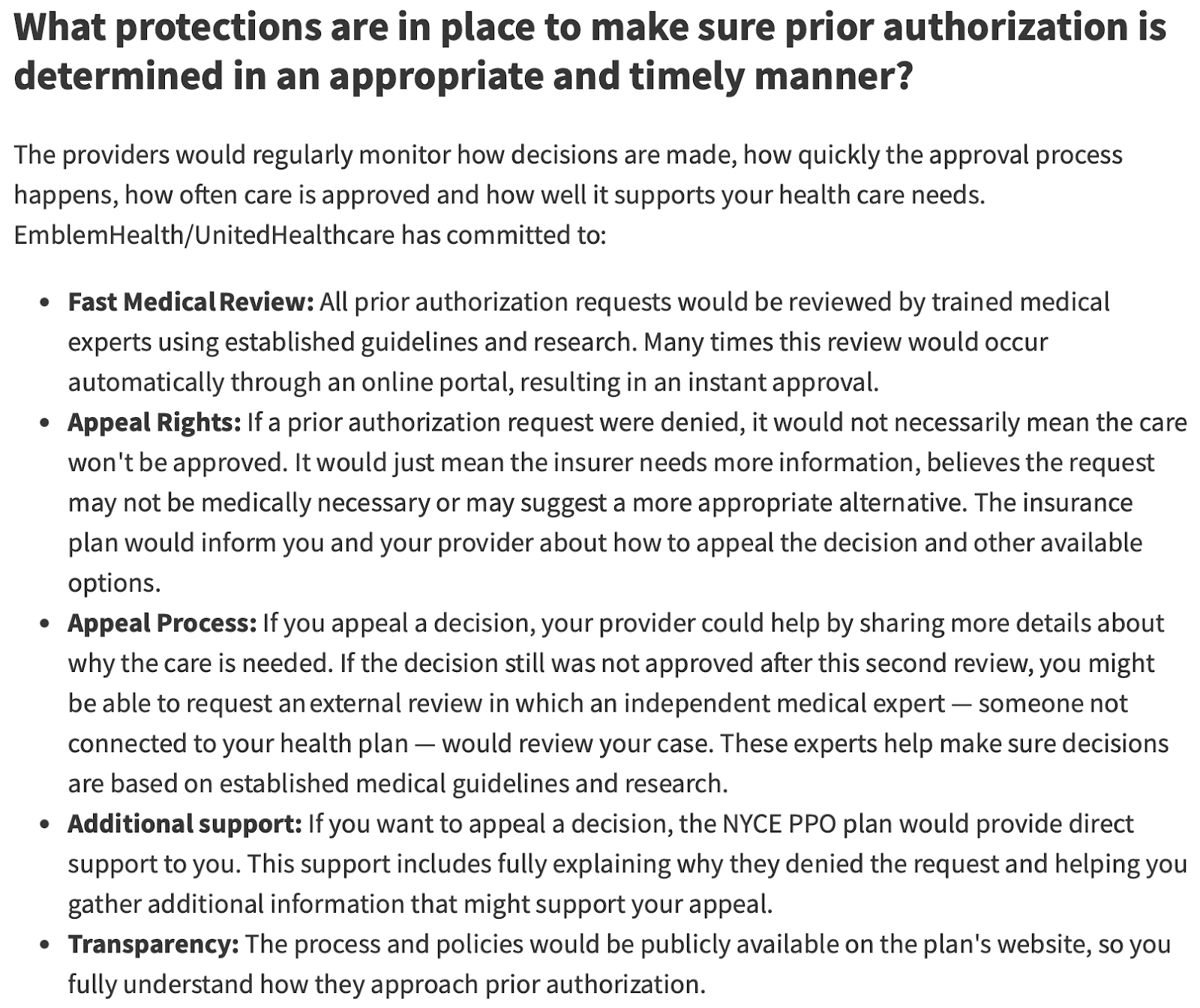
This sounds like a bunch of gobbledygook. There are no specific timelines given for approvals, denials, or appeals. Right off the bat, it says “The providers would regularly monitor how decisions are made, how quickly the approval process happens, how often care is approved and how well it supports your health care needs.” These are the same providers who make money by delaying and denying treatment.
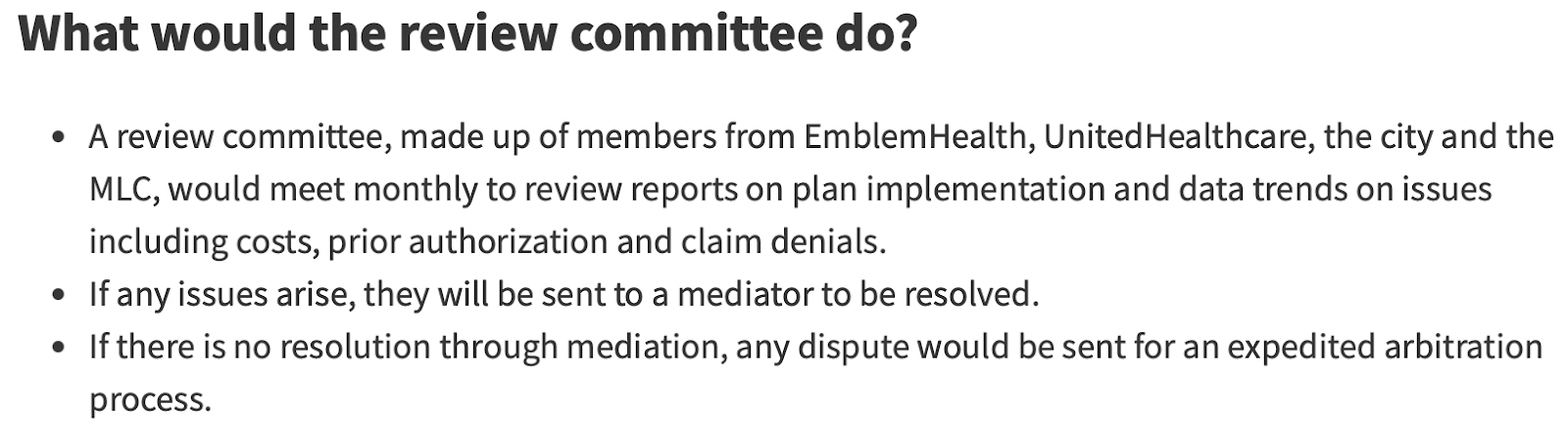
This sounds like our plan can be altered at any time if the healthcare providers and city aren’t happy with the arrangement. The MLC will be there but a) They’re outnumbered, b) We’ve been stung by them before – will they really defend us from catastrophic changes?, and c) Who would be the arbitrator? We consistently lose arbitration decisions. Currently, the most infamous arbitrator is a power player who has tried to diminish our health insurance for years and has been consistently unfriendly to us.
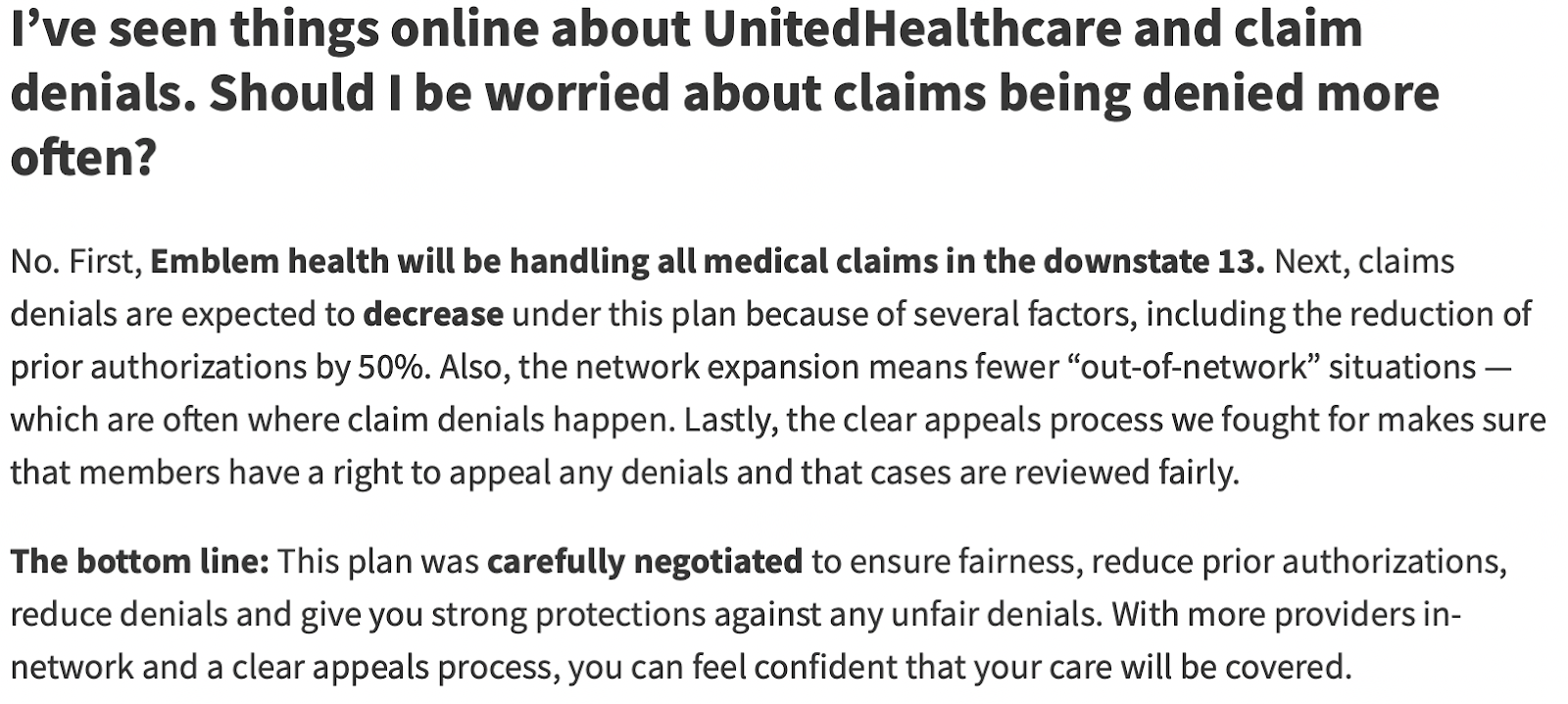
Which procedures, specifically, will receive fewer denials? There is no wording here that explains which procedures may be denied more frequently under the new plan. Will denials be down all across the board, or will there be an increase in denials in certain areas? 

As you can see, although there are some benefits in the new healthcare plan, there are many questions and concerns that have not yet been thoroughly addressed. Hopefully, in the coming weeks, we will get some more clarification. This impacts the vast majority of UFT members and city workers. We need to pay attention and we cannot be afraid to ask questions and voice our thoughts. There can be no ambiguity when it comes to health coverage that protects us and our families.
Retirees Sue to Halt Forced Switch to Medicare Advantage

Yesterday, the NYC Organization of Public Service Retirees initiated a new lawsuit against the City, as reported by the Daily News. Using a complicated mix of legal strategies, the goal of the legal action is ultimately to stop Mayor Adams from switching retired municipal workers—such as UFT members—off traditional Medicare and onto an Aetna-run Medicare Advantage Plan (MAP).

I of course am no legal scholar, but I did read through the 106-page official court filing,  and encourage others to do the same. The lawsuit makes an overarching claim that retired City workers took lower salaries and made irreversible financial, geographic, and medical decisions, both while working and once retired, in part because they were assured during and after their careers that in retirement the City would pay for their Medicare Part B premium plus their choice of a Medicare Supplemental plan. As good as any excerpt detailing the lawsuit’s primary claims can be found on pages 73-74. In this section, we see the facts/arguments tailored toward an ‘unjust enrichment’ claim, though other passages tailor those same facts/arguments toward other types of claims. That section is reproduced here:

“First, Respondents engaged in an unjust bait and switch. For 57 years, the City has promised municipal workers that a career in civil service – which pays wages substantially below those in the private sector – would entitle them to City-funded Medicare plus supplemental insurance in retirement. Retirees worked for the City for decades in reliance on this promise. When he was running for office, now-Mayor Adams agreed that eliminating Medicare plus supplemental insurance would be an unfair “bait and switch” that would “traumatize” these elderly and disabled Retirees. 50 He added: “You don’t become a civil servant to become a billionaire. You become a civil servant to have stable health care, a stable pension and a stable life, and we cannot destabilize it after they retire. Right now, after serving your city, we should not do any type of bait and switch. When you retire, you retire with an understanding, and we need to make sure we live up to that agreement.”

Second, Respondents are statutorily and contractually required to continue offering, and paying for, a choice of Medicare Supplemental plan.

Third, the vast majority of Retirees survive on meager pensions. Absent the City fulfilling its obligation to pay for Medicare plus supplemental insurance, most Retirees will be unable to afford the healthcare that they need and to which they are entitled.

By forcing Retirees to incur expenses that Respondents themselves owe, Respondents have been, and will continue to be, unjustly enriched. Equity and good conscience demand that Respondents’ unjust enrichment be enjoined and that any financial benefit they receive (including in the form of savings) be disgorged.”

Altogether, the legal filing presents an interesting case—really, cases, plural—to prevent the City from throwing retirees onto MAP. Whether the petitioners will be successful is another story, and—again—I  lack the legal expertise to make a valid prediction. The retirees do have a solid track record – one they’ve been building since they won their first big lawsuit. In that case, the City and official union leadership were stopped from throwing retirees onto a different version of MAP unless they paid up to stay on traditional Medicare (now they don’t even have that option). But Judge Frank’s decision in that case was made on the basis of a narrow reading of Administrative Code 12-126. Our own Unity-led UFT leadership misrepresented that precedent all over the place, suggesting that because of it, the City would be able to unilaterally throw all retirees onto whatever MAP plan they wanted without a pay up option. That of course wasn’t completely true. The City would only be able to do this if union leadership agreed to this ‘nuclear’ option. As we now know, most unions did not agree to this decision, but because of the outsized weight that UFT and DC-37 have in voting on healthcare bargaining decisions through the MLC, Mulgrew and Garrido were able to almost singlehandedly greenlight the MAP nuclear option, and without consulting their memberships either.  (Why? The most likely reason for Mulgrew/Garrido selling out the city’s retirees can be gleaned from Jonathan Rosenberg’s testimony on budgetary implications of moving retired municipal workers onto MAP. While the City is the respondent of the new lawsuit, the primary savings of MAP (and, by extension, changes to in-service healthcare) go not to the City exactly, but to our joint stabilization fund. But I digress – that’s a post for another day.)

Will Marianne Pizzitola’s group be able to use the law to stop the City from pushing retired municipal workers onto an inferior Medicare Advantage Plan? Their legal strategy worked the first time around. It also worked the second time around. But, with a nuclear option now activated—a nuclear option that was tailored precisely to legally circumvent Judge Frank’s previous decision—we’ll  have to see if the law will still be on our side. Still, let’s keep up hope.

Union elections have consequences. One of those consequences is apparently getting your healthcare and retirement benefits stripped away without a membership vote. 

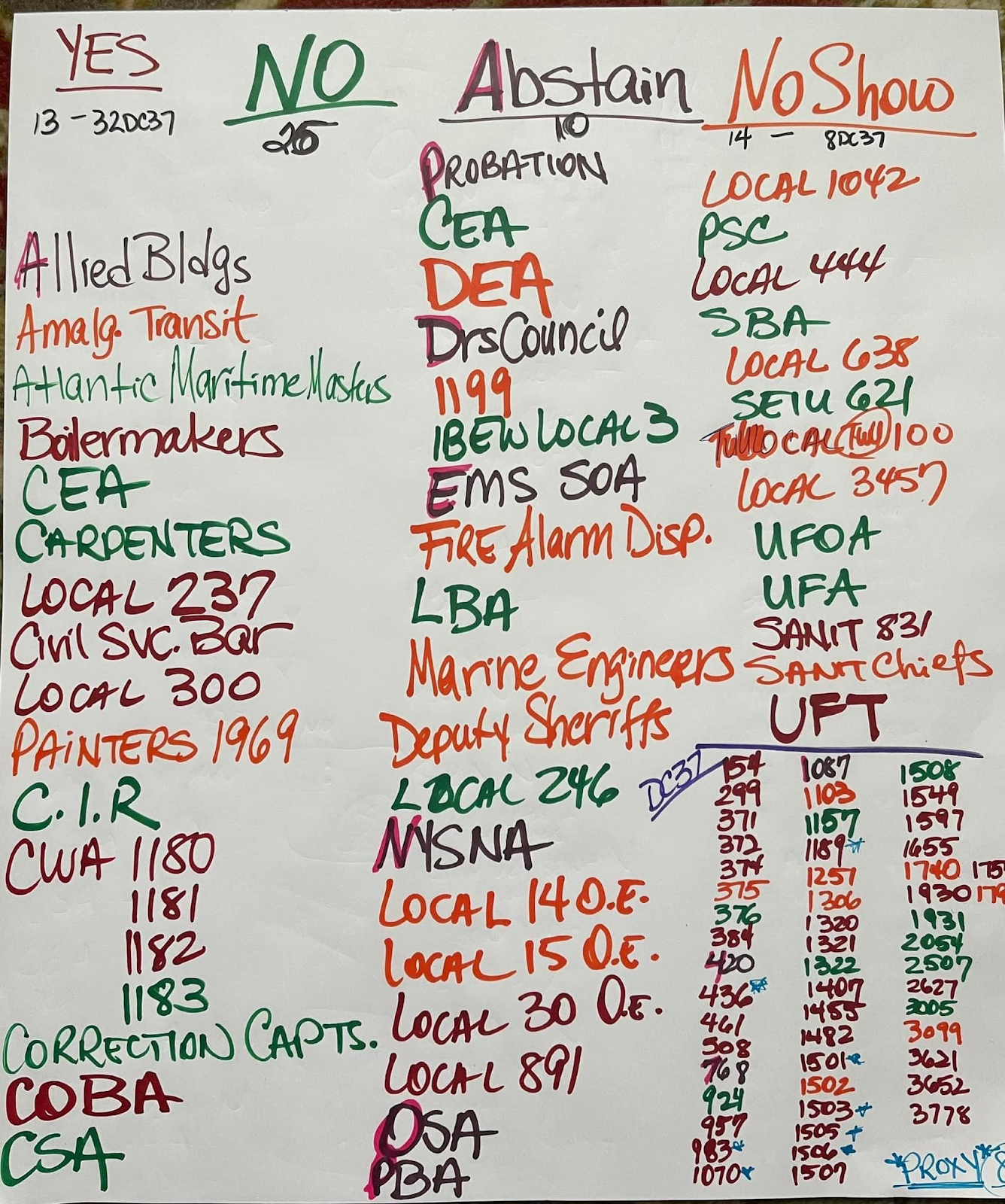
Today, the Municipal Labor Commission (MLC) voted to force hundreds of thousands of retirees off of traditional public Medicare and onto one of two privatized Medicare Advantage Plans (MAPs). (Full analysis of those two plans and the UFT’s role: here). Most of the City unions did not vote in favor of this change. But most unions are much smaller than the UFT and DC37. Therefore, with weighted voting, Mulgrew and Garrido were able to ram through Mulgrewcare with the help of a handful of other union leaders.

Weighted voting in itself isn’t unfair. Some of the unions in the MLC are smaller than divisions in the UFT. It makes sense that our union would get more of a say than particularly tiny ones. On the other hand, does it make sense that UFT votes as one giant bloc? Perhaps, the issue is that UFT has a winner-take-all model of democracy. Only a few minor seats, such as the High School Executive Board, are obtained through division votes. So, even though more than 40% of in-service teachers voted against Mulgrew, including the majority of high school voters, Mulgrew gets to speak for us – and use our weight to influence MLC votes. That’s particularly egregious, because those who voted against Mulgrew voted overwhelmingly for United for Change (which included New Action).  One of our platform items was to preserve traditional Medicare and end healthcare givebacks. It’s sickening to know that Mulgrew was able to use our numbers to vote against our interests as explicitly outlined in our election materials. 

Better yet, why wasn’t a decision this big opened up to a vote for general membership? Even those who voted for Mulgrew in the last election didn’t know that he would push through MAP without even a payup option to keep traditional Medicare. We should have been able to directly vote on this question. But, when asked, Mulgrew made it clear to the executive board, the DA, and–most explicitly–to the retirees that membership would not get a say. His message was simple, a paraphrased version of Trump’s infamous: ‘elections have consequences.’ By winning the UFT election, it seems, Mulgrew earned the right to throw us off our healthcare. He earned the right, in fact, to throw every municipal union off their healthcare. 

Look, the damage isn’t necessarily done. Tier sixers, like myself, are probably feeling pretty pessimistic right now. (We might be able to win for a while, but how do we win for another 50 years?) Nevertheless, we can organize. We can fight back. And we need to take Mulgrew at his word. If elections have consequences this drastic, it’s time for members to start getting involved with alternatives. 

We can’t keep letting Mulgrew’s ‘political party,’ Unity Caucus, do this to us. We can’t keep letting them do this to our brothers and sisters throughout the labor movement either. It’s time for a change.


Learn more about

our UFT Caucus

Content Policy

Content of signed articles and comments represents the opinions of their authors. The views expressed in signed articles are not necessarily the views of New Action/UFT.
Follow New Action – UFT on WordPress.com
December 2025
M T W T F S S
1234567
891011121314
15161718192021
22232425262728
293031  

Blog Stats

  • 401,256 hits