Posts Tagged 'Healthcare'

Some Initial Thoughts and Questions About the New Healthcare Proposal

UFT members received an email on August 28th alerting us to the fact that a tentative agreement has been reached with EmblemHealth/UnitedHealthcare to replace GHI-CBP, which covers about 730,000 participants when factoring in “active city workers, pre-65 retirees, and dependents.” This is obviously a matter of tremendous importance for many of us, as well as our families. 

In this document, we attempt to look at what is currently known about the proposal as even handedly as possible, and within the context of the larger healthcare agreements from which this proposal stems. As we’ll see, many aspects of the proposal look very good. For example, it seems as though there will be expanded access to healthcare providers outside of NYC for UFT and city employees who live further out. Still, other questions remain unresolved or are answered ambiguously in the FAQs.  Without delving into history, it’s a fact that we owe hundreds of millions of dollars in healthcare savings to the City. Those promised savings are going to color how many of us see this plan. Many of us, understandably, will have at least some skepticism. Indeed, some of our first questions, are not answered by the FAQ:

  1. What percentage of the promised savings are met through this agreement?
    1. How are those savings met and to what extent (if any) is that done by reducing quality/quantity of care? To what extent (if any) are the savings met by setting the conditions for potential reductions of quality/quantity of care down the line?
  2. What savings, if any, still need to be met to be in compliance?
    1. If the answer to the aforementioned question is anything more than 0, what does that mean for how care might change down the line?

So in addition to the obvious questions…

  1. Based on what we know, what is good about the plan?
  2. Based on what we know, what is not so good about the plan?
  3. What don’t we know about the plan that is either good or bad?

…without more information relating to questions 1 and 2, it is impossible to understand whether the new healthcare plan is the only healthcare news we’ll see over the next few months and years or whether new surprises might later transpire. Interestingly, we see some hints of that potential news in the FAQ, which can be accessed by clicking on the link at  the bottom of the August 28th email. So, without further ado, after reading the FAQ section (screenshots below), and without being accusatory, we have some thoughts and questions about the new healthcare proposal:
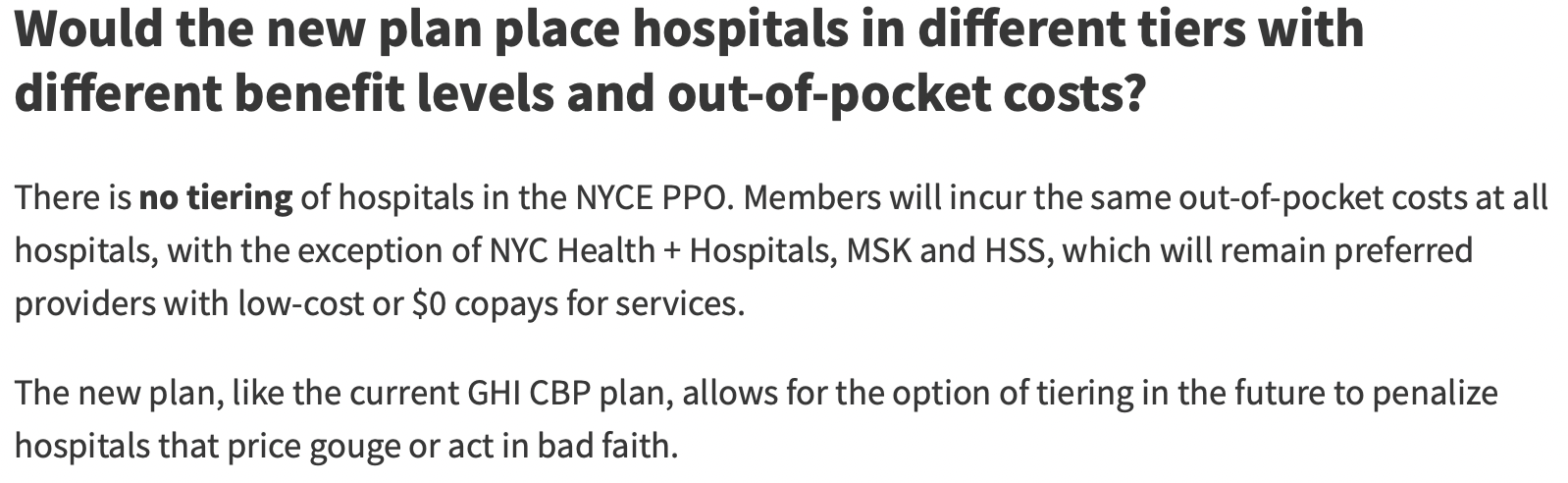
The possibility of tiered hospitals in the future should scare everybody. That would mean that the “better” hospitals would charge higher co-pays, forcing us and our families to go to mid-tier (which would still charge co-pays) or lower-tier (little or no co-pays) hospitals. Besides the obvious disadvantage of not getting the best treatment available, there is also the distinct possibility that the nearest hospital to your home is the one who will charge you an arm and a leg for medical care, should tiered hospitals be implemented down the line.
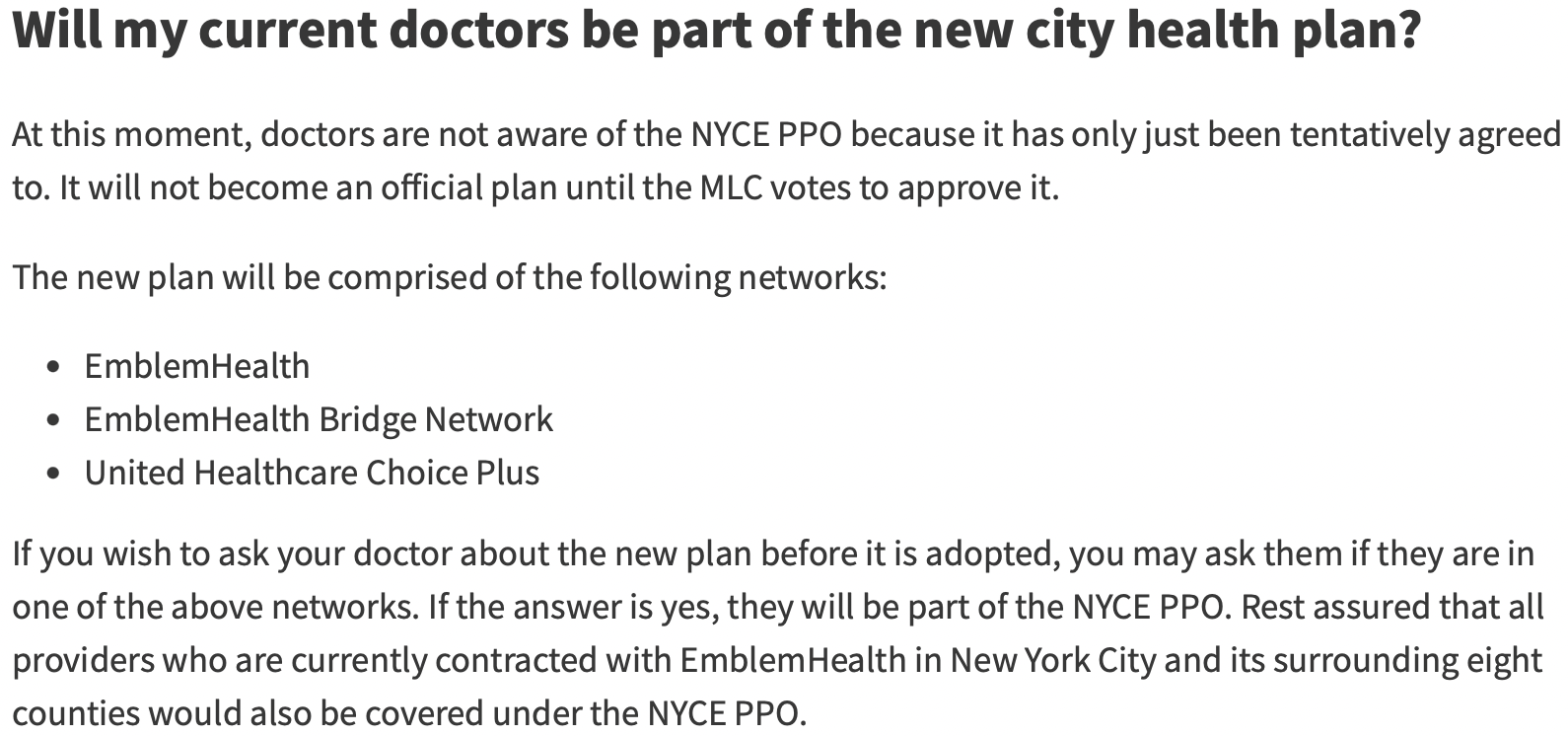
“We don’t really know if your current doctors will be part of the new city health plan. You should ask them… but they may not know either since they’re not aware of the NYCE PPO.” Perhaps everyone’s doctors will be in-network but this answer leaves a lot to be desired.
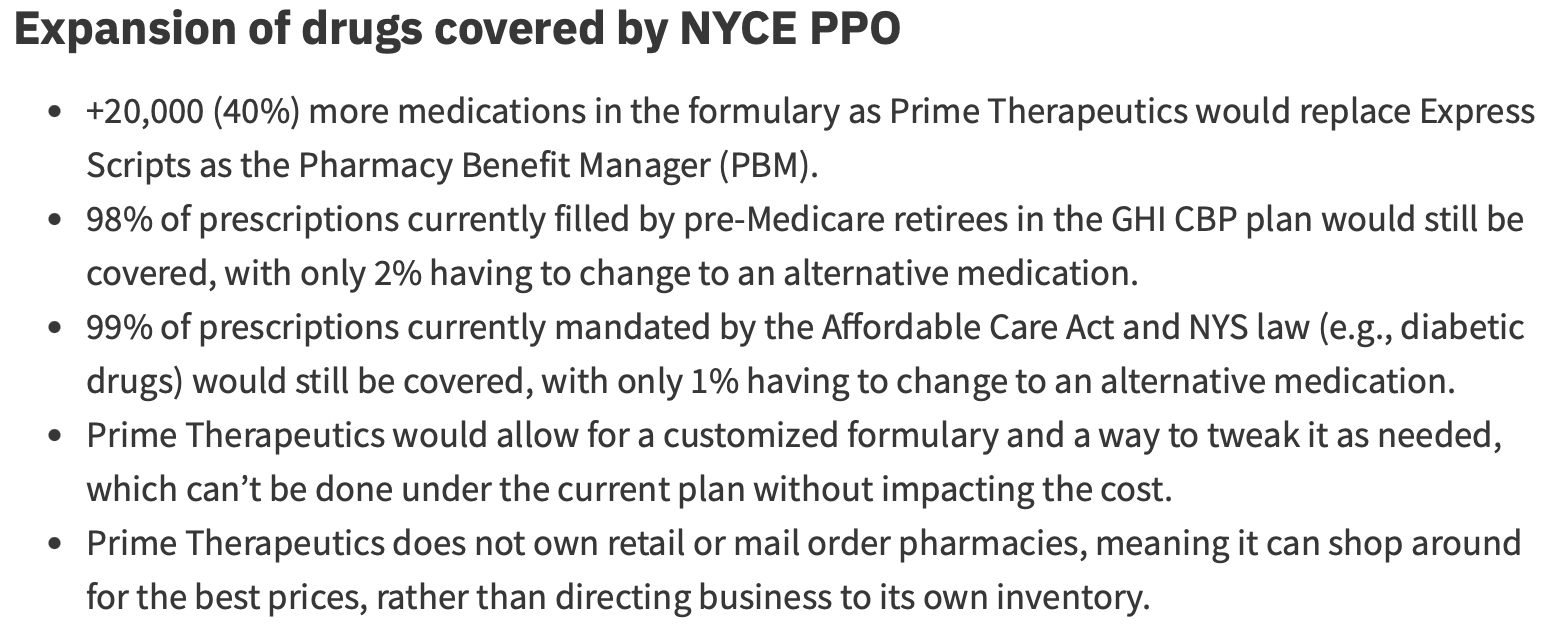
This doesn’t sound terrible, but we would like to know what 2% of prescriptions currently filled by pre-Medicare retirees will have to be changed to an alternative. Same goes for the 1% of prescriptions that are currently mandated by the ACA and NYS law. 

The words “not changing at this time” are never comforting, especially when it comes to cancer treatment and injectables. 
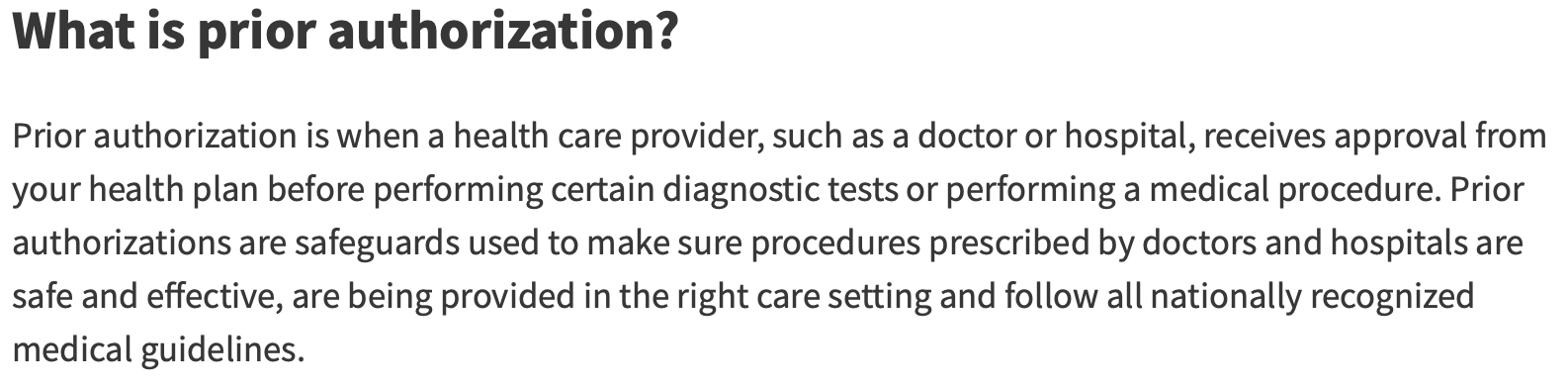
This is a carefully worded, soft-pedaled definition of prior authorization. What is not mentioned here is the fact that health insurance companies hold our collective fate in the palm of their hand. They can choose to delay or deny procedures on a whim because they profit heavily from doing so (procedures cost them money – if they authorize fewer procedures, they make more money). 
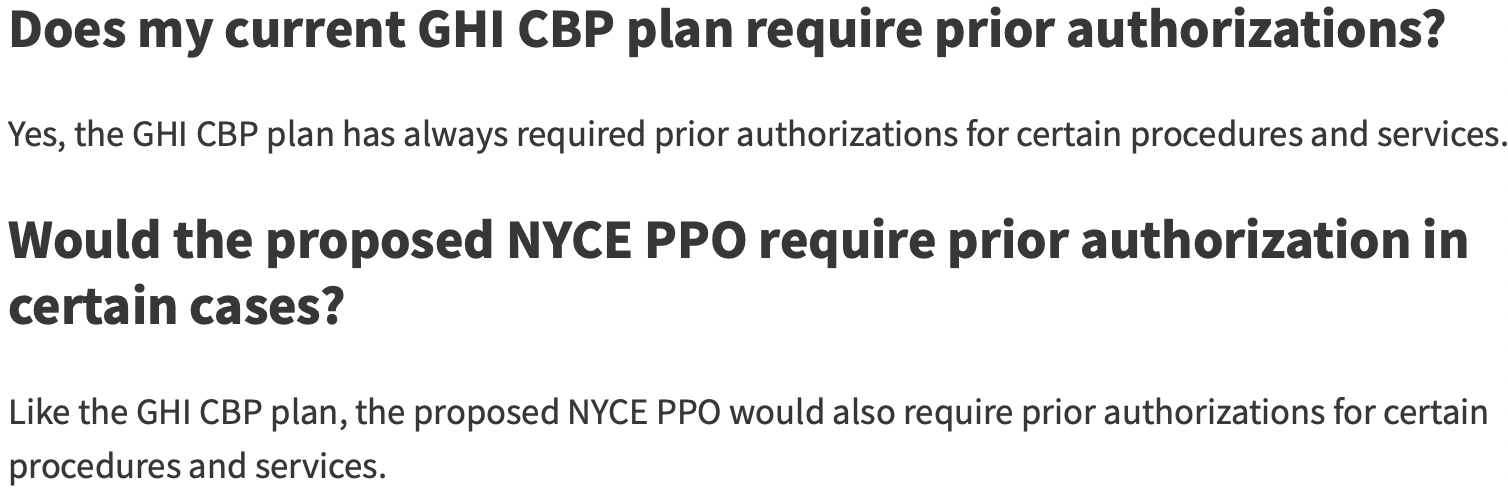
We would like some clarification on this. The information is technically not incorrect (i.e. GHI CBP requires prior authorizations for MRIs), but we would like to know, specifically, which procedures and services currently require prior authorizations under GHI CBP, and which procedures and services will require prior authorizations under the proposed NYCE PPO plan. 
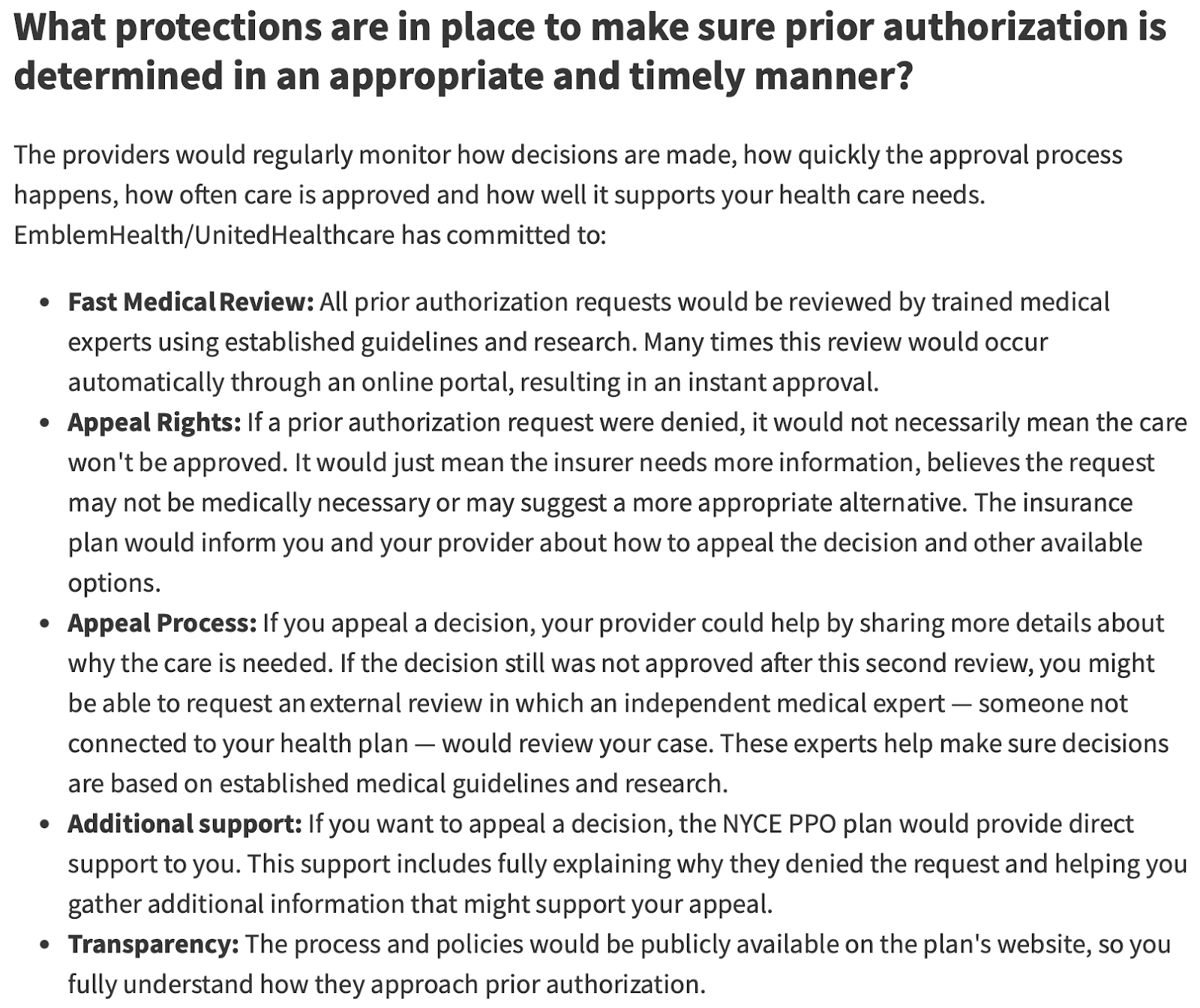
This sounds like a bunch of gobbledygook. There are no specific timelines given for approvals, denials, or appeals. Right off the bat, it says “The providers would regularly monitor how decisions are made, how quickly the approval process happens, how often care is approved and how well it supports your health care needs.” These are the same providers who make money by delaying and denying treatment.
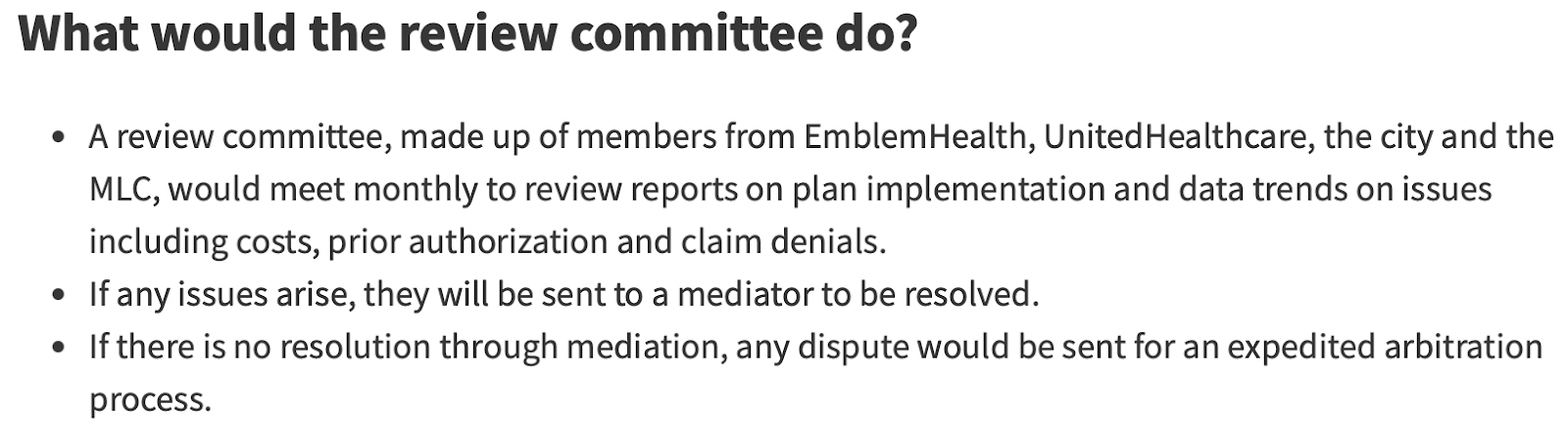
This sounds like our plan can be altered at any time if the healthcare providers and city aren’t happy with the arrangement. The MLC will be there but a) They’re outnumbered, b) We’ve been stung by them before – will they really defend us from catastrophic changes?, and c) Who would be the arbitrator? We consistently lose arbitration decisions. Currently, the most infamous arbitrator is a power player who has tried to diminish our health insurance for years and has been consistently unfriendly to us.
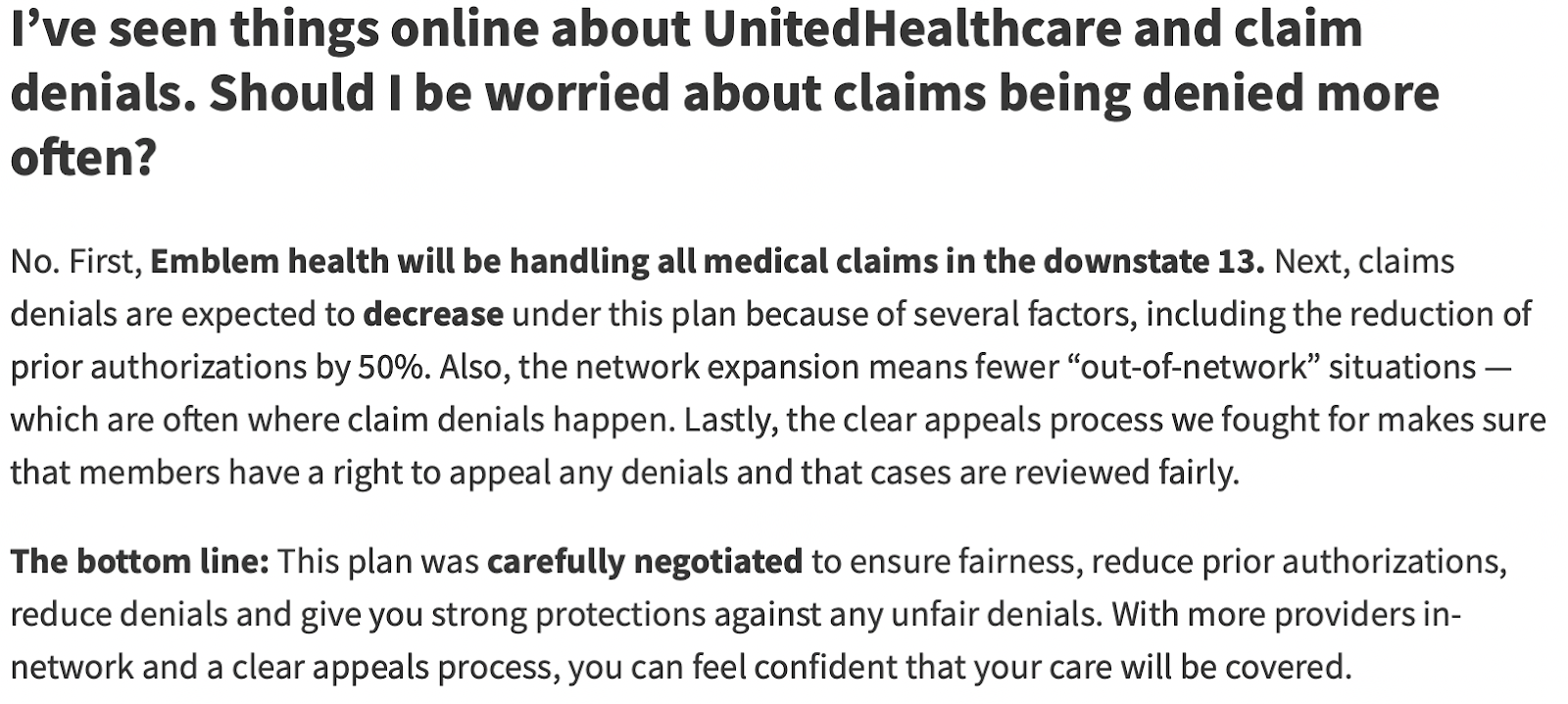
Which procedures, specifically, will receive fewer denials? There is no wording here that explains which procedures may be denied more frequently under the new plan. Will denials be down all across the board, or will there be an increase in denials in certain areas? 

As you can see, although there are some benefits in the new healthcare plan, there are many questions and concerns that have not yet been thoroughly addressed. Hopefully, in the coming weeks, we will get some more clarification. This impacts the vast majority of UFT members and city workers. We need to pay attention and we cannot be afraid to ask questions and voice our thoughts. There can be no ambiguity when it comes to health coverage that protects us and our families.

UFT: Are you ready to lose GHI-CBP?

On Wednesday, October 11th, following an audio leak of internal talks about the Request For Proposal (RFP) to select new healthcare insurance providers, UFT President Michael Mulgrew told us more about the pending healthcare switch than he has in a long time. Don’t get me wrong—that isn’t much—but now we have official confirmation that GHI-CBP as we know it will no longer be our insurance carrier.  To most of us, that’s not exactly welcome news. What will we have? Either Emblem (but newly with UnitedHealthcare) or Aetna (with Aetna).

The Context of Savings

We’ve been hearing about the in-service healthcare changes for years now, with most of us hoping it would go away. 

What we know from those previous talks is that the RFP has a motivation – to save money. When we hear about healthcare savings from Mulgrew or Adams, it’s key to know that the savings aren’t for you or me. They’re either for the City, so they can pay less for our healthcare; or they’re for the UFT/UFT Welfare Fund, so that they can move money around (and hold on to sacred patronage jobs).

Hence, when urgent care copays went up from $15 to $50, then to $100 (for most urgent care centers such as City MD) and radiology (e.g. MRI) costs increased, we heard about ‘savings,’ even though members ourselves were clearly on the hook for more.

Copays, of course, are only one way to pass costs onto members. Another is to reduce networks (providers). We already see this with mental health coverage. Members routinely learn the hard way, often in times of crisis, that they can’t find psychologists, therapists, or psychiatrists who take our insurance. Those members can either not get care or pay hundreds of dollars per visit to out-of-network therapists. Further cost savings could mean we see an exacerbation of this problem and possibly its expansion into other types of healthcare, where limited networks can mean long and potentially lethal waits to see overbooked specialists.

And then there’s the gold standard of healthcare savings: prior authorizations. As we already saw with the Medicare Advantage discussions for  our retired members, for-profit insurances make much of their money on ‘the administrative side,’ i.e. by deciding that members cannot get care that their doctor says they need. Could it be that our new insurance plan would mean more denied MRIs, physical therapy sessions, or surgeries?

Finally, there’s adding premiums. Right now, UFT members don’t pay premiums for GHI-CBP, whether they’re enrolled as individuals or with their families. Mulgrew didn’t mention the possibility of premiums in his speech at the Delegate Assembly meeting (for chapter leaders and delegates), but the lawyer in that leaked recording did. As we already grapple with ever-ballooning copays, we do not want to unleash a pandora’s box of ever-ballooning premiums too.

These questions need to be considered, because the City and UFT leadership have been clear from the start – they aren’t looking for a betterhealth plan for which they’re willing to spend more. And while they won’t admit to seeking a health plan that would reduce our care, they’re very open about looking to spend less. Those things usually go hand in hand.

Closing out

We don’t know whether the switch will be to Aetna or Emblem with UnitedHealthcare (instead of Blue Cross). We also don’t know what versions of Aetna or United—or Emblem for that matter—we’ll get. So I’ve opted not to analyze those companies, for now. We do know that both Aetna and UnitedHealthcare have had plan-wide contract disputes with some of the hospitals UFT members use. In other cases, a few plans from each company are accepted, but variants designed for lower income members are not (such as the following example at Mt. Sinai). The bottom line is that we know we’re being primed to get coverage that costs less. And we know that realistically this means we are set to lose something. Perhaps it’s time to learn from the retirees and fight. They fought the Medicare Advantage Plan they were being forced into, but took it to court while mobilizing mass rallies, worked with local elected officials and hired their own lawyers to stop this move in court. They won’t be thrown off traditional Medicare (GHI Senior Care), but only because they are organized. That’s the only way we keep GHI-CBP too.  

As a start, make sure that you and your entire chapter have signed the healthcare petition to let us vote on proposed healthcare changes.

– Nick Bacon, New Action Co-Chair and UFT Executive Board Member


Download & print this article

E-Sign the Healthcare Petition

Download & print the petition here.

A Farewell to Collective Bargaining?

Over the last several years, UFT leadership has claimed repeatedly to be in an existential fight for our very right to collectively bargain. Infamously, they’ve made the absurd claim—over and over again—that pushing retirees onto Medicare Advantage isn’t about saving money at the expense of our most vulnerable members. Rather, they’ve suggested, Medicare Advantage is about our ‘collective bargaining’ rights. To Mulgrew and company, any judicial decision or piece of legislation that keeps the City/MLC from throwing retirees off their healthcare somehow diminishes the union’s negotiating power. What UFT leadership doesn’t say in their communications to members is that, for them ‘collective bargaining’ on healthcare primarily consists of promising away billions of dollars of funding and managing our losses by robbing Peter (in this case, retirees) to pay Paul (in-service members, who by the way, will probably soon be Peter). For UFT leadership, that beats actually organizing—which is precisely what they would need to do in order to preserve existing healthcare coverage for both in-service and retired members. That, of course, is unacceptable, especially since in some models doing the right thing on healthcare might mean losing valuable Unity patronage jobs.

But, since collectively bargaining away our healthcare is so important to UFT leadership, there’s a certain irony to yesterday’s AAA certification of the OT/PT revote. While in most circles a ‘yes vote’ would be a positive thing, in this case it’s not so simple. As readers know, the contract that just passed is a carbon copy of a deal that was voted down by a 2/3 margin earlier this summer. When our UFT President communicated to membership that he wouldn’t be able to do the job of collectively ‘re-bargaining’ in a timely manner, Unity orchestrated a divisive and undemocratic re-vote campaign to avoid going back to the negotiating table.  

But why would UFT leadership—who would rather throw retirees to the wolves than give up a chance to collectively bargain—forego their right to negotiate with management? Why would they instead ask membership to simply take the first deal the City threw at them?

The truth is that the UFT hasn’t seriously engaged in ‘collective bargaining’ for decades. Instead, they’ve engaged in ‘concessionary bargaining,’ accepting the bulk of what our employer demands, including a decline in real wages, reduced healthcare spending (for the City, not us), and changes in working conditions that have predominately favored management rather than labor. When workers, like the OT/PTs, have had the audacity to ask for more—for true collective bargaining—the UFT has responded by disorganizing them into acquiescence.

So, as MLC/UFT leadership pretends that we are on the verge of losing ‘collective bargaining’ rights because of a bill that would preserve retiree healthcare coverage, let’s call their bluff. They bid farewell to collective bargaining in the interests of membership long, long ago. What UFT leadership is fighting for is the right to concede.

Nick Bacon is a co-chair of New Action Caucus (NAC) and a member of the UFT Executive Board


Learn more about

our UFT Caucus

Content Policy

Content of signed articles and comments represents the opinions of their authors. The views expressed in signed articles are not necessarily the views of New Action/UFT.
Follow New Action – UFT on WordPress.com
December 2025
M T W T F S S
1234567
891011121314
15161718192021
22232425262728
293031  

Blog Stats

  • 401,256 hits