New Action Caucus will meet today at 5:30 PM to discuss the 2022-2027 tentative agreement. Members who have not yet received an invitation should first make sure they’re signed up, then reach out to Nick Bacon.
We’ve had good calendars, and we’ve had less than good calendars. The 2023-2024 calendar, however, is nothing but brutal. What’s worse, there are indications that the calendar could have been just fine, but that the City opted to make decisions that were nothing short of malicious.
Let’s look at some highlights:
According to an informal count, we have 185 school days next year, and 187+ workdays. Keep in mind that the minimum number of school days is 180. Historically, the DOE would make the calendar longer than 180 days to make room for possible snow days. But now that DOE policy is to force kindergarteners onto Zoom sessions during blizzards. So, without snow days, we’re left with the question of why on earth we’d need a full week of school days in addition to the legal minimum.
There are no vacations longer than 6 workdays. Typically, at least one vacation ends up being more like 2 weeks. This time, we’re looking at a week, or a week and a day, for every single ‘extended’ break.
Some parent teacher conferences are scheduled on Friday nights. Typically, we’ve done parent teacher conferences on Thursday nights, to avoid forcing Jewish teachers to work on the sabbath or preventing teachers in general from losing their weekends.
Speaking of religious observance, there are days during Passover that observant Jewish teachers will need to take off. Christians who celebrate Easter will need to be back to school the very next day. And there’s no indication of Diwali, not to mention Lunar New Year. Forcing members to take religious observance or vacation days that they traditionally would not have to take is particularly bad since many of these same members were shorted vacation days during the Spring Break arbitration (for taking religious observation days back in 2020).
There are weekends where observed holidays, such as Veterans Day, fall this year. In most industries, when that happens, the Monday following the weekend is instead observed. UFT members and students, however, will be expected back at school.
Some of this might be understandable if the school year was extremely tight. But we have five extra school days. We could have easily fixed all or most of the problems stated above and still had a few extra days in case of an emergency that somehow trumped the City’s ‘no more snow days’ policy. Many UFT members are left scrambling to ask why? Is this how the DOE is getting back the 7 vacation days our union won in arbitration after NYS forced us to work over Spring Break? Is this some sort of bizarre negotiating tactic the City is employing on the brink of a contract? Is this the first step or compromise move that Mayor Adams is taking to extend the school year, which he wants to be year-round?
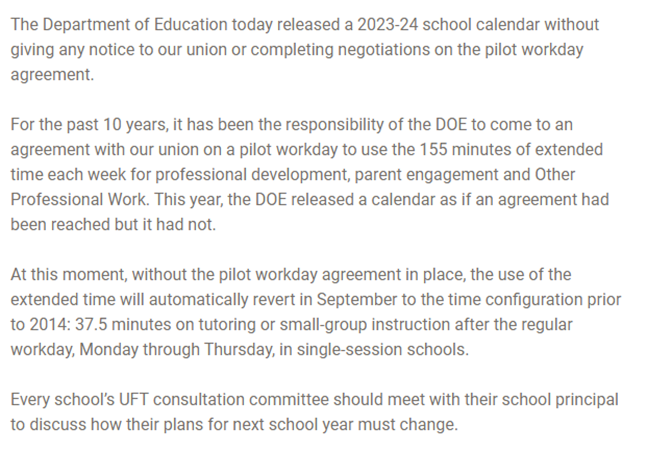
We may never know. But whatever it is, this feels like union animus. Teachers have shown extreme discontent around social media over the last 24 hours. And it doesn’t help that Mulgrew’s response seems wonky and disinterested. See below for the email sent to active UFT members yesterday, titled “an update to the pilot workday” and bearing Mulgrew’s signature:
Notice, Mulgrew does not suggest that he or the rest of UFT leadership cares about some of the major blows to membership in the calendar itself. He doesn’t suggest he or anyone else is working to rectify things. Instead, he focuses our attention on ‘the pilot workday,’ which literally no one was thinking about. So now, members are not just fretting about working extra days next year – they’re thinking about having additional teaching work to do each day, effectively adding insult to injury. Why Mulgrew thought this would be a good response to the anger of membership over losing so many paid days off next year is beyond me. And why the City would come out with a calendar so offensive to teachers right on the brink of a potential contract vote is also beyond me. Do the powers that be actually want us to vote no?
We cannot accept this. Especially with signs that we will be given sub-inflation wage increases below the mostly non-unionized U.S. average, forcing teachers to work extra days–and longer days–is a bridge too far. UFT leadership needs a much better response to this than a wonkish and fear-mongering update. This calendar reeks of having been weaponized against our membership. We need to see our union leadership recognize that fact, and organize to fix it.
This Monday morning, as we rush into our schools and get our first lessons set up for the week, we also have the pleasure of pondering what the heck Mulgrew is talking about in a bizarre non-update on in-service healthcare, sent out when I assume he and the rest of UFT leadership were still sleeping soundly. (It reached me at 6:12 AM).
Titled “An in-service healthcare update,” he begins by reminding us that “All of our members have and will continue to have access to premium-free health care,” failing to mention that this is actually already guaranteed by City Administrative Code 12-126, which he used UFT resources to try and get scrapped – and without a membership vote.
He then reminds us how good we have it, noting that “UFT is one of the few teachers’ unions in the country that still offers premium-free health care coverage for members…” However, he fails to note that other unionized cities that have it, such as LA, are not working to weaken it or trade it away for minor wage increases, but are instead effectively organizing to keep their healthcare and increase their wages above the inflation rate.
Next, Mulgrew hints that we might not be renewing GHI-CBP – an insurance plan that most of our workers have been using for decades, and then vaguely mentions that four providers responded to an RFP, but didn’t say who. In fact, when we asked at executive board last week, Joe Usatch, the Assistant Director of the UFT Welfare Fund, told us that he didn’t even know who responded. Mulgrew also fails to tell us that the RFP to replace GHI sought 10% in cost savings – an amount that would be impossible to save without somehow increasing member costs or reducing member care. There are only so many savings, after all, that Mulgrew can make by weakening GHI itself, such as by inserting massive copays for urgent care visits.
Then, he mentions switching retired members off of traditional Medicare and onto an Aetna Medicare Advantage plan as a win, and not as the failed plan to reach cost-savings at our expense that it actually is. To read this paragraph and not squirm, you have to be massively in the dark about what is going on, as the retiree healthcare battle has been front page news now for years. If he’s using what he’s done to retirees as an example of what he plans to do to in-service workers, however, we should definitely listen.
There are no new updates in this email. In fact, there is less information here than we’ve gotten at executive board meetings, DAs, and even other email updates. No, this isn’t an update. It’s a limp response to a petition organized by opposition to give us a say on healthcare changes before they happen. Sign that petition today.
Content of signed articles and comments represents the opinions of their authors.
The views expressed in signed articles are not necessarily the views of New Action/UFT.

 New Action - UFT