As can be expected in any arbitrarily rushed UFT contract ratification process, union staffers have gone into full fledged ‘yes vote’ mode, issuing some reasoned arguments, but mostly propaganda, as to why members should approve the 2022-2027 contract. In this piece, I’ll debunk some of the most common variants circulating the web.
Wage Arguments:
- ‘The wages are fine, so let’s vote yes and get salary increases now!’ This statement is clearly false. The wages we would get in this deal fall below the rate of inflation. They fall below the average increase in pay for even non-unionized Americans. And they fall significantly below what more militant teachers’ unions are getting, such as UTLA. While, yes, accepting the contract in an early vote would put money into our pockets quicker, voting yes would also confirm to the City that, yes, we are willing to commit to doing the same work but at a pay cut. Think of Tier 6ers who have 30+ more years to work before you vote to set a precedent that the UFT is willing to work for less.
- ‘The wages aren’t great, but the bonuses are.’ There are two types of bonuses here: the pensionable $3,000 ratification bonus and the non-pensionable annual bonuses that supposedly will be given in perpetuity, even in future contracts. Both come out of the same pot as the money put into our salaries. While some members, particularly in lower paid titles or at lower salary steps, would benefit from getting ‘a lot’ of money at once, all of us would have been better off seeing this money in fully pensionable salary increases. Moreover, those persons who would benefit from the money most, such as paraprofessionals, would have benefited far more from simply getting living wages in the first place. They did not. Ultimately, all of us should be wary about nonpensionable bonuses, which we’ll see very little of until after tax refunds anyways, due to high withholding rates for bonus checks.
- ‘The pattern is the pattern.’ The pattern is the pattern only so long as we agree to take it. UFT leadership tried to sell us on pattern bargaining, but pattern bargaining has clear disadvantages. Namely, it ensures that inequalities that existed 40 years ago, will continue in perpetuity. Teacher salaries will never approach the salaries of police officers, for instance, as long as we accept that salaries that were set at absurdly unequal rates 40 years ago, should continue to grow at the same percentage rate each year (and actually go up at higher ratesfor police officers). If teachers took a stand and used more militant negotiating/organizing strategies, we could force the City to negotiate better salaries. Moreover, accepting the pattern by voting yes on this contract also signals to UFT leadership that we’re OK with them having not worked with DC37 to set a pattern that all of us could be proud of. Indeed, when I pressed them about this in an executive board meeting, UFT leadership claimed that they would not touch the pattern, because it would be ‘interfering with another union’s contract.’
- ‘Inflation might not be as bad in the future.’ I hope the people making this argument are correct. I also think they are missing the point. Inflation was already bad starting toward the end of our last contract. We already need a massive salary increase to catch up to the new cost of living. We aren’t getting that in this deal. Moreover, we can never know if predicted future inflation will stay as low as expected. Back in 2019, no one expected high inflation. Then, Covid-19 hit and costs started skyrocketing. Just as inflation could be low in the future, it could also be much higher than expected. And because this is a long deal, ending in 2027, we’d be locked into increases that were insufficient to meet potentially astronomical rises in costs.
Healthcare Arguments:
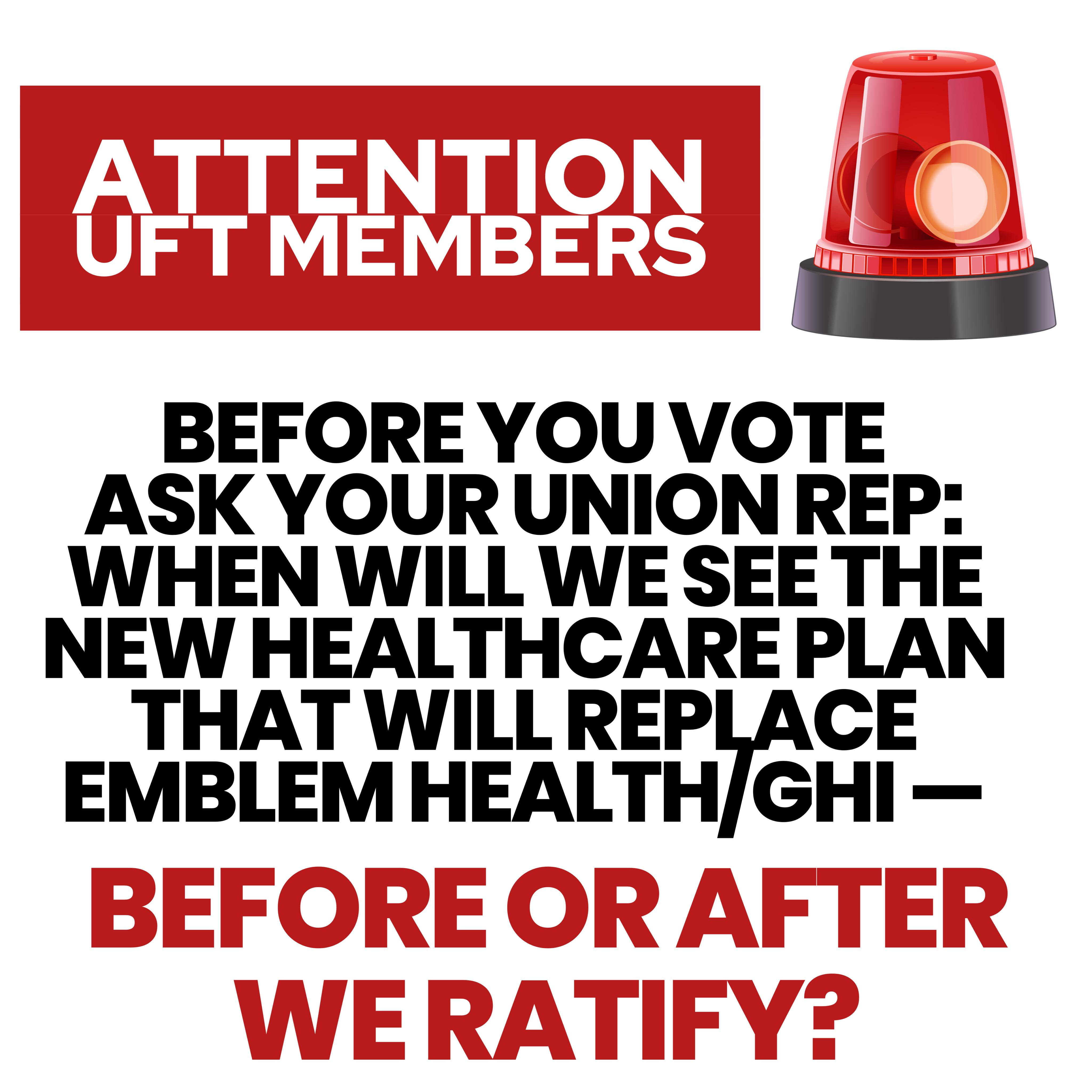
- ‘Healthcare givebacks are not a part of this deal.’ Members are anxious that they might lose GHI or GHI SeniorCare as a result of negotiations. Anecdotally, this appears to be one of the major reasons people are currently opting to vote no. So, to mitigate the possibility of healthcare givebacks derailing a yes vote, Mulgrew has been claiming, on the basis of a technicality, that healthcare is not a part of this deal. To buttress this claim, existing MLC agreements committing us to healthcare savings have also not been listed alongside the MOA (I explain the implications of this more in the next bullet point). Nevertheless, healthcare is clearly a part of negotiations. Mulgrew’s sophistry is just to pretend medical coverage is a separate entity from contract negotiations. But, as the City knows well, these apples and oranges are in the same basket of rotting fruit. As described in the UFT’s official magazine, the NY Teacher:
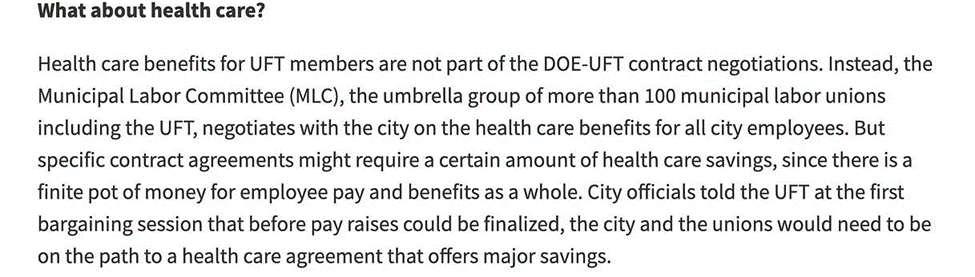
And, indeed, as recently as late March, Mulgrew sent us terrifying updates about the specter of taking our GHI. UFT leadership also simultaneously approved massive guttings of GHI itself, keeping us on the popular health plan in name, but making it unrecognizable by allowing networks to diminish and copays to spiral out of control. Similarly, Unity led the charge to demolish our retirement healthcare, switching Medicare-eligible retirees to onto an inferior Medicare Advantage plan, which can be made progressively more inferior in time. Healthcare givebacks, in other words, are implicit to this tentative agreement, and have already begun to be realized. It would behoove us to vote no, in part, to show that we do not approve of these givebacks.
- ‘Healthcare was a part of the 2018 deal but is not a part of this one.’ This argument has not been formally made, as UFT leadership frankly wants to distance itself from the terrible decision it made in 2018 to commit to $600 million in healthcare cost reductions in perpetuity. But the argument has been made implicitly by not including the famed appendix that committed us to this giveback on the MOA landing page. If that appendix is not there, doesn’t that mean it’s not a part of this deal – that healthcare givebacks were only a part of the last deal? No. If that were the case, we’d see a document with language crossing out that giveback, modifying that language, or—better yet—reversing that language to read that the City would reinvest money into our healthcare (rather than save on it). Indeed, Mulgrew would have announced all of this from the mountain top if it were the case. So, expect that the ongoing healthcare givebacks from the previous contract are still in effect. The proof is in the pudding, as shown in the previous bullet point.
Non-economic Gain Arguments:
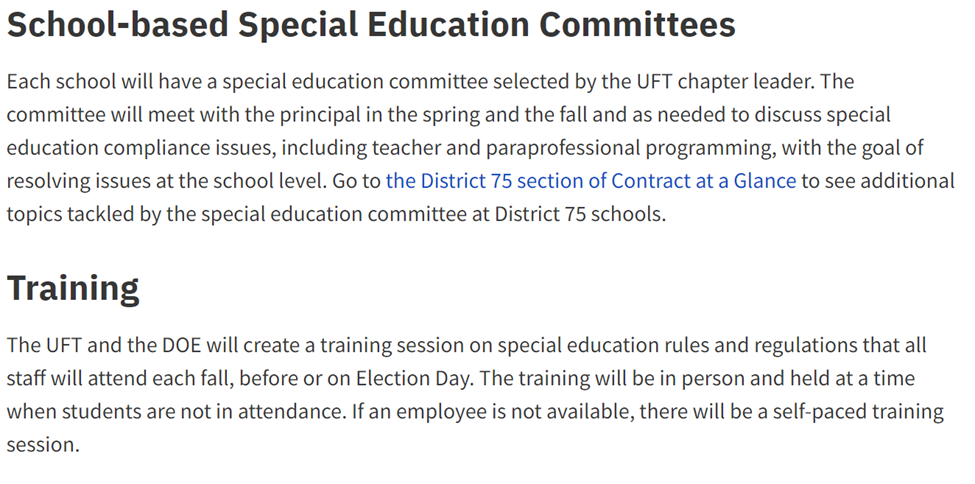
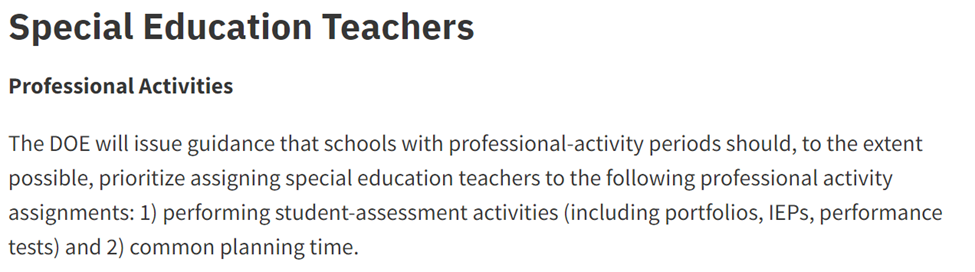
- ‘Even if wages aren’t great, that’s to be expected, and at least the rest of the contract is good.’ It appears to be true that the non-economic part of the contract is not worse than the 2018 agreement, but it’s also in no way a good contract. It doesn’t win us back what we lost in 2005, for instance, and therefore belongs to the same ‘giveback epoch’ wrought in during the aughts. The major gain that most UFT titles will see is being able to work remotely during parent engagement time. That’s not nothing, but it’s still part of the same extra 155 minutes that we shouldn’t be working in the first place. And, it has red tape, like excessive paperwork to prove compliance and the ability for an abusive principal to revoke the right to work from home without due process. Moreover, most of the gains in this contract appear to be distracting ‘perks’ that do little to actually improve working life, while drawing attention away from major economic givebacks. One key area where there were few to no gains is special education. We had implicit leverage there, so it’s unclear why we didn’t really gain anything. Indeed, the fact that we didn’t is a bit of microcosm of the entire deal, demonstrating that other than a few peanuts here and there, we got little of substance in this negotiation.
Temporal Arguments:
- ‘Yes, we aren’t giving you much time to review the deal, but that’s because this is our last chance to get you a contract before summer.’ This argument is absurd in many ways. Ignoring, for a moment, that opposition has been predicting that UFT leadership might do this as a yes vote tactic for some time now, let’s look at why this is a bad argument to begin with. Timeliness of a contract is only a good argument if it is a good contract. But this contract, with its massive givebacks in salary and healthcare, and with its only minor increases in labor gains, does not meet that threshold. There is no point to timeliness if what’s timely isn’t good for labor.
- ‘Teachers all have access to the MOA, and it’s OK that no one had advanced access to it before voting to send it out to membership.’ Because the arbitrary summer deadline forces us to vote quickly, we end up not really being able to assess the contract’s fine print as well as we’d have been able to with a longer ratification process. That should worry us. And the situation is compounded exponentially by the fact that no access was provided to union leaders beforehand. Contract committee members, executive board members, chapter leaders, and delegates were not allowed any advance access to the contract, leading them precious little time to read up on the contract details and have conversations with members of their chapters. Busy as we are with end of year craziness, many teachers will be forced to make a decision before having a chance to read and understand the fine print.
- ‘Because of the timing, if you don’t vote yes, you won’t be able to have an SBO or Prose Ballot.’ In effect, I cannot disprove this argument, because UFT leadership itself is the culprit. Unity has weaponized Summer by telling members that SBOs and PROSE ballots are conditional to the contract passing. In fact, I’m starting to wonder if the game of chicken Mulgrew entered into over reverting back to 37.5 was never with the City at all. At the very least, he’s kept that game going – but now it’s with the UFT rank-and-file. Despite the City having agreed to a version of the Pilot workday approved of by UFT leadership, Mulgrew is leveraging the specter of a reversion to 37.5 against members to vote yes. As he indicated in various meetings last week, if members don’t vote the contract in, we’ll be forced onto the unpopular 37.5 deal after all. With a contract vote this late in the game, we’d have nowhere to go but 37.5, after all, especially because Mulgrew didn’t consider a conditional Pilot Workday if the contract was voted down. All I can say is, if Mulgrew is correct that 37.5 is worse for the City than the Pilot Workday (due apparently to busing costs), then voting down the contract would, by his own estimate, keep our leverage at the bargaining table, albeit at the shared expense of membership. However, I am still disappointed that UFT leadership has effectively used ‘workday chicken’ as a yes-vote tactic, rather than a negotiating one.
- ‘You will keep people, such as parents who are both UFT members, from being able to reap the gains of this contract, such as taking 12 weeks (combined) of parental leave.’ This is an unfair argument. It’s also easy to debunk, because the reverse is also true. Voting yes on this contract will keep people from realizing workplace gains and wages that meet the increasing cost of living.
Fear-Mongering Arguments:
- ‘If you don’t vote yes, the City won’t negotiate with us.’ History has proven this wrong. In every no vote we’ve held in the past 30 years, we’ve gotten a better deal as a result. For a case study in what happened most recently when OT/PTs voted their contract down, see here.
- ‘Voting no means that we strike.’ This is not true. While it would of course behoove the UFT to have a strike plan in case it ever needed to do so, a strike is not a necessary component of a ‘no vote.’ Indeed, we haven’t had a strike since 1975, but we’ve had several no votes, all of which have gotten us a better deal.
So, if paid UFT staffers and/or other Unity members try to pressure you into taking a bad deal, shoot back with dissections/debunkings of their arguments and propaganda. And for more New Action sources with criticisms of the contract, see the articles below:
- Examining the 2023 UFT Contract Draft: a ‘Tentative’ Analysis.
- UFT Contract Analysis: Zeroing in on Special Education. What went wrong? And what does that mean for the rest of the agreement?
- UFT Contract PSA: Beware of Distracting ‘Perks.’
- UFT Tentative Agreement Online (Mostly) – Not as Rosy as Mulgrew’s Presentations

 New Action - UFT