Posts Tagged 'Raises'

UFT News – September 2026 (Unofficial)

1. We just got a 3.5% raise on September 14. Now would be a good time to raise your TDA contributions if that’s something you’ve been looking to do. Timing TDA bumps with pay raises is an easy way to increase our retirement without feeling it in our paychecks. Don’t hesitate!

2. Three weeks ago, the NYS Board of Regents shared info about the Class of 2028 expectations. They said Regents exams will no longer be mandated for graduation. They announced that Portrait of a Graduate will be enacted next school year. What do we know about Portrait of a Graduate? Practically nothing. We know that portfolios will likely be involved. That’s about it. Back in April, we were told that Portrait of a Graduate wouldn’t roll out until the 2028-2029 school year. They moved up the start date by a year and we still have zero information even though we’re less than a year away from implementation. Hopefully, the UFT fights to push back the start date until we know what we’re dealing with.

3. If you are interested in earning your +30 differential, the cheapest option is usually ASPDP (aka A+) credits. The link to the ASPDP site is here: https://pci.nycenet.edu/aspdp/ Fall Registration opened on September 28. Classes run between 10/5/26 and 1/8/27. You can take up to 12 credits per semester. Each three credit course costs about $300 in total, meaning you can get your +30 for $3,000. It’s a great deal if you have the time and money, considering the permanent $9,000 pay increase teachers receive.

Recommended providers: Teach & Kids Learn and Long Island Learning Institute for Educators (LILIE),

4. Governor Hochul has expressed her support for the federal tax-credit scholarship. This is a school voucher program that will rob tax money from public schools and public works in order to fund private schools. This is a blatant, anti-public school initiative that could have serious consequences. Sign the petition against school vouchers HERE. In January, Chalkbeat published an alarming piece about the school choice tax credit program. The author explains, “families can donate up to $1,700 to scholarship-granting organizations and receive an equivalent tax credit back.” Allowing families to receive tax credit to basically fund private schools reduces the amount of tax dollars that go into our communities. In fact, in 2022, Kentucky’s Supreme Court “ruled that Kentucky’s tax credit scholarship program is unconstitutional.” As Peter Greene explains, “In a tax credit scholarship program, corporations or individuals contribute money to a ‘scholarship’ fund that will pay part of some student’s tuition at a private school. The state then counts that contribution towards taxes.” In other words, tax dollars are reallocated to private schools instead of going to public schools, projects, and programs that would otherwise benefit our communities.

5. A few months ago, the Class Size mandate was extended by two years. As part of the deal, the City agreed to give teachers differential pay for oversized classes. Unfortunately, only a very small portion of teachers will receive the $8,500 differential this year. Only teachers from schools that filed for an exemption will be eligible to receive the differential. 

Under the original agreement, 80% of all classes were supposed to meet the compliance threshold this school year, followed by 100% in 2027-2028. Instead, the expectation is that 70% of all classes will meet the Class Size mandate this school year, 80% next year, 90% for the 2028-2029 school year, and 100% for 2029-2030.

UFT Contract Update and Analysis – Get Ready for a Pay Cut

Bad news abounds on the upcoming UFT contract. Teachers, paraprofessionals, and the rest of our members deserve answers on why. While, I’m bound by NDAs not to disclose what is said in the 500-member negotiating committee, I have more flexibility with information given in the Executive Board, Delegate Assembly, and other sources. So, in this post, I’ll go through some of the public information we have right now and analyze what it means for our members and for our union.

Committing to a Pay Cut

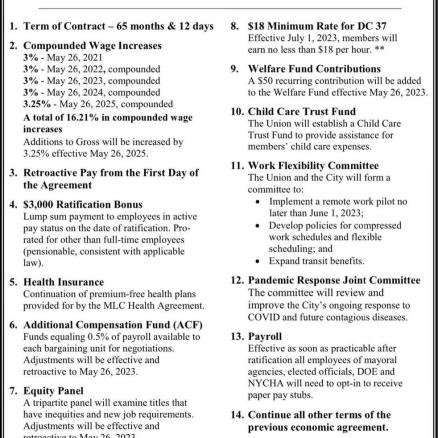
It’s no secret that DC37 is about to set the economic pattern for all other New York City municipal unions. A roughly 3% annual salary increase is absolutely dreadful. Even when accounting for the one-time $3000 signing bonus, DC37 is committing to sub-inflation increases. The exact numbers for UFT may be slightly more or slightly less depending on other ‘economic’ decisions made in DC37’s contract. But, we have the big numbers here. DC37 is effectively committing us to a pay cut in real wages. And, because their contract will last for more than five years, DC37 is also committing to a pay cut for a very long time. If that’s hard to stomach, it’s even worse when we look at the pattern in context. Nationally, non-unionized workers are getting better raises on average than unionized municipal employees are about to agree to here in New York.

That’s why at Executive Board this Monday, I asked LeRoy Barr why we weren’t publicly taking issue with the pattern about to be set. His response, that ‘we can’t make public statements about another union’s contract,’ astonished me. First of all, let’s be clear that UFT leaders have publicly criticized the pattern set by other unions before. For instance, back in 2001 Randi Weingarten stated that a pattern set by DC37 was too low for teachers to take. Second of all, why on earth would current UFT leadership place being courteous to other union’s leadership over the interests of our members? If our raises are about to be set at horrendous levels by DC37 leadership, it is the absolute duty of Mulgrew et al to do whatever they can to stop that. The fact that UFT leadership isn’t publicly fighting for pay increases that exceed that of non-unionized workers frankly raises existential questions about our union.

A ‘Gentlemen’s Agreement’ on Healthcare Reductions  

At this week’s executive board meeting, Mulgrew claimed that ‘there won’t be any ‘healthcare savings’ in this round of bargaining.’ In the next breath, however, he said ‘but, we’ll look at the RFP.’ There are currently two RFPs, both of which were designed so that the MLC could realize cost savings for the City. The problems with the first RFP, Medicare Advantage, are well known. In short, retirees could lose access to traditional public Medicare and face diminished networks and tons of red tape. The second RFP, which is more mysterious, is for in-service members. Union officials have stated that they are seeking a plan similar to GHI at around 10% less of a cost. They have also threatened the possibility of premiums. So, call me crazy, but if healthcare isn’t a part of this round of contract negotiations, why are we humoring plans that potentially reduce our benefits or increase member responsibility for healthcare costs?

The only possible answer here is that clearly healthcare is a part of contract negotiations. This shouldn’t surprise anyone. The City was blunt with all unions that new contracts would be predicated on finding healthcare savings first. And frankly, the City and the MLC have been lock-step on many of the proposed changes. Now, on the eve of DC37 ratifying a new contract, we see two RFPs in the mix to reduce the City’s fiscal obligation to our healthcare. This isn’t rocket science.

Where does this leave us? As Mulgrew has stated time and time again, healthcare is a part of our overall compensation package. So, if the City reduces our healthcare or increases our costs, the already bad 3% annual wage increase could be much worse. Heck, we might see a pay cut even without adjusting for inflation.

Settling for Minor Workplace Changes

So, if salary is down the drain and healthcare reductions are already in the works, what’s left? All UFT can do is negotiate for workplace stuff. There’s potential here, but I’m still pessimistic. First of all, if we can’t even negotiate raises above inflation, do we really think we can get the City to improve our working conditions? My guess is that we’re only going to get the City to agree to stuff they want anyways. Mulgrew kind of hinted at this at the last Delegate Assembly, where he said ‘[The DOE is] listening on us to some extent on things we need just to be able to do our jobs better.’ I’d love to see those improvements that make it easier for me to do my job well. But, changes that are mutually beneficial to both the employee and the employer are easy fights. We see those types of wins in places that don’t even have unions. But, we do have a union. What we need to be fighting (yes fighting) for is precisely the stuff that is good for teachers and not necessarily good for the City (as an employer): things like smaller class sizes, caseload reductions, and yes – better wages and healthcare. Bottom line: the UFT must do better than settling for what the City wants anyways. We aren’t going to get anything more than the bare minimum unless we act like a union and organize.

DC37 Sets Pattern Below Mostly Non-Unionized U.S. Average

It’s the last day of school before a much needed vacation, so just a few words on the terrible pattern set by the DC-37 contract. I’ll write something more in depth later.

A 3% wage increase is absolutely horrendous. It’s far below inflation, which is running into the double digits. It’s literally a pay cut. 3% is also below the national average. Most of the country isn’t represented by unions. So unionized New York City municipal unions are getting crappier raise increases than people who are working at-will. That’s terrible. And things will only get worse if we also end up paying for premiums, as Mulgrew has already prepped us to accept. 3% could easily become -3%.

Adams took advantage of DC37. DC37 is a large and diverse union, but most of its members make offensively low salaries. The union’s website stresses the reliance of its membership on public assistance programs to make ends meet. A 3% wage increase with a $3,000 signing bonus would go a long way for people who are already making non-living wages during a time of record inflation. Knowing full well that DC37 members would be the most in need of an immediate raise, Adams weaponized the increased cost of living (which he himself had a hand in driving up) to get the City’s lowest paid workers to agree to a wage increase that would never be accepted by other unions. And now everyone is stuck with that rate.

This is an absolute abuse of pattern bargaining. Pattern bargaining is supposed be a means of efficiently organizing fair wage increases for like-unions. Larger or more powerful unions negotiate first, ensuring that smaller and less powerful unions get the same deal. Everyone wins because less negotiating energy gets spent on figuring out financials, leaving more room to discuss workplace improvements and other non-economic factors. Here, in an absurd reversal, the City exploited the union with the most disadvantaged members so that it could force an unfair deal onto everyone else.

The blame doesn’t just go to the City. For MLC labor leaders, who make hefty compensation packages and don’t have to live with the consequences of sub-inflation wages, this is win-win. DC37 leadership gets to quickly get out wage increases to its membership, who is after all willing to take the deal. Then, labor leaders of unions whose membership would not take the deal get to sit back and blame DC37 for the crappy wages. They can now say ‘sorry, all we can negotiate now is non-economic factors.’ Hiding behind the pattern system and the Taylor Law, union leaders and bureaucrats can rest at ease, spending the rest of their time convincing membership why their hands are tied. This is a perfect example of what I meant when I said that “[UFT Leadership] will take on the task, not of organizing us to fight, but of disorganizing overworked members into acquiescence.”

But, Mulgrew isn’t off the hook. I’ll ask question number one: if we are conceding to the pattern–and recent communications seem to suggest that we are–are we also conceding to the work day that no longer makes sense under said pattern? About 20 years ago, we agreed to work extra time (now called PD Mondays and OPW/PO Tuesdays) in exchange for raises in excess of other unions. But now, we are likely to have to take a pay cut. In my view, if we aren’t getting the raises we deserve, that means it’s time to sunset extra time. To be frank, we now need that time to find extra jobs to afford living in this city.

Unions can and must achieve more than non-unionized America. The nurses just proved this. Their leadership didn’t hide behind patterns or find reasons not to organize. They struck and now will get 19% over 3 years. DC37 and the rest of us will be getting 16.21 over 5.5. See the difference? DC37 deserves far more than a 3% increase, as do the workers represented by other municipal unions. We can and must push for better, Taylor Law or not.

That’s all for now. I look forward to analyzing the situation more and publishing something longer in the coming weeks. Hopefully DC37 members vote ‘no,’ but we’ll see. It’s tough when your union recommends you do.


Learn more about

our UFT Caucus

Content Policy

Content of signed articles and comments represents the opinions of their authors. The views expressed in signed articles are not necessarily the views of New Action/UFT.
Follow New Action – UFT on WordPress.com
October 2026
M T W T F S S
 1234
567891011
12131415161718
19202122232425
262728293031  

Blog Stats

  • 416,665 hits