Posts Tagged 'Gov. Hochul'

UFT News – September 2026 (Unofficial)

1. We just got a 3.5% raise on September 14. Now would be a good time to raise your TDA contributions if that’s something you’ve been looking to do. Timing TDA bumps with pay raises is an easy way to increase our retirement without feeling it in our paychecks. Don’t hesitate!

2. Three weeks ago, the NYS Board of Regents shared info about the Class of 2028 expectations. They said Regents exams will no longer be mandated for graduation. They announced that Portrait of a Graduate will be enacted next school year. What do we know about Portrait of a Graduate? Practically nothing. We know that portfolios will likely be involved. That’s about it. Back in April, we were told that Portrait of a Graduate wouldn’t roll out until the 2028-2029 school year. They moved up the start date by a year and we still have zero information even though we’re less than a year away from implementation. Hopefully, the UFT fights to push back the start date until we know what we’re dealing with.

3. If you are interested in earning your +30 differential, the cheapest option is usually ASPDP (aka A+) credits. The link to the ASPDP site is here: https://pci.nycenet.edu/aspdp/ Fall Registration opened on September 28. Classes run between 10/5/26 and 1/8/27. You can take up to 12 credits per semester. Each three credit course costs about $300 in total, meaning you can get your +30 for $3,000. It’s a great deal if you have the time and money, considering the permanent $9,000 pay increase teachers receive.

Recommended providers: Teach & Kids Learn and Long Island Learning Institute for Educators (LILIE),

4. Governor Hochul has expressed her support for the federal tax-credit scholarship. This is a school voucher program that will rob tax money from public schools and public works in order to fund private schools. This is a blatant, anti-public school initiative that could have serious consequences. Sign the petition against school vouchers HERE. In January, Chalkbeat published an alarming piece about the school choice tax credit program. The author explains, “families can donate up to $1,700 to scholarship-granting organizations and receive an equivalent tax credit back.” Allowing families to receive tax credit to basically fund private schools reduces the amount of tax dollars that go into our communities. In fact, in 2022, Kentucky’s Supreme Court “ruled that Kentucky’s tax credit scholarship program is unconstitutional.” As Peter Greene explains, “In a tax credit scholarship program, corporations or individuals contribute money to a ‘scholarship’ fund that will pay part of some student’s tuition at a private school. The state then counts that contribution towards taxes.” In other words, tax dollars are reallocated to private schools instead of going to public schools, projects, and programs that would otherwise benefit our communities.

5. A few months ago, the Class Size mandate was extended by two years. As part of the deal, the City agreed to give teachers differential pay for oversized classes. Unfortunately, only a very small portion of teachers will receive the $8,500 differential this year. Only teachers from schools that filed for an exemption will be eligible to receive the differential. 

Under the original agreement, 80% of all classes were supposed to meet the compliance threshold this school year, followed by 100% in 2027-2028. Instead, the expectation is that 70% of all classes will meet the Class Size mandate this school year, 80% next year, 90% for the 2028-2029 school year, and 100% for 2029-2030.
UFT vs. Charters: Could new NYC charter schools mean layoffs down the road?

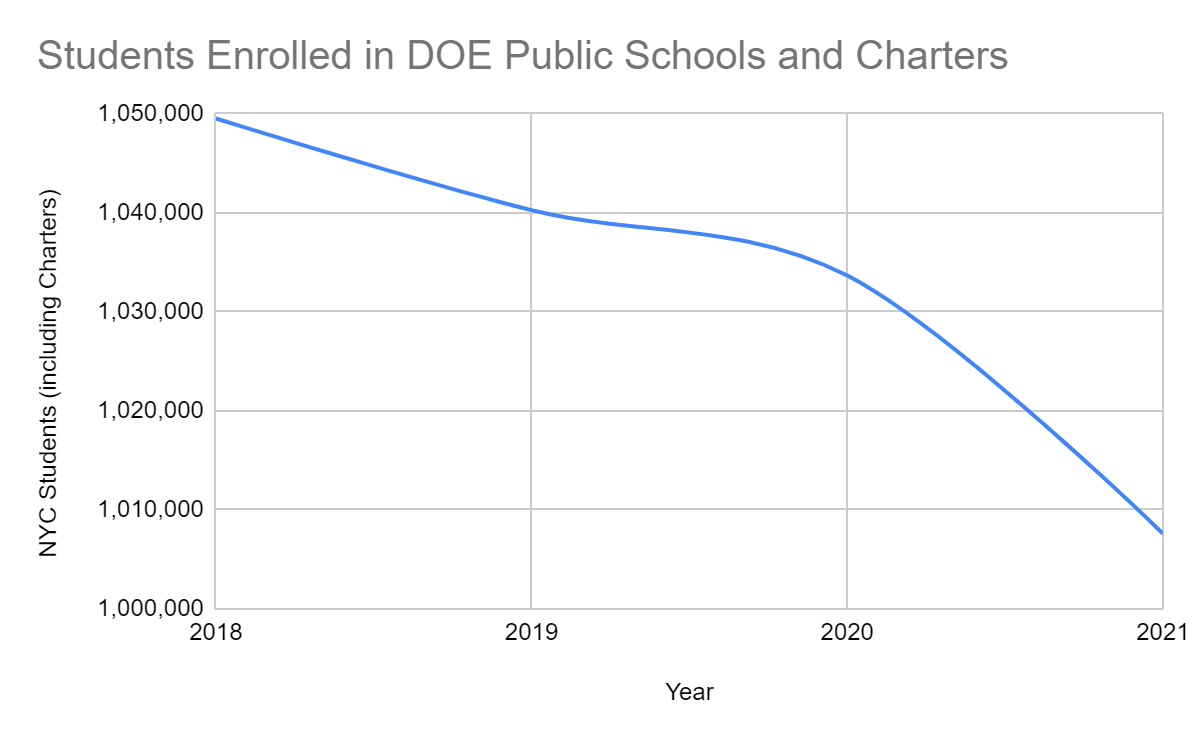
Governor Hochul is reportedly preparing to alter the charter cap so that as many as 106+ new charter schools can be ‘built’ (really co-located) across New York City. Charter schools are an assault on public education even in ‘good’ times. But today, enrollment is down, hiring freezes are up, and the specter of layoffs looms. Allowing more charter schools to open today could ultimately threaten the very nature of teaching as a unionized profession in New York. 

Frozen and Broken Dreams 

Even with new class size legislation that should technically force the City to hire more educators, the loss of thousands of students from our rosters has led to an anxiety that layoffs might finally hit New York public schools for the first time in decades. While layoffs have so far been averted, at a minimum, the DOE has recently frozen hiring for many licenses. When hiring is frozen, that means newer teachers must look elsewhere to start their teaching careers. When that happens, younger teachers find that in order to teach in NYC, they must work at charters.

Source: Graph by Nick Bacon using data from NYSED.

Charters have notoriously low rates of unionization and no concept of tenure or due process. As a result, teachers who work in charters must put up with horrendous working conditions. It is therefore no surprise that charters have twice the teacher turnover of public schools. Indeed, at charters, great teachers–and developing but potentially great teachers–are churned out at a dangerous rate. Even if you don’t care at all about teachers being happy in their jobs, this should matter to you. Teacher experience is known to be one of the most important factors in teacher effectiveness. If Hochul greenlights the creation of more charters in NYC, she will effectively ensure that good teachers who would have worked until the age of 63 at DOE schools are instead churned out at 23 in charters. Does Hochul really want a part in replacing the current system with that of a revolving door of ‘teacher temps’ who never make it to the years where they would be most effective at educating NYC’s students?

The Specter of Layoffs

We haven’t had layoffs since the 70s. That isn’t to say that there haven’t been threats. As recently as 2020, Bill de Blasio formally threatened he might lay off City workers, including teachers, due to budgetary woes caused by the pandemic. Our budgetary situation is at least temporarily much better, and no formal threats are on the table. But, there have been hints. Mayor Adams’ willingness to cut budgets for schools despite new class-size legislation does not bode well. And, ambiguous comments made by people at the top have implied layoffs could very well be a thing someday if trends continue. 

In the context of declining enrollment, new charters could spark a specific form of layoff in which DOE teachers are terminated and forced to become teachers at non-unionized charters. Imagine getting hired at a public school, forming pedagogical relationships with your students, getting tenure, becoming involved in your UFT chapter, only to be laid off because too many of your potential students enrolled in a charter school that was heavily marketing themselves next door. Not only would you now be jobless; you’d also likely be forced to apply for a job at one of the very charters that cost you your job. You’d still be an NYC teacher, but now you’d have no union, no tenure, and no due process. Your life, in effect, would be turned upside down, just so a few people at the top of charter schools could make a buck. Make no mistake, this is an actual risk if we allow charters to expand in the context of declining enrollment.

The Fight Ahead: Utilizing Contract Action Teams to Fight Charter Expansion

Charters are inherently bad for New York City educators. However, the fight against them presents an opportunity for unified action. All UFT caucuses agree that charters are something we need to fight. Now, with Hochul looking to expand their role in our city, charters are presenting an existential threat to public education and unionized teaching in NYC. As discussed above, teachers in earlier stages of their careers, especially teachers with ‘less hard to staff’ licenses, are particularly at risk, because a charter expansion could mean they’re laid off from the DOE and forced to find jobs with Eva Moskowitz. That’s unacceptable. And it would inflict untold damage on our union.

Here’s an idea: Let’s build off the successes of our new-found ‘contract action teams’ and start brainstorming ways we can fight charters. Unlike with the contract, for which actions are currently seen to be limited because we are still in the ‘pleasant’ stage of negotiations, the fight against charters is imminent. The battle lines are already being drawn. What can our chapters do to start readying for the fight? How can UFT leadership help motivate and support our chapters to do that organizing? Whatever the answer is, it can’t be nothing. Too much is at stake. 


Learn more about

our UFT Caucus

Content Policy

Content of signed articles and comments represents the opinions of their authors. The views expressed in signed articles are not necessarily the views of New Action/UFT.
Follow New Action – UFT on WordPress.com
October 2026
M T W T F S S
 1234
567891011
12131415161718
19202122232425
262728293031  

Blog Stats

  • 416,849 hits