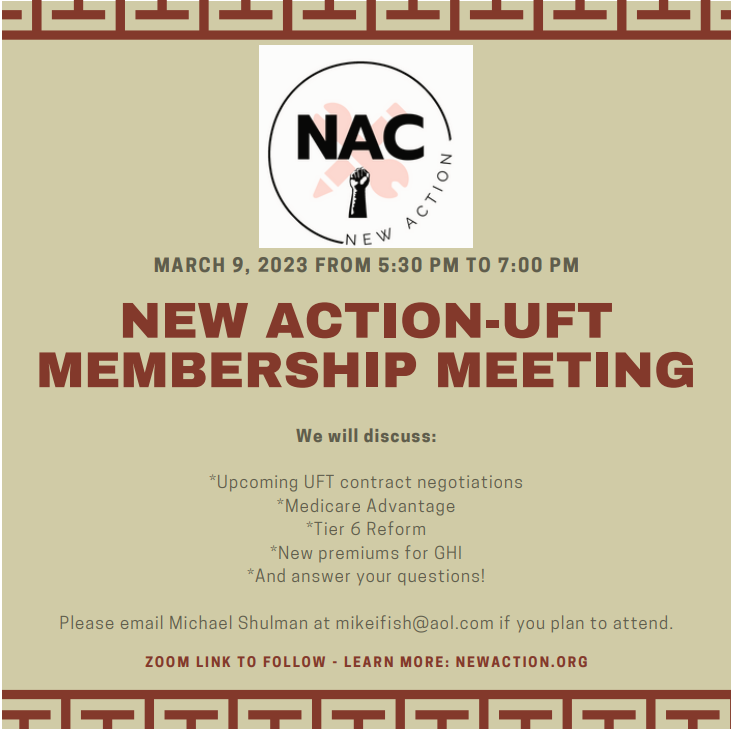
New Action Caucus will have our monthly meeting this Thursday, 3/9/23 at 5:30 PM. UFT-represented newcomers are welcome and can sign up to attend here. We will discuss a number of topics and potential actions around:
The potential for new premiums in GHI and a mysterious RFP for in-service healthcare.
We will also leave plenty of time for questions.
Note: for New Action members affected by the elementary school parent teacher conferences (or other conflicts), we can catch you up in committee. The next official New Action meeting after this one will be in April.
I was cautiously optimistic about the contract teach ins. So were a lot of people in the UFT’s progressive opposition. We had questions, to be sure — doubts. As I put it in January, “We need to make sure that the ‘teach in’s in our schools are not just infrastructure for an undeserved ‘yes’ vote, but a true means for chapters to think about what the contract means to them – and what sorts of contracts are worth that ‘yes’ vote.”
Unfortunately, the materials UFT gave us did resemble propaganda for a yes vote. They overstated the power of our current contract, slid over give-backs that have weakened it over the years, and made the negotiating process for a new contract seem much too fool proof.
Then, on the eve of the Teach Ins, I published this: “Luckily, at this point, we have some new materials. The good folks over at MORE published a much better version of the UFT’s official powerpoint. It looks to resemble the original powerpoint well enough that it could be switched out without any new planning.’ I used this powerpoint at my own chapter’s teach in. It allowed me to tailor that event in an honest way that provoked real discussion amongst rank-and-file members.
Then, a few weeks ago, MORE got a cease-and-desist letter from a law firm to which the UFT pays millions of dollars in our dues money. They were threatened not to use the UFT logo in their materials, which I now understand were written by individual MORE members and not even authorized by MORE itself. Opposition was stunned. Norm and James already published good think pieces on this, so I just have one extra point today.
This is the work going on at 52 Broadway. UFT leadership did nothing to stop DC37 leadership from committing us to a sub-inflation pattern. No matter how much we organize at this point, we’re going to be stuck with sub-inflation wage increases below the non-unionized U.S. average. I’ve written a lot about this (here, here, and here), but the main point is this: when well-paid DC37 leaders, who Mulgrew has described himself as talking to ‘all the time,’ put us in financial jeopardy by championing a bad pattern, UFT leadership does nothing. However, when opposition unionists try to organize members to help UFT get a critical mass of rank-and-file members ready for a contract fight, they get challenged to be sued, using our dues money. See the difference?
This is the legacy of our teach ins: actual organizers were given cease-and-desist letters by the UFT’s law firm, while our union leadership sat on their hands and let our real wages plummet.
Bad news abounds on the upcoming UFT contract. Teachers, paraprofessionals, and the rest of our members deserve answers on why. While, I’m bound by NDAs not to disclose what is said in the 500-member negotiating committee, I have more flexibility with information given in the Executive Board, Delegate Assembly, and other sources. So, in this post, I’ll go through some of the public information we have right now and analyze what it means for our members and for our union.
Committing to a Pay Cut
It’s no secret that DC37 is about to set the economic pattern for all other New York City municipal unions. A roughly 3% annual salary increase is absolutely dreadful. Even when accounting for the one-time $3000 signing bonus, DC37 is committing to sub-inflation increases. The exact numbers for UFT may be slightly more or slightly less depending on other ‘economic’ decisions made in DC37’s contract. But, we have the big numbers here. DC37 is effectively committing us to a pay cut in real wages. And, because their contract will last for more than five years, DC37 is also committing to a pay cut for a very long time. If that’s hard to stomach, it’s even worse when we look at the pattern in context. Nationally, non-unionized workers are getting better raises on average than unionized municipal employees are about to agree to here in New York.
That’s why at Executive Board this Monday, I asked LeRoy Barr why we weren’t publicly taking issue with the pattern about to be set. His response, that ‘we can’t make public statements about another union’s contract,’ astonished me. First of all, let’s be clear that UFT leaders have publicly criticized the pattern set by other unions before. For instance, back in 2001 Randi Weingarten stated that a pattern set by DC37 was too low for teachers to take. Second of all, why on earth would current UFT leadership place being courteous to other union’s leadership over the interests of our members? If our raises are about to be set at horrendous levels by DC37 leadership, it is the absolute duty of Mulgrew et al to do whatever they can to stop that. The fact that UFT leadership isn’t publicly fighting for pay increases that exceed that of non-unionized workers frankly raises existential questions about our union.
A ‘Gentlemen’s Agreement’ on Healthcare Reductions
At this week’s executive board meeting, Mulgrew claimed that ‘there won’t be any ‘healthcare savings’ in this round of bargaining.’ In the next breath, however, he said ‘but, we’ll look at the RFP.’ There are currently two RFPs, both of which were designed so that the MLC could realize cost savings for the City. The problems with the first RFP, Medicare Advantage, are well known. In short, retirees could lose access to traditional public Medicare and face diminished networks and tons of red tape. The second RFP, which is more mysterious, is for in-service members. Union officials have stated that they are seeking a plan similar to GHI at around 10% less of a cost. They have also threatened the possibility of premiums. So, call me crazy, but if healthcare isn’t a part of this round of contract negotiations, why are we humoring plans that potentially reduce our benefits or increase member responsibility for healthcare costs?
The only possible answer here is that clearly healthcare is a part of contract negotiations. This shouldn’t surprise anyone. The City was blunt with all unions that new contracts would be predicated on finding healthcare savings first. And frankly, the City and the MLC have been lock-step on many of the proposed changes. Now, on the eve of DC37 ratifying a new contract, we see two RFPs in the mix to reduce the City’s fiscal obligation to our healthcare. This isn’t rocket science.
Where does this leave us? As Mulgrew has stated time and time again, healthcare is a part of our overall compensation package. So, if the City reduces our healthcare or increases our costs, the already bad 3% annual wage increase could be much worse. Heck, we might see a pay cut even without adjusting for inflation.
Settling for Minor Workplace Changes
So, if salary is down the drain and healthcare reductions are already in the works, what’s left? All UFT can do is negotiate for workplace stuff. There’s potential here, but I’m still pessimistic. First of all, if we can’t even negotiate raises above inflation, do we really think we can get the City to improve our working conditions? My guess is that we’re only going to get the City to agree to stuff they want anyways. Mulgrew kind of hinted at this at the last Delegate Assembly, where he said ‘[The DOE is] listening on us to some extent on things we need just to be able to do our jobs better.’ I’d love to see those improvements that make it easier for me to do my job well. But, changes that are mutually beneficial to both the employee and the employer are easy fights. We see those types of wins in places that don’t even have unions. But, we do have a union. What we need to be fighting (yes fighting) for is precisely the stuff that is good for teachers and not necessarily good for the City (as an employer): things like smaller class sizes, caseload reductions, and yes – better wages and healthcare. Bottom line: the UFT must do better than settling for what the City wants anyways. We aren’t going to get anything more than the bare minimum unless we act like a union and organize.
Content of signed articles and comments represents the opinions of their authors.
The views expressed in signed articles are not necessarily the views of New Action/UFT.

 New Action - UFT