PBA now has a contract. The details are better than DC37’s, which has led to some questions and confusion amongst rank and file in the UFT. In this post, I analyze some of the details/implications, answering some questions I’ve seen circulating along the way.
Beating ‘the pattern.’ I’ll start with the question I’m hearing the most: if police officers beat the pattern, can we? The short answer is no. You see, police officers are grouped under what we call the ‘uniformed professions,’ who effectively get their own pattern. So, while NYFD may benefit from PBA’s negotiation, UFT will not. We’re stuck with the ‘non-uniformed’ or ‘civilian’ pattern, and that sub-inflation embarrassment was set by DC37 without any pushback from UFT leadership. Similarly, police officers will apparently get their retro settled right away – they won’t have to wait for years and years to be ‘made not quite whole,’ as UFT infamously did.
The gendered ‘pattern gap.’ The uniformed/civilian distinction sets an incredibly problematic double standard. Pattern bargaining already has the issue of ‘cementing’ old inequalities into eternity. All titles are subject to the same economic increases, so whatever inequalities were there at the beginning of pattern bargaining are doomed to be perpetuated ad infinitum. But the distinction between uniformed/civilian professions only further exacerbates inequalities. By ensuring that salaries even grow at a higher rate amongst male-dominated professions (e.g. police officers and firefighters) compared to female dominated professions (e.g. teachers and paraprofessionals), inequalities between the pay rates of each job actually increase over time.
There’s no substitute for real organizing. NYPD officers have a bit of a reputation for ‘stretching’ the Taylor Law and getting away with it. (Think: ‘blue flu’). But, PBA solidly negotiated this contract within the confines of New York public-sector bargaining laws. In other words, they did not strike. And it’s telling that police officers, despite predictably doing better than DC37 in terms of their pattern, still ended up with sub-inflation wage increases. Education workers in Los Angeles on the other hand, who held a three day strike, did beat inflation. So yes, NYPD will get better relative raises than the UFT, but the more militant Local SEIU 99 beat both out by a longshot.
So, yes, teachers and all other ‘civilian’ union members should at least get what ‘uniformed’ workers get. The inequality in our patterns exposes some of the most blatant absurdities of pattern bargaining, and should be immediately abolished. But to truly get what we deserve, we will need to push beyond what even uniformed unions are getting in post-Taylor, New York. To get what we really deserve, we will need to dramatically increase our scope of contract tactics to that of what we are seeing in L.A. and Chicago. It is organizing, and organizing alone, that can beat inflation.
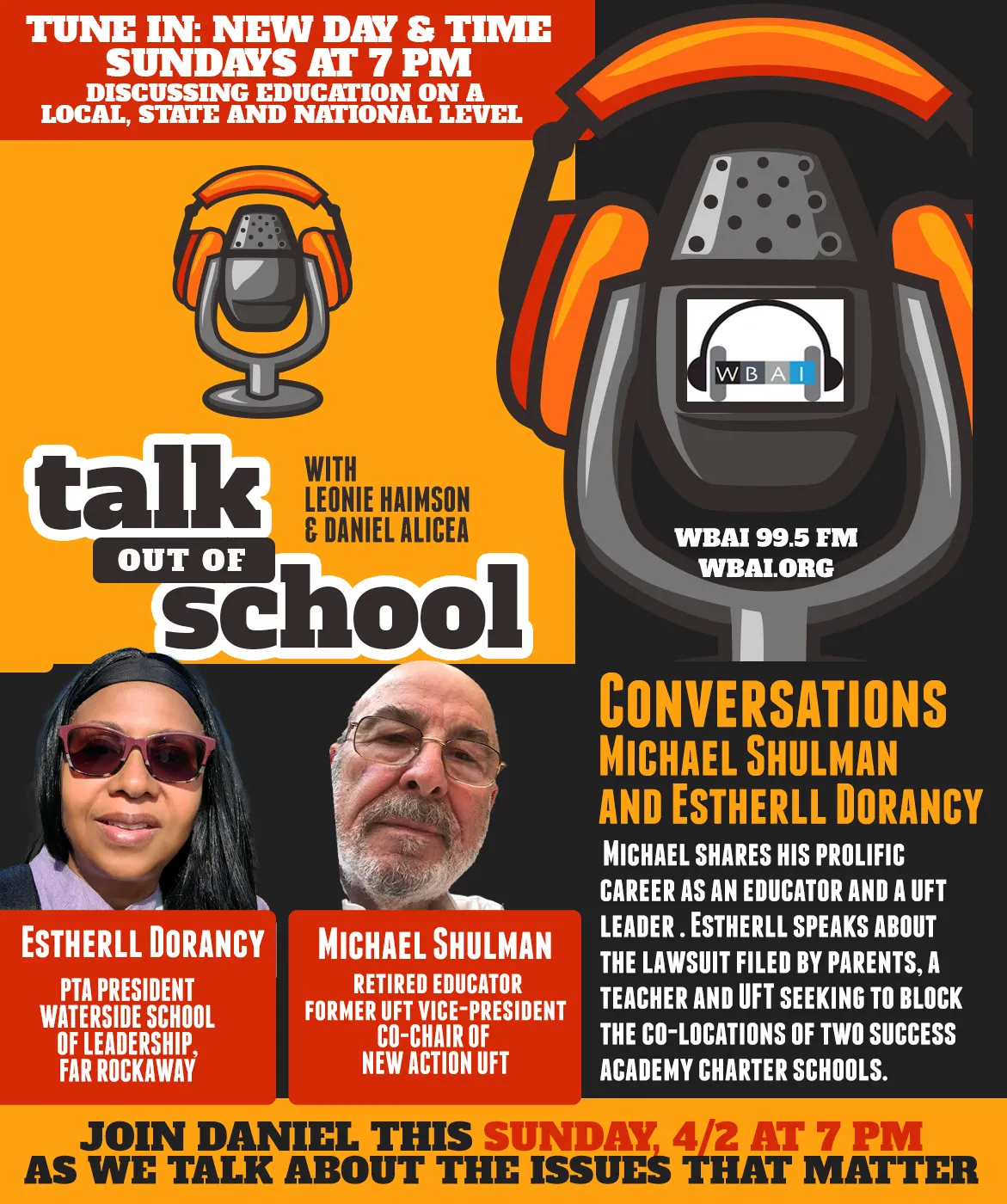
Earlier this week, Michael Shulman was interviewed by Daniel Alicea on his WBAI radio show, Talk out of School. That essential interview is also transcribed below.
Danieal Alicea: I’m on the line with Michael Shulman. He is a retired educator, who taught in New York City schools for 36 years. He is also a longtime UFT leader and union activist, arguably the most significant leader of dissent within the United Federation of Teachers and also the founder and co-chair of the New Action Caucus, the oldest caucus within the United Federation of Teachers that is an opposition caucus. Welcome Michael Shulman to Talk out of School.
Michael Shulman: Thank you, Dan.
Daniel Alicea: So Mike, I know that you are a born and raised Brooklynite – a product of New York City schools.
Michael Shulman: Yes.
Daniel Alicea: Let’s kind of segue to your decision to become a New York City public school teacher and your decision to get involved in union activism within the UFT. What made you become a teacher? What got you involved in Union activism?
Michael Shulman: Well, the first part was easy for me. I really enjoyed working with young people. I thought that I could make a big difference. Because of my empathy, because of my understanding of the conditions they grew up with —they were the conditions I grew up with. So, I was anxious to give back and just engage with young people. In terms of my union activism, it was pretty simple. In 1970, when I started teaching, it was what they called permanent subs. I didn’t have an appointment. So I was working as a substitute with a regular program – the same kids every day. And I discovered that I did not have healthcare coverage. And I was kind of shocked because I was working alongside colleagues doing the same job – the same expectations. And I filed a grievance. I was not oriented that way to, you know, to fight immediately over an issue like that, but I was so offended that I wasn’t covered. And so I filed the grievance. And at the grievance hearing, my union never showed up. And I said, this is unacceptable, and I have to change this – if this is the way they behave, then I’m going to — and by the way people did win coverage, shortly after then so I was made whole, but nothing to do with the effort that my union made. And I realized that this was, as I said, unacceptable. I got involved. And, it’s interesting, I waited to till 1973, because I was always also very aware that union activists who put themselves out there could get their heads chopped off. So, I decided to wait till I had tenure. And in 1973, I ran as a delegate at Bushwick High School and was elected. And from that moment on, I’ve served in this union.
Daniel Alicea: And so as a delegate, were you – did you become a chapter leader? What got you involved? Within the UFT, there is a caucus that we call Unity Caucus. It’s Albert Shanker’s Unity Caucus that has held control of the United Federation of Teachers for over 60 years. So, did you immediately get involved with the Unity Caucus? Or where did you gravitate? And why did you do that?
Michael Shulman: Okay, well, in 1970, I was drawn into activity around the war in Vietnam, and there was a group in the UFT, called Teachers Against the War in Vietnam and I gravitated to that group. Many of the people coming out of that group were also members of a caucus at that time called the Teacher Action Caucus (TAC). So that was where my pull was. I liked the fact they opposed the war. Albert Shanker at that time, you know, if you recall, or just want to mention that Shanker declared himself a hawk on the war in Vietnam. So, I could not join a caucus, that was antithetical to my beliefs that the war was wrong, it should be opposed. And I joined, you know, tens of thousands of New Yorkers in the streets of New York and in Washington opposed to the war in Vietnam. So, it was it was kind of natural for me. The war was really what had my political interest. I was not a political person. Before then, I didn’t come from a family that was political. But that was the impetus to get involved with that particular group, the Teachers Action Caucus.
Daniel Alicea: And so, by the mid-1980s, I believe you start the New Action Caucus with along with others. Can you talk a little bit about the trajectory that helped you become the first leader within the UFT from an opposition caucus to be elected an officer – vice president of high schools within the UFT?
Michael Shulman: I’ll kind of sum it up because this, there’s a lot of detail. But in the early 1980s, there were other groups besides New Action. Matter of fact, at that time, there was a group called New Directions. There was a group called the Coalition of Schoolworkers. And those groups, including my own – the Teacher Action Caucus, united around a coalition, it was called the New Action Coalition, much as in our recent elections of groups that were active in the union coalesced around United for Change. Very similar. So, we pulled together in 1983, a coalition and two years later, I was elected Vice President of the Academic high schools. So, it was very significant. It was the first time an opposition person had won a seat in the leadership body. They call ‘Adcom’, the Administrative Committee of the Union. So, I served there for a year and a half. Of course, there’s a history to that. Shanker and the Unity Caucus refused to seat me, it was a challenge. Guy I defeated was George Altomare, first vice president of the high schools, New York City, and Altomare claim was that I lied in campaign election material. I said that he had been out of the class — the lie was that I said, he was out of the classroom for so long, he forgot what it was to be a teacher in New York City. That was the lie. And that was what the challenge was. So, we went to a second election, it was pulling the coalition deep into debt, legal fees, I decided to go to another election.
Daniel Alicea: And we won that more handily. And so even after that, some changes were made – so that wouldn’t happen again, among leadership. Can you speak to us about your tenure during this time as vice president? What are some lessons you learned? And tell us a little bit about how UFT leadership dealt with having someone of dissent within its leadership?
Michael Shulman: there was clearly an effort to isolate me, blocking me out from any sort of publicity, they refused to allow me to have a secretary of my own choosing. I had to have somebody that they selected–that Sandra Feldman selected. She was the president at that time. Al had retired, just during that period of the election challenge. And the other thing that was significant is that Sandra Feldman refused to allow me to publish a newsletter, which had traditionally been published by George Altomare for years preceding my becoming Vice President. And I fought that. I did not accept that. I issued my own newsletter, with my own editor, and distributed it to the high schools throughout New York City at my own expense. And Feldman recanted and said that I could, in fact, use the official channels. So that was the first major fight that I had with our…
Daniel Alicea: So, it had to be really hard to effectuate change almost by yourself within such a large group. Can you tell us about the constitutional amendment where there was some type of change to the Adcom to kind of prevent another opposition leader to be elected as you were?
Michael Shulman: It was a major change. It started in January 1994. Feldman in a letter put out to the entire membership, not just the high schools, put out a statement–I think it was a three page statement–with her rationale why she was changing the UFT Constitution to allow the divisional vice presidents to be elected at large, meaning that an elementary teacher would now determine who would be the intermediate vice president – be the high school vice president. And that would be true for other categories, paraprofessionals would now determine who the representative of teachers in the high schools would be. Representatives of the intermediate school would be representatives of the elementary – so all divisional vice presidents were now elected by the membership but as a whole. And by the way, Daniel it’s very instructive that in the last several elections, the individuals James Eterno, Jonathan Halabi, received the majority of votes in UFT city-wide elections, and were not seated as vice president, because they didn’t win the vote of the other categories. So it was a major undemocratic move, done precisely to prevent any opposition. And that’s clear to this day. It’s true in the last election that the UFT held. So this was a real undermining of the intent of the of the positions. And they did it because— it’s interesting– because the high school members elected to the executive board, were all elected off of opposition slates. They didn’t change the way executive board members were elected. So this was directly intended to keep me from becoming vice president, and subsequently, other opposition leaders.
Daniel Alicea: Tell us a little bit about your tenure at 52 [Broadway, UFT Headquarters]. What did you learn about – just being an officer? And am I right in understanding that you refused a pension as a result?
Michael Shulman: Well, yes, that was very early in my tenure. I wasn’t asked – I stated. Because I knew that officers and full time workers at the UFT were paid a double pension, they still are today. It’s really disgraceful. But I don’t remember if it was the first, the second meeting of adcom. Adcom met once a week. It was Monday morning, the 13 officers of the Union met – at that time it was 12. They met and policies were decided – what was coming before the delegates, etc. And I, I made a statement upfront, I said, I understand that officers received a double pension, second pension, I refuse to accept it. And I wanted that on the record. And I was told that, Mike, then this is, I think, almost verbatim: what’s wrong with union leaders being in the vanguard of the Union, meaning getting second pensions? At that time, it was interesting, because I said, come back and talk to me when you won pensionability for people who are doing other work after their regular work day. And of course, as you know, that came to fruition – many years later, when those years of extra service are now compensated in terms of pensions and factored into pensions. But at that time, they weren’t. And I was very offended by that and said that I would not. But you know, you asked the question, what did I learn? I learned, I think that the leadership was very out of touch with what the membership was experiencing in their day to day lives. And that was the most profound thing to me. A second thing that occurred almost immediately, I think it was also the first or second meeting of the, my tenure as VP, Sandra Feldman turned to me, I remember she was sitting two seats away from me, and said, Mike, what is this, these postcards I’m receiving, calling for the divestment of pension funds from companies doing business with the Republic of South Africa. And I said Sandy, join the rest of the labor movement and join the leadership that is now opposing this racist apartheid regime in South Africa. And I’m part of that movement. I will be part of it until we are successful. And that kind of made me realize also, this was a major movement back in the 1980s – major movement. As a matter of fact that see that the gentleman who started the anti apartheid movement – I saw his obituary in the newspapers last week. But that aside, that made me realize also that there had to be a combining of both the fight for improved working conditions and salaries and the fight for around the social justice program. And I still —to me that that serves me very well as a guidepost. Yes, certainly working conditions have to be up front and center. But there also has to be a perspective by any union that they are a social justice – they’re not detached from what the students and their parents and the communities are experiencing. So today, we would be in the forefront of the fight against police violence. Matter of fact, we did. I’m very pleased that as an opposition leader, the New Action Caucus started the fight against stop and frisk under Bloomberg. And as you’re aware, our union did call a major rally under Randi Weingarten against stop and frisk, which put an end to that policy. So from Sean Bell, Trayvon Martin, all of those issues have also been very high on the agenda of New Action – and I believe many of the opposition groups today see, social justice is a major, major fight.
Daniel Alicea: And so let’s segue to the 2000s. New Action caucus has been on the forefront of opposition for many, many years. And in the 2000s, New Action Caucus decided to make an alliance with Unity. I believe Randi Weingarten was the president at that time. In hindsight, was that a good decision? How long did that alliance last?
Michael Shulman: It was a four year alliance. And background to that question– you asked a question, I’ll answer you very directly, I still believe it was a correct decision. It caused a lot of dissent within our caucus, I don’t know how much damage it did to our caucus – the respect that members had fad for us. It’s hard, it’s really hard to know. But it was in the context of the rise of Mike Bloomberg as mayor. And it was in the context of Giuliani saying he would be he would blow up the Board of Education. And Bloomberg, who pretty much decided to decimate the large high schools in New York City breaking them up. A guy like Bloomberg who decided to change the way funding was done in New York City schools, by the way, that’s a major issue – still has ramifications today. Bloomberg went from funding the teacher pool centrally, to giving the authority to principals to hire. And what that caused was a major – anybody in the system then knows that the harassment against veteran teachers was fierce. And the idea of being – get rid of a veteran teacher and you can hire two new teachers. And that has implications to today as well. So that was the rationale behind it. We had somebody who Giuliani, and then Bloomberg who wanted to destroy the unionization. And by breaking the large high schools, they clearly went after the most militant sector of our union.
Daniel Alicea: And I would say public education in general.
Michael Shulman: Yes.
Daniel Alicea: We are still feeling the after effects of Bloomberg in New York City schools.
Michael Shulman: Absolutely. So that was the basis of it. We formed a number of committees in exchange – and we ran our own slate. We did not come under Unity Caucus, but we supported Weingarten as the presidential candidate, but also Daniel it’s important to know that as a condition for, for that support, and it definitely did hurt. I mean, I’m glad you raised it because it was a major factor in the rise, I think of other caucuses. But in exchange, she agreed to set up four committees. One was the committee to combat abusive administrators. One was a committee, we called it the Action Committee to rank and filers. There weren’t 500 Like there are on now, there was a real bipartisan committee to unfold, fight around contracts. And to not only formulate contract proposals, but the fight for a contract. And we did that. That’s another story. But we did that in 2000, when New Action organized hundreds of chapters around the city to go out and do informational picketing for salary parity. And eventually that became a priority. But it took many years to get to that recognition that New York City educators were paid less than surrounding districts. So that was a second committee. Third Committee was – I mentioned the abusive administrative, which by the way, led to a PINI campaign, principals in need of improvement, that went after the two to three hundred abusive administrators in New York City. That program has long been dropped by Unity caucus.
Daniel Alicea: And that’s too bad.
Michael Shulman: Excuse me?
Daniel Alicea: And that’s too bad. There needs to be more accountability on them.
Michael Shulman: Yeah. Yes. Yes. Then the third group was to me very important. There were they all they were important, but was an Organizing Committee. It sent teams of veteran educators, teachers, retired, into schools to help build chapters, morale, practical questions, chapter strength. And that Organizing Committee was at one point involved in over 260 schools in New York City – were getting visited by teams of retirees, comprised by the way of Unity Caucus members, New Action members and independents. We made sure that anyone who was an independent and wanted to work in a union, which is so contrary to today, were the only people who get jobs working for the unions are members of Unity Caucus. The fourth committee, which was very important, and I chuckle when I mention it, was a committee to look at union democracy. And that one, Weingarten came back and said, she could not institute a committee to look at Union democracy, because according to her, her caucus, Unity Caucus would not agree to it. But with the three committees I mentioned, we moved forward organizing, action, and going after abusive administrators that she did put in place. We felt it was significant for the people in the schools. It’s very interesting when we finally broke with supporting the Unity candidate for president–we did with Mike Mulgrew, as well, for one election cycle–we did so because we began to see that the union was not as committed as it was to addressing the working conditions of teachers. And when that happened, we made a decision to break, run our own full slate, including the presidential candidate. But during all of those years, and there were four or five years of that relationship, we always ran a full slate, we always had hundreds of rank and file teachers, social workers, guidance counselors, paraprofessionals, who ran with us on our slate. So clearly, they believe that that relationship worked for the members in the schools, and we’ve ran with hundreds of people, not one person Daniel hired to work in this union is a member of any other caucus other than Unity Caucus. That pulls hundreds of members to support them no matter what, and you take a look at this fiasco, this disaster of the move to go to privatized health care. And you can see that Unity Caucus lines up – nobody has a problem with that. Imagine a union leader proposing that an issue as important as health care become privatized? What with the membership of the United Federation of Teachers do if Mulgrew got up on stage and similarly said, ‘You know what, guys, I think if we privatized our public schools, it would be the best for the children in New York City, and people who work in a system?’ So to call for privatization. And unity caucus is okay with it. They’re down with it. And I think that says more in 2021, 2022, 2023, then any other thing that we could discuss about Unity Caucus.
Daniel Alicea: So, in your opinion, in 2023 – I love my union. I think we have some strengths. We have some weaknesses. What is our biggest strength, in your opinion, as the United Federation of Teachers, and what is a weakness that we need to improve on?
Michael Shulman: Well, it’s interesting. This week, this past week, I was invited along with one of the co-chairs of New Action, Greg DiStefano, to speak at a middle school on Staten Island. And some people raised the issue, should we withdraw our COPE money? Should we withdraw our dues from the union? And we gave an emphatic NO!. We do not support that. Because we too come at this from a love for our union. Otherwise, I would have left in 1971 when I was denied that health care. So, I would have left then. My answer would have been ‘to hell with this union. If this is the way a member gets treated, then I don’t want a part in it.’ I didn’t. I stayed and I’m still fighting today for a better union, a more responsive union. I believe in Unionism. Without the Union, we are literally helpless. So, I agree with you. I identify with that sentiment. I feel it fundamentally, we have to fight for a better union, a more responsive union. And that’s what I’m committed to doing. It’s – that’s my life’s work. I think we have to be sure that we’re into the schools. We get ours are our district reps. I’m not saying they don’t go into schools, but they come into schools not with spinning the leadership line. But they come in listening and they come in asking the membership. What is it that – We have a perfect example. Several years ago, a teacher began a petition campaign for maternity leave. Can you imagine having to employ your union to fight for maternity leave? So that’s what I mean when I say unresponsive. You don’t have your ears to the ground and hear that women who make up the majority of the staff of the educators in New York City – we should be fighting for this? So these are the kinds of things since I started teaching, one of the big demands was lower smaller class size. That was a major fight in the union. The union didn’t even pose that as a priority demand in negotiations since 1970, since I started, no change in class size. Well, there was there was in the elementary level. Many years back, there was a reduced number of children in the elementary schools. But that’s what I mean by non-responsive. Class size, no change in 50 years? Maternity, no change in all of those years that I stood… That’s what I mean by being responsive. And the Union must do that. They have to send people into schools and say, ‘What do you guys – what’s priority on your minds? What do you need to see change?’ And I think we have to put an end, not I think, we have to put an end to the idea which, which has been true since I started teaching that union leadership always said, Do you want salary increases? Or do you want smaller class size? No, we want both. We want wages that keep up with inflation, at least keep up with inflation. we have to have smaller class size — you know, in this whole fight around charter schools, the union is now beginning to realize the importance of it. And I say beginning, because they have fought to put a cap on charter schools. But in all of this fight, I don’t hear the union leadership saying to the parents and communities, we will commit to make every school in New York City a quality school. What do you think are the elements that would make your school make your schools the kind of schools that we will… is it is it class size? Working conditions? The physical plants that your kids walk into? The physical plants of the buildings? Is it school safety? What are the issues that you guys feel? This is what I need to set to feel comfortable sending my kids into school and knowing they get the best education? We still have not heard that. I’ve raised that with Mike Mulgrew. Mike, you want to fight charters? Put forward our program for quality schools. To me that that is still the number one area that they are lacking.
Daniel Alicea: responsiveness?
Michael Shulman: Yes.
Daniel Alicea: Thank you so much, Michael. There’s so much more I want to explore with you but because of time, we can’t.
Michael Shulman: Thank you for allowing me to speak with your audience.
During the open mic, two visiting members spoke about the ongoing conflict going on for Instructional Coordinators and Social Workers in the DOE’s early childhood department. As a recap, massive excessing occurred over the summer and there is good reason to believe that the City is seeking to replace UFT positions with non-unionized contractors via private companies. Members of UFT’s administrative committee responded, but didn’t speak on many specifics. Another member spoke out about getting assistance for UFT parents whose own children have IEPs.
During the questions period, Ronnie Almonte pointed out that, despite asking many times now, we still haven’t heard back about where the data comes from that supports Mulgrew’s decision not to support the New York Health Act despite two DA resolutions telling him to do so. I wrote about Mulgrew’s missing homework here with Daniel Alicea. Rather than give Ronnie the still missing answer, LeRoy Barr suggested that this had been asked and answered. But, New Action hasn’t missed a day of executive board minutes this year. The question has been asked many times; it’s never been answered.
Two massive political endorsements were put up with no prior notice made to the High School Executive Board (and therefore to any caucus other than Unity). We pointed out that it was impossible for us to vote on this many endorsements at once, since no one coordinated with us – literally only giving us the lists of names the moment of the vote. We also pointed out that it was difficult to believe the endorsements were ‘bipartisan’ (in the union ‘caucuses’ sense of the word), because some of us were literally dropped from the endorsement committees between when we were in Unity and when we were a part of other caucuses. We also pointed out that just through a quick look, we could spot names that we weren’t sure should be there – such as people who voted for DOE budget cuts. We didn’t ask for any amendments, just that we be given more time before voting. Unity wouldn’t grant it. No offense Unity, but who is really political?
Mulgrew wasn’t there, and we heard nothing about healthcare or about what the DC37 pattern means for our upcoming contract negotiations. Surprisingly, only one person—George Geiss—spoke out about the contract actions last week (see info here for mine), though it was better optics for a school-based member to speak on school-based actions rather than UFT staffers. Geiss had a good story about a ‘contract action haircut’ that went viral. But, he also offered that the cycle on Trump’s indictment probably drowned reception of our organizing out. To that end, I wonder how widespread/effective the overall strategy was. Does analyzing our contract actions make me ‘against organizing,’ as Unity misrepresented recently as part of a blitz on high school representatives? No. Rather-as I have argued in various places, the fact that our union officers are against even having the right to strike, and are willing to accept bad patterns over risking disharmony with other labor leaders, has put us in a bind. Their unwillingness to organize in these critical areas has done us no favors in terms of mobilizing our members or leveraging our power against the City. Nevertheless, I hope the contract actions prove to be a success. At a minimum, they helped organize chapters to bond over union activities and engage with their communities. I certainly saw that at the contract action that I attended. But, let’s hope they swayed the City too. Because now that we’re stuck with a bad pattern, the nature of our fight just changed big time.
More from the executive board can be seen below. Alternatively, see Joe Diodato’s minutes here.
Informal Minutes for the 4-3-2023 UFT Executive Board Meeting
Open Mic: (Name missed): Instructional coordinator supporting birth through pre-k. Noticing that my colleagues and I are being glossed over by the UFT, prompting me to speak out this evening. My colleagues and I are the UFT, and here’s what we’ve done: we’ve spoken out, had rallies, come to executive board meetings before, spoke with the Deputy Chancellor and their team, conducted a vote of no confidence, written articles; yet still, our voices are not being heard. Decisions are being made without us in the room. We know there’s a new admin – but their changes are privatizing union jobs. We are asking that our union be our ‘ride or die.’ We appreciate the work that’s been done before, but our future is up in the air.
Jia Lee: I’m on sabbatical this year, and it’s been pretty busy. In September, 2 days before school started, early childhood people were told their positions were being eliminated. We fought, we organized. I appreciate everyone in the room for their efforts. But, it’s unknown what’s going to happen for next fall. Seems like these positions are slated to be eliminated. It’s about sending a message to this administration. There’s nothing about us without us. Educators/admin are saying this is our central support; not perfect, but can’t just eliminate them. We’re asking that the executive board please meets with these essential workers. We know the goal of this administration is privatization. They’re getting ready to contract out. Let’s come together and make changes together.
Christina, School psychologist. Also a parent with a child who has an IEP. This year, my child with an IEP wasn’t getting services. It’s been a long road. Would like there to be a mechanism for UFT parents. Found a lot of support from our own members; key people in my chapter. Moving forward, having such a mechanism would be a good thing to have around.
Minutes: All approved.
Questions:
Ronnie Almonte: What is the data around the NY Health Act that says it is not in our interest. Can you please correct the current source being cited – which cites anti-union persons in favor of privatization. I don’t want to be misconstrued on facebook. I’m simply asking about that data – following up.
LeRoy Barr: This has been discussed ad nauseum in these meetings. President has said it doesn’t make financial sense. I’ll punt that question to the president (not here).
District Reports:
Mary V. Curriculum report wasn’t exactly what we planned. Not that it was bad, but we didn’t get info on the actual learning. We will have workshops ready to go on May 1st. So we should be ready to go on all three curriculums as well as Algebra.
Ibeth Mejia. I would like to report in recent months there has been a spirited resistance started to grow at Middle College and I been their CL for 5 years and I am very familiar how the principal retaliates against any teachers that uphold the contract. I myself was retaliated against the principal for advocating for children with special needs and I was eventually pushed out and with that said I got some very disturbing information that a union official came into a school and bad mouthed two members of the UFT opposition at a meeting of a group of chapter members. I raise this not to attack anyone. That said, can we get clarification that when UFT officials go into a school in their official capacity that all of us here are on the same team, the UFT, and we don’t represent a caucus or look to criticize members who might not hold the same political views within the UFT as we do?
LeRoy Barr: Hard to address this because it’s vague, get why you don’t want to say names when there’s a record. We can talk 1:1. I like to believe that we are on the same team. Sometimes comments made here or outside are not indicative of unison, because people aren’t coming for me, they’re coming for the entire UFT, so unless we guard the gate together, they will get inside the gate. Goal should be moving forward as one. Unfortunately, that’s not always what people say. Know this, when there are attacks, and it feels like it’s undercutting the foundation on we stand, ultimately we’ve weakened us. I can talk for hours on this. When people go into buildings they represent their truth. I am not going to shackle my people who have an opinion whose opinion might differ from that of others. Let’s have a more private conversation.
Ibeth Mejia: It was purely contractual violations.
LeRoy Barr: Taking opportunity to talk about how we can be better to guard the gate.
Janella Hinds: On Tuesday, a group of us went to Albany to continue in our public schools over corporate charters campaign. Partnered with many groups, including NAACP and NYSUT, to fight back against the Governor. The budget is late, so there’s still an opportunity to lobby. We have a letter writing campaign – please do that this evening. We want to make sure public schools are strengthened.
Chris Verdone: Reporting out on safety updates. Thanks to everyone for opportunity to speak. UFT liaisons have been holding meetings with CLs – open to all. Working with all stakeholders to ensure safety of our members. Forum for CLs to discuss rise in violence. During first Manhattan meeting, CLs expressed concerns, we brainstormed solutions.
Rashad Brown: Meeting with members about student loans. Holding webinars for paraprofessionals/librarians.
Rich Mantell: Labor seder last week. Well attended. Jewish Labor Committee applied to AFT to become a national caucus. Nov. 30th having first ever Jewish labor committee – award.
Karen Alford: Visited Richmond pre-k center. Girls came over – high school kids read to 3 and 4 year olds. Kids see the high school students, many who are women of color. Big to bring these kids to this center. On Saturday, this room was transformed – early childhood conference. Great day.
Karen Alford with Mike Sill: Karen: Looking at all of what ICs and social workers. With regard to where we are right now, we have debriefed with DOE and are still waiting to hear—when we get back from the break—about their plans for next year. We know that any title can have changes done. We want to make sure it is changed the right way and that they have the right to make those changes. Mike adds that it is April 3rd, the day before MLK was assassinated. He gave a speech to striking workers about collective struggle. Things don’t always move as quickly as we’d like them to move. We have to move toward radical selflessness. To say that the concerns have been glossed over is wrong. UFT has done a lot, including rally. Had demands: (1) no excessing this year; (2) chancellor needs to know what the folks do; (3) any changes made must be made after talking to ICs and social workers. Things don’t go quickly, but we are right there. We’re all working towards justice.
Luli Rodriguez: This Saturday, school librarians did outreach, including here, helping parents access digital library. We talked about the need for having a librarian in every school.
George Geiss: Round of applause for grade-in. Got upset that news of indictment took away our thunder. My barber in Queens showed up and gave me a haircut. Students were reaching out – saying like your haircut, hope you get a fair contract. This is coming full circle. Next action in District 30 on 4/20. Our noise worked.
Ilona Nanay: Speaking on behalf of division of early childhood educators. Sent a letter to the UFT district reps. Urge us to consider all the functionals that make up our union. They are hungry too and want to be considered a part of the membership.
Nick Bacon: Just seeing this list of names for the first time. I used to be on the committee that selected these names; not sure why I was taken off. To that end, I’m worried about how ‘bipartisan’ this resolution is. I don’t know who was on the list to select them. There has been criticism here that when I and others here bring resolutions forward, they aren’t sent to you with enough time in advance so that you can collaborate. But what about this? This list of names is too long for me to look at right now and vote yes, especially since I have no way of verifying that they were selected in a way that respected the diversity of views in our union. I have to do more research and can’t possibly vote yes on a list this big at this at this time.
Response: Political committees in districts. Worked with district reps. Not everyone drew an election. Some members on list we already have a good relationship with. Politics is important. We have 51 members. We have issues where we won’t agree on them. The people on this list have either drawn an election or are leaders.
Rashad Brown: People on committee did the work and sat down. They came up. Mr. Bacon worked at a different school.
Luli Rodriguez.: It’s not necessarily the people on this list, it’s about time for us to vet it. Should table.
Ilona Nanay: Last week we passed a resolution on budget. A lot of the people on this list approved a budget that decreased funding for public schools, including the speaker. Some may have signed a letter of regret, I don’t see them working towards rectifying it. So why are we endorsing?
Motivator: In politics, we can go through each of the names on this list and find things we don’t agree with. Budget was a tough situation. But budget as a whole was a good situation. Relationships now very close. We have to be careful.
Name Missed: Calls all questions before the house.
Resolution Carries, but with some no votes and abstentions from H.S. Exec Board
Same person (name missed) endorses another resolution on District Attorney positions (same link, scroll down).
Ilona Nanay: Should table.
Mike Sill: Speaks against tabling.
Nick Bacon: We’re educators. We don’t do politics full time. So we should have time to vet these names.
Rashad Brown: As members of society, we should be informed what’s going on in our own boroughs. This body is collective, so we have enough people who do know and can make the decision.
Content of signed articles and comments represents the opinions of their authors.
The views expressed in signed articles are not necessarily the views of New Action/UFT.


 New Action - UFT