Archive Page 21

UFT Contract: There’s a 0% chance we vote yes to 3%!

Inflation is out of control. Educators, who have never made enough to begin with, know this acutely. We feel it while stocking up at the grocery store and while searching for even the most modest apartments. We feel it while trying to buy a used car or while saving for the college education of our children. Everything costs more, except apparently the labor of educators. That’s why “fair pay with raises we deserve and pay parity” is the first of United for Change’s big 5 contract demands. 
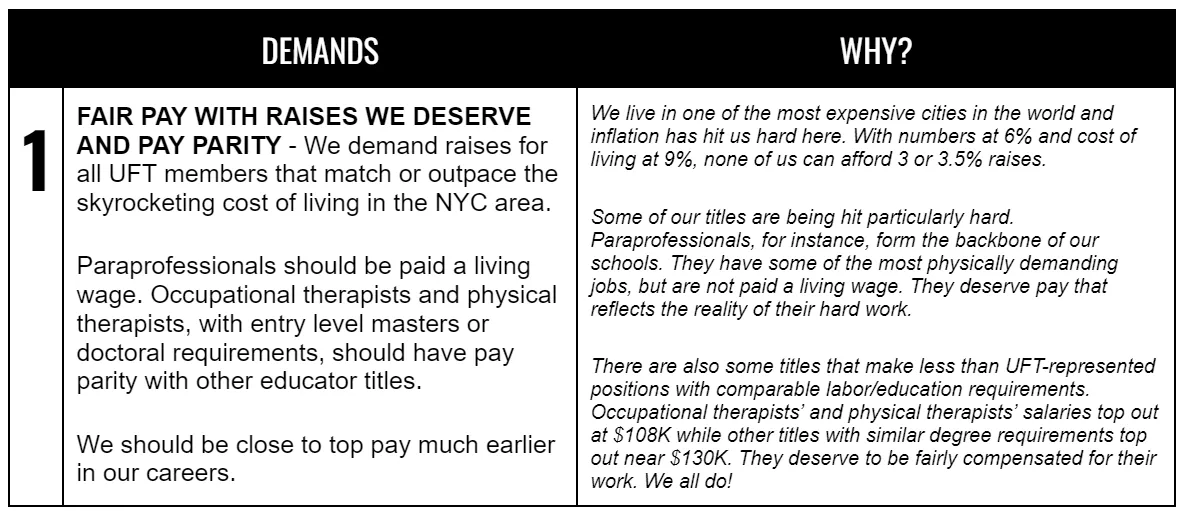
We can turn to the mayor himself to paint a picture of the gravity of our financial situation. In 2007, when then NY-Senator Eric Adams gave his infamous “Show me the money” speech, he told an audience of New Yorkers that $79 thousand isn’t enough to live on. Flash forward almost two decades later and that same figure is worth $115,000 – almost the top salary for DOE teachers ($128,657 with a Masters +30). Starting teachers today make $61,847, worth only $42,271 in 2007 dollars. That’s about half the figure Adams was calling poverty wages. And, because it takes teachers twenty-two years to reach top salary—(police, in sharp contrast, make theirs after 5 ½)—it takes new teachers decades to make a reasonable wage. For paraprofessionals, the situation is even more bleak. With starting paras making $27,920 – but a fourth of Adams’s poverty figure in 2007 dollars ($19,083), and with senior paras never exceeding the wages of first year teachers, career-long paraprofessionals never make close to a living wage.

Today, Adams is on the other side of the negotiating table. While he and Chancellor Banks hire each other’s romantic partners to make absurd salaries of which New York UFT members could only dream, all Adams is likely to offer us is a measly 3% to 3.5% increase per year. 

Yet, Mulgrew’s Unity-led UFT has told us to accept the pattern. Indeed, when it was being set, they did nothing to stop it. At contract meetings, they’ve told us that asking for cost-of-living adjustments is ‘political’ – that it doesn’t necessarily match how unions negotiate salary increases. At the Brooklyn contract rally of May 24th, chants of ‘3% is not enough!’ were suppressed by union leaders making salaries of $200,000 and $300,000+. ‘Stay on message!’ they countered, redirecting rank-and-file unionists to demand vague changes to working conditions. 

Easy for them to say. Yes, we need changes to working conditions. But we also need to survive. Inflation is astronomical. Social Security adjusted their COLA increases at 5.9% for 2022 and 8.7% for 2023. And yet for New York City municipal workers, we’re likely to get a pay increase lower than the mostly non-unionized national average. But, in cities where unions fight, raises are far higher. Los Angeles, for instance, whose teacher union does not argue that its members should lack the right to strike, just got 21% increases over a three year period. We don’t have to accept 16.21% over five years (roughly 3% per year), because we know we’re worth more than that.
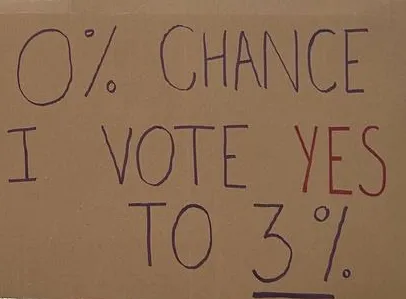
We can do better. We can vote no, regroup, use real union negotiating tactics to fight for the raises we deserve, and get a contract worth a yes vote. 

UFT Members: How to transfer on Open Market and not end up with an abusive administration

It’s late May and slowly but surely, positions are starting to list on the DOE’s Open Market system. UFT members can use this system to seek out transfer opportunities within the NYC public school system. Teachers who do this keep their pay, seniority, and tenure (as long as they work under the same license under which it was granted.)  Now, I have my criticisms of Open Market. It should not be the UFT’s go to solution for dealing with abusive administration. And, the City’s adaptation of a ‘unit costing’ model makes it very difficult for teachers with more years in the system (i.e. – higher pay) to find principals willing to hire them. New Action and UFC have both called for changes in transfer policy, including bringing back some form of ‘seniority transfers.’ Nevertheless, Open Market as currently constituted is the system we have, so it’s worth discussing how to use it right.

Seeking out schools that are hiring

Using the Open Market transfer plane, you can transfer this year from April 19 to August 8 at 5:00 PM. However, keep in mind that not all schools will post to Open Market right away. There are often budgetary issues that prevent principals from putting up vacancies, even when they know for a fact that they will have them. For that reason, it can be a good move to email principals at schools you know are good fits for you with queries as to whether they are hiring. You may discover that your dream school really does have a position available, that it just isn’t up yet. Just be cautious to accept an offer without a signature. You do hear of schools who thought they were going to be able to hire, but then got bad news on budget or discovered that a teacher whose position was becoming vacant opted not to retire/transfer. In the end: you haven’t actually been accepted to a job until you’ve signed the papers and gotten a confirmation email from the ‘Transfer Plane.’

If you don’t have schools in mind, all you can do is go with the list of schools available. Some teachers make their own crowd-sourced lists, or you can just go with the official list on Open Market. An AP friend of mine used to always say that ‘good schools hire early.’ Of course, less than good schools also hire early, and better schools will still have sudden vacancies in July and August. But it’s true that you can tell a lot about a school from how they administer the hiring process. Take note of how many teachers are involved, and how much power they seem to have in making decisions relative to principals. Look for green and red flags in how principals answer your questions. Keep in mind, however, that hiring often looks very different depending on when you apply for a position. Typically, if you apply early, i.e. when schools are still in session (before Regents for high schools), principals interested in hiring you will ask candidates to come in and do a demonstration or ‘demo lesson.’ Try your best to schedule such demos before/after school, so you don’t have to deal with the anxiety and risk of illicitly taking a day off from work for what is ironically an inter-department transfer. I was once taken out of the running for a job for refusing to do this, but I digress. If you wait until July or early August to apply, it’s doubtful you’ll be asked to jump through so many hoops. Another good friend of mine used to say, ‘wait until the end of summer to apply, when schools are scrambling!’ If you aren’t a fan of demo lessons or second and third interviews, there’s some truth there. Just make sure you are still doing your due diligence.

Research and Data

If you aren’t sure whether a school will be a good fit for you, it’s good idea to do some research. UFT scrapped PINI, which included a list of principals in need of improvement. (New Action is in the process of recreating such a list, but that’s still in the works). So, there’s no official place to see where schools will definitely be a bad fit. But, there is tons of public data out there. Remember those surveys teachers and students take each year? You can use websites like insideschools to see some of the results, or go straight to the source here. One of the most important pieces of data you will find is on whether teachers think the principal is trustworthy or a good manager. If you see bad results here, you might want to pause and do some more research. Keep in mind that there are limitations to this data. Teachers don’t always fill out surveys (leading to extremely small sample sizes). Others, fearing that their answers aren’t anonymous, end up ‘rounding up’ their responses. And of course, if principals have recently left, you may be looking at data from a previous administration – meaning the data is likely useless for your purposes. Keep factors like this in mind as you look at data, but do look at data if you’re seeking to transfer to a school of which you know little to nothing. It could save you a world of trouble.

And remember that there is no substitute for speaking to actual teachers who work at the schools you’re considering. I chose the school I currently work at – a very good fit – based on conversations I had with a diverse group of teachers who work there.

So good luck with your transfer search, New Action members, and if you’re interested in hearing more about our idea to re-create a PINI list, make sure to come to the NAC general meeting on May 30 at 5:30 PM.

NAC / UFT Meeting on Tuesday, May 30 at 5:30 PM

The New Action Caucus of the UFT will convene a meeting on Tuesday, May 30th at 5:30 PM via Zoom. With contract and healthcare changes imminent, we’ll strategize our next steps. To ensure that you get a Zoom link, email Michael Shulman.


Learn more about

our UFT Caucus

Content Policy

Content of signed articles and comments represents the opinions of their authors. The views expressed in signed articles are not necessarily the views of New Action/UFT.
Follow New Action – UFT on WordPress.com
March 2026
M T W T F S S
 1
2345678
9101112131415
16171819202122
23242526272829
3031  

Blog Stats

  • 404,931 hits