Archive for the 'Contract' Category


Should teachers wear uniforms? Some thoughts on the PBA contract and the uniform pattern.

PBA now has a contract. The details are better than DC37’s, which has led to some questions and confusion amongst rank and file in the UFT. In this post, I analyze some of the details/implications, answering some questions I’ve seen circulating along the way.

  • Beating ‘the pattern.’ I’ll start with the question I’m hearing the most: if police officers beat the pattern, can we? The short answer is no. You see, police officers are grouped under what we call the ‘uniformed professions,’ who effectively get their own pattern. So, while NYFD may benefit from PBA’s negotiation, UFT will not. We’re stuck with the ‘non-uniformed’ or ‘civilian’ pattern, and that sub-inflation embarrassment was set by DC37 without any pushback from UFT leadership. Similarly, police officers will apparently get their retro settled right away – they won’t have to wait for years and years to be ‘made not quite whole,’ as UFT infamously did.
  • The gendered ‘pattern gap.’ The uniformed/civilian distinction sets an incredibly problematic double standard. Pattern bargaining already has the issue of ‘cementing’ old inequalities into eternity. All titles are subject to the same economic increases, so whatever inequalities were there at the beginning of pattern bargaining are doomed to be perpetuated ad infinitum. But the distinction between uniformed/civilian professions only further exacerbates inequalities. By ensuring that salaries even grow at a higher rate amongst male-dominated professions (e.g. police officers and firefighters) compared to female dominated professions (e.g. teachers and paraprofessionals), inequalities between the pay rates of each job actually increase over time.
  • There’s no substitute for real organizing. NYPD officers have a bit of a reputation for ‘stretching’ the Taylor Law and getting away with it. (Think: ‘blue flu’). But, PBA solidly negotiated this contract within the confines of New York public-sector bargaining laws. In other words, they did not strike. And it’s telling that police officers, despite predictably doing better than DC37 in terms of their pattern, still ended up with sub-inflation wage increases. Education workers in Los Angeles on the other hand, who held a three day strike, did beat inflation. So yes, NYPD will get better relative raises than the UFT, but the more militant Local SEIU 99 beat both out by a longshot.

So, yes, teachers and all other ‘civilian’ union members should at least get what ‘uniformed’ workers get. The inequality in our patterns exposes some of the most blatant absurdities of pattern bargaining, and should be immediately abolished. But to truly get what we deserve, we will need to push beyond what even uniformed unions are getting in post-Taylor, New York. To get what we really deserve, we will need to dramatically increase our scope of contract tactics to that of what we are seeing in L.A. and Chicago. It is organizing, and organizing alone, that can beat inflation.

DC37 Makes Sub-Inflation Pattern Official

As expected, DC37 has voted overwhelmingly to ratify a new contract. This is important news for teachers, because the contract is pattern-setting. In other words, the economic details will also apply to the UFT. I hope the contract turns out to be a fair one that improves working conditions for our fellow unionists. But, we already know the economic details aren’t good.

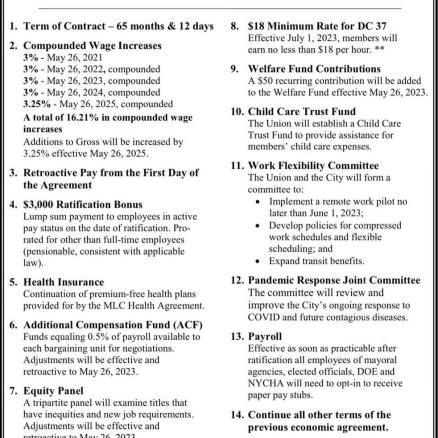
The numbers come down to about 3% in annual wage increases, along with a $3,000 signing bonus. In the end, that will come to about 16.21% over 5.5 years. That might sound like a big number, but it’s less than inflation. It’s also less of a pay increase than what workers are getting on average across the United States – and most U.S. workers aren’t in labor unions. For a unionized comparison, in Los Angeles, where public sector workers have and exercise the right to strike, SEIU 99 just negotiated 30% raises. In New York, where labor leaders argue against even having the right to strike, DC37 just agreed to about half that.

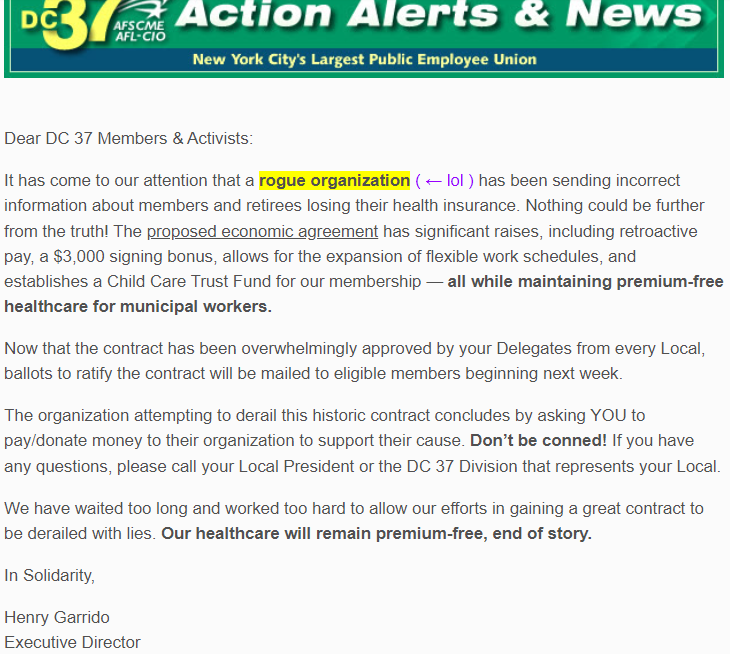
Still, DC37 had access to the numbers and still voted in the contract. We don’t know the ins and outs of their negotiations and what led them to settle for less. We do know that DC37’s membership was strongly encouraged by their union leadership to take the deal. We also know that, other than the pertinent financials, DC37 members did not have much information about their contract. They didn’t receive a full copy with their ballots. All they had was this one pager. And, while I hope the document was accurate, we’ve also seen hidden appendixes get voted in before.

Speaking of hidden appendixes, we also know that healthcare is being negotiated in parallel to our contracts. So, we aren’t just looking at a disappointing pattern. We’re also facing the possibility of being switched off our health plans for something cheaper. And unless we are successful with our petition, we won’t even have a say in that decision. Some DC37 dissidents tried to urge a no vote based on healthcare uncertainty alone. However, DC37’s progressive opposition is smaller than the UFT’s, and their union is much larger and more difficult to organize without the advantage of leadership’s institutional resources.

There are still loose ends to uncover. Soon enough, we’ll learn the specifics of in-service healthcare changes. With time, the full DC37 contract will also become available for analysis, and we’ll have more detailed information about what their deal means for us. Once we know more, we’ll publish more. In the meantime, I hope DC37 maximized the improvements they were seeking.

Organizing against a stacked deck: analyzing the UFT ‘Grade-Ins’ today

Today, we’ll witness phase 2 of UFT’s official contract actions. The flagship of this phase is the ‘grade in,’ where members will choose a public place near their schools and perform paperwork, planning, grading, or other administrative duties. Here is the idea from UFT’s official materials, put succinctly: “

  • Meet up, bring your work, stack it up, and get to work.
    • Idea: stacks of grading, planning.
    • Idea: One pile of important work you would like to do, one pile of paperwork/other work that you are being forced to do that is taking up your time.”

Many in our union’s progressive opposition, including a number of members affiliated with New Action, are pursuing grade-ins and related activities. Some are enthusiastic, others are more pessimistic, but dutifully going through the motions. New Action hasn’t taken an official stance on the grade-ins, but here are some thoughts going in:

Positives

  • Organizing with fellow members on contract-related activities can be a very good thing. It increases a sense of intra- and inter-chapter solidarity. I’m looking forward to meeting up with fellow UFT members near my own work-site today for an informational picket for that reason.  
  • This can be a very good moment to demonstrate to the broader public just how much work teachers do.

Criticisms:

  • Many members now see contract actions as pointless. With the pattern set below inflation, and with teachers going in already knowing that we’re getting a pay cut that our leadership did nothing to stop, a lot of members no longer see the point in organizing at all.
  • There’s something that feels insincere and performative about doing ‘contract actions’ with the most important parts already set. We also know that the City is unlikely to take any of this seriously.  UFT leadership has proclaimed that they are against members even having the right to strike, so I think Adams has pretty good idea that these ‘grade ins’ are about as far as we’re going to go as a union.  
  • The idea itself of a grade-in is arguably flawed from the get-go. Do we really want to normalize to the City that we do extra work at home after our contractual hours? And is this contract-action really inclusive for the diverse range of titles held by our membership or is it too teacher-focused?
  • With members having been threatened with legal action by the UFT’s own law firm for organizing even slightly outside of the box the last time around, many unionists feel turned off from official CAT actions this time. Members are also worried that they’ll be sued themselves for making some sort of error here. This feeling is compounded by the fact that UFT leadership admitted that they encouraged members to modify previous contract materials and sent their lawyers after us anyways.

I’ll admit. Weighing the pros at cons, at this point, the design of the CAT actions may feel futile. Is all this really designed to convince the City of anything? When the City already knows we’ll accept a pay cut and fight against our right to strike, do they really have an incentive to change anything else? Is the real audience actually UFT members themselves – just infrastructure for a yes vote, as I worried from the get-go?

Perhaps. Nevertheless, I don’t want to discourage members from having them. These sorts of events can be great places to organize with our colleagues and build solidarity. Just make sure to bring copies of the healthcare petition We aren’t just organizing against the City at this point; we’re organizing to get our own UFT leadership to do the right thing about our healthcare.


Learn more about

our UFT Caucus

Content Policy

Content of signed articles and comments represents the opinions of their authors. The views expressed in signed articles are not necessarily the views of New Action/UFT.
Follow New Action – UFT on WordPress.com
March 2026
M T W T F S S
 1
2345678
9101112131415
16171819202122
23242526272829
3031  

Blog Stats

  • 404,998 hits