There’s a tentative contractual agreement between the UFT and the DOE that will soon be sent out for ratification. Before I give my complete take on it, I’ll need to actually see it. I can’t yet of course. Even though I’m on the much touted ‘500-member negotiating committee,’ the executive board, and the delegate assembly, neither I nor the other members of those bodies have been afforded a copy. All we’ve seen are the contract at a glance and a PowerPoint, and only the latter was ready in time to actually be read before those aforementioned votes. Both documents have a purpose – they’re part of a pitch to convince members that the contract would be a good deal if we approved it. To that end, we should read them, but read them critically and with more than a grain of salt. Because there’s no actual tentative agreement yet to which we can compare the presentations, we must be particularly wary about omissions. Indeed, the sales pitch in 2018 left out some serious givebacks on healthcare and salary. There’s precedent to be worried here.
Still, not everything is omitted from these presentations. Some of the potential contractual changes are reported. So, salt in hand, let’s look at some of what UFT leadership and staff have told us so far, and think about some possible ways that fine print could matter.
Money: Here is the pitch on money, and the new predicted salary schedules. Yes, as expected, it’s the same bad pattern as DC-37. That matters, because when adjusted for inflation, 3-ish percent annual increases solidify a pay cut. The ‘raises’ are below what workers on average are getting in the U.S. – and most workers are not unionized. Indeed, our raises pale in comparison to what was achieved by unions like UTLA, who used their strike-readiness to their advantage and got more than double the wage increases that we’re getting. If we look at the details of how we’ll get the economics of our pattern into our pocket should we accept this deal, we see some further annoyances.
- There are ‘bonuses’ that call out as deal sweeteners, but which are in actual truth carved out of the same pattern. In other words, that money could just as easily have been a part of our raises. Instead, in perpetuity, a portion of our income will be in the form of these bonuses, and therefore will not be pensionable. Let’s be clear – that makes the so-called ‘bonuses’ a giveback.
- We won’t get any of this money until September, so despite this contract being thrown at us at the last possible minute so that we ‘won’t have to wait til after summer,’ we won’t see any money until Fall, anyways.
- Some raises are delayed. For instance, we don’t get the 3% raise for 2023-2024 until January of 2024, meaning we actually get less than a 3% raise for next school year. That’s somewhat buried in fine print, making the UFT’s take on the pattern look better than it actually is.
- There is nothing mentioned about healthcare here. That’s big, because the worst giveback in the last contract was our commitment to finding hundreds of millions of dollars in healthcare savings. That ‘backroom deal’ has led us to Medicare Advantage for retirees (and future retirees) and a mysterious in service plan for which RFPs sought 10% in savings. What little we got in raises this year could easily be eaten up by new member-facing healthcare costs of which we won’t be notified until after this deal goes through.
- There is nothing on joint lobbying for Tier 6 pension reform. Tier 6ers like myself will still be stuck contributing large percentages of our salary for life, despite getting much fewer benefits than our peers in Tier 4 and below.
Time: Here is the pitch on time, the workday, and remote work. Our supposed game of chicken, if it wasn’t actually just a yes-vote tactic all along, is now over. 37.5 days of tutoring is now out, and we have a reconfigured version of the pilot workday, which will need to be reapproved each calendar year (or default back to 37.5). In most (single-session) schools, this will look like 60 minutes of PD on Mondays (down from 80), 40 minutes of OPW (up from 35), and 55 minutes of parent engagement time (up from 40). However, while we were promised teacher autonomy and less micromanagement, I’m not sure this new plan delivers.
- That PD is now 20 minutes shorter each week is a welcome surprise for many of us, including myself, but we need to pause around the provision that “[t]he DOE and the UFT Teacher Center will create a catalog of professional learning options aligned with DOE initiatives that will confer CTLE hours and other required PD credits, such as CEUs. These options may be used in PD time during the workday at the school’s discretion.” The word ‘may’ is far from ‘must,’ and we should expect that many schools will see absolutely ‘0’ CTLE credits conferred for any PDs at all.
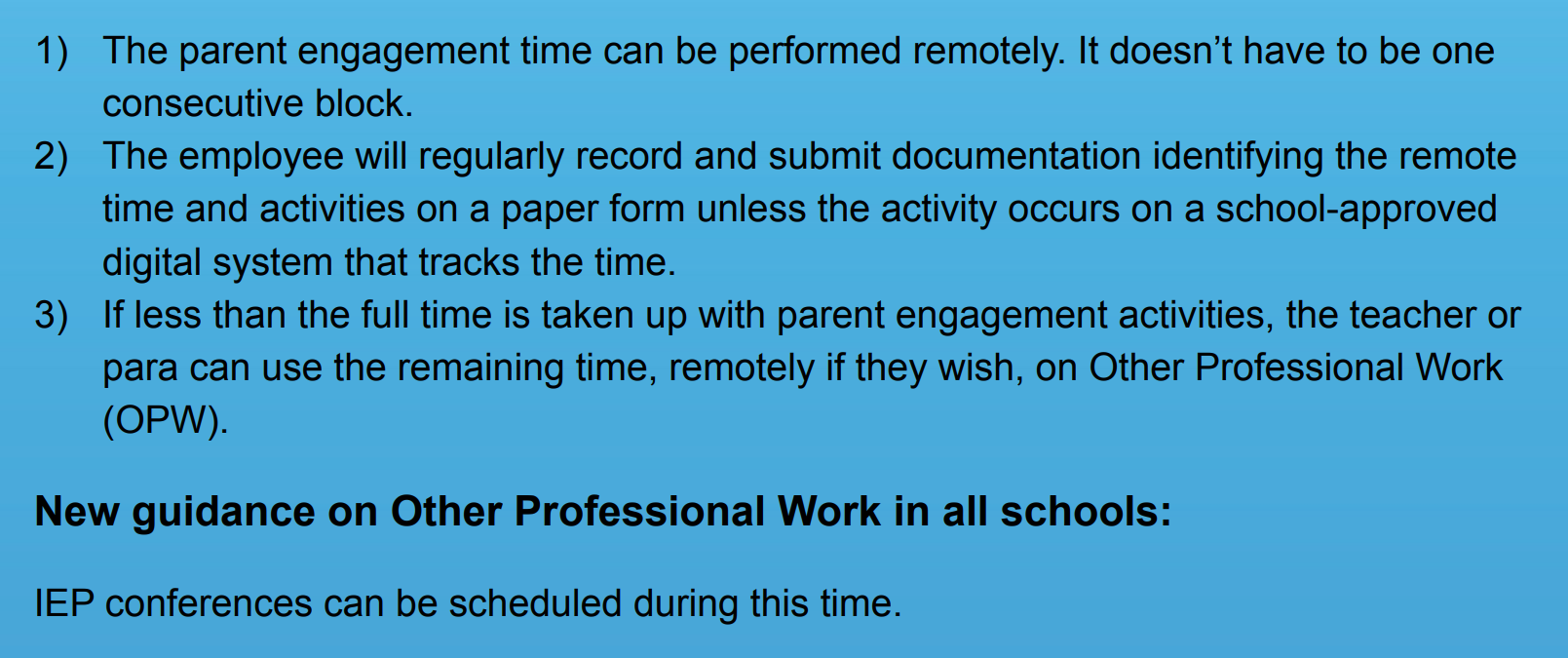
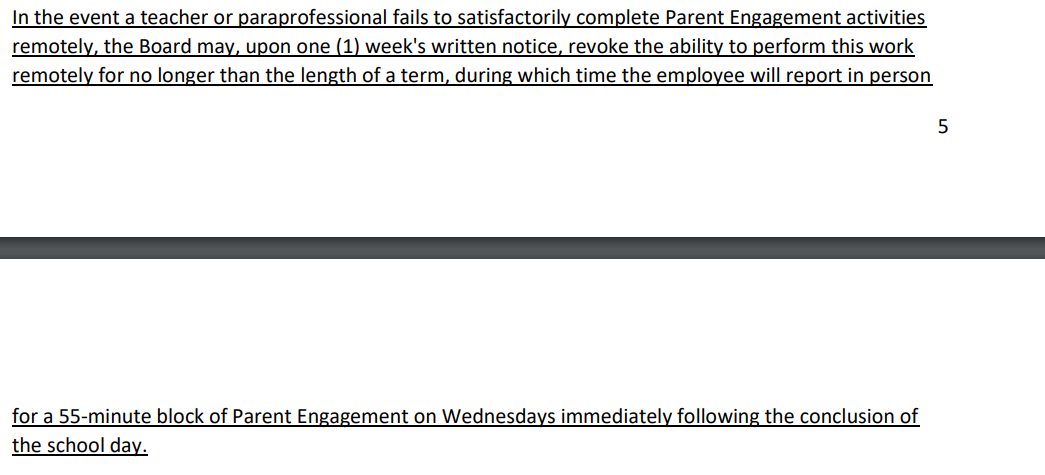
- Moreover, 15 of the 20 converted PD minutes go to parent outreach time, not self-directed OPW. Now, the parent outreach can now occur on our own time at home, and that’s a good thing. But, we should not take lightly that part of the remote PE will entail that “the employee will regularly record and submit documentation identifying the remote time and activities on a paper form unless the activity occurs on a school-approved digital system that tracks the time.” I expect that in some schools we will see a big shift to micromanagement of that time, something that a lot of hybrid workers have reported on time they work remotely.
- There are pre-approved SBOs available on the pitch page, but the decision to force this vote to happen at the last possible second and make SBOs ‘conditional on ratification’ means a lot of chapters will be scrambling right now to put together a vote in time for the deadline.
- 5 minutes of added OPW time is, to be frank, not much of a win, especially since that’s the only extra time that’s been granted to teachers to do things on their own time and at their own discretion. As a special education teacher, I’m particularly disappointed that I’ll only see a maximum of five extra minutes added to work on IEPs each week. On that note, it’s good that the DOE will issue “guidance that schools with professional-activity periods should, to the extent possible, prioritize assigning special education teachers to the following professional activity assignments: 1) performing student-assessment activities (including portfolios, IEPs, performance tests) and 2) common planning time.” But the language here sounds awfully tentative and easy to get around. We may still see schools where special education teachers are not given their much needed IEP time. In general, we need to be careful about words like “guidance,” “should,” and “extent possible,” especially when used in the same sentence. And I do worry that much of the new contract may be written in such a fashion.
Respect: In addition to time and money, respect was the big theme of our ‘fair contract’ campaign this year. There isn’t a dedicated section for that on the contract at a glance, but we can try to infer from the other things that are up there.
- The improvement to bereavement time is welcome. I lost two grandparents this year and the memorial was outside of the previous timeframe I was allowed to take off that way. We need to be able to use that time more flexibly, and the new language is an improvement.
- It’s a welcome improvement that two UFT members can now take 12 weeks of combined parental leave (up from 6). But, this does not change the extremely flawed cost structure of our parental leave program, which UFT members overpay into significantly. Moreover, we still don’t get 12 weeks of parental leave individually, whereas most NY workers do.
- There are some improvements to the process/result when staff are injured in the line of duty.
- Teachers now need to be given a reason if they are extended for probation, although I’m not convinced this will make a big difference. I’m sure there are a host of ready-available reasons the DOE will have. And this does nothing to change the onerous and broken tenure process – which leaves teachers without due process for far too long relative to other unionized municipal professions.
- There is no language here on improvement to the evaluation process.
- There is no language to reduce class sizes, which experts believe will remain unaffected by the new state law due to DOE non-compliance. There is also no language to reduce caseloads for related service providers.
- Most oversight for issues like special education and assessments are going to come down to committees which may not have much teeth. The new school-based special education committees, for instance, will not have the express power to escalate issues through any dedicated process. While it’s good that meetings about compliance will be taking place, we need to ask whether committees without power will have much of an effect.
Therefore, in the final ‘tentative’ analysis, this potential contract, while possibly an improvement on that of 2018, fails to meet the 5 primary contract demands of United for Change. We can see that based purely on the materials the UFT has released with the intention of persuading us to vote yes. Imagine how much worse the deal will stack up once we see the fine print.

 New Action - UFT