Posts Tagged 'Contract'


OT/PTs Continue to Fight for a Fair UFT Contract

On Monday, 7/10/23, when UFT leadership announced that the 2022-2027 contract had passed “overwhelmingly,” the numbers weren’t as unanimous as suggested. Reduced support for the teachers’ contract—at under 75%—meant the highest ‘no’ vote percentage for that particular contract since 2005. But the larger omission from the UFT announcement was that not every bargaining unit’s contract had even passed.  OT/PTs once again voted down the first offer for their functional contract (1,129 no to 782 yes), along with nurses, audiologists, and supervisors of nurses and therapists, some of whom were inexplicably combined with the OT/PT chapter for the first time.

Why did OT/PTs vote no?

OT/PTs appear to have predominantly voted no due to their position of economic precarity – a position which is exacerbated by graduate degrees and certifications being a condition of employment. Indeed, OT/PTs have similar and sometimes more extensive higher educational requirements when compared to teachers (including doctorates), despite being paid much less than pedagogues. As per Chalkbeat, “by January a therapist with 10 years of experience and a master’s degree would earn $86,131, according to UFT documents, while a teacher with the same years and degree would earn $103,594.” An internal survey conducted by the city-wide OT/PT chapter suggests that about 2/3 of their members must work two to three extra jobs just to pay back student loans and make ends meet.

The City’s line is that OT/PTs are paid at or above the market rate, something UFT officials have suggested puts them at a bargaining disadvantage. The entire industry of occupational and physical therapy needs major pay reforms, just as is the case industry-wide for teaching. However, the job of being an OT/PT in a public-school environment is apples and oranges to what a typical OT/PT job looks like in the private sector. It often requires traveling, creative scheduling, IEP-writing/interpretation, matching therapeutic regimens to educational needs, and sifting through various layers of regulatory compliance. For similar and other reasons, titles that technically exist in both the DOE and the private sector rarely match financially. Teachers in the public sector, along with counselors and social workers, tend to make above the ‘private sector’ rate. Nurses actually make below it, though interestingly don’t appear to be a major factor in why their combined contract with OT/PT got a ‘no’ vote.

OT/PT activists such as Chapter Leader, Melissa Williams, believe that their titles deserve parity with social workers, who are paid at a higher rate that is almost identical with teachers. OT/PTs were offered the option of earning more by working extra sessions, but this was a controversial proposition as it would have required working longer hours only to still make less than similarly educated peers. The option was particularly unpopular because it was negotiated by paid officers/staffers over the heads of rank-and-file members of the OT/PT negotiating committee.

How has UFT leadership responded?

In theory, one would think that the ‘no vote’ of a majority of OT/PTs would nudge union leadership into an energized position of solidarity with their aggrieved workers. However, the response by UFT leadership has been disappointing, generating widespread concern that OT/PTs will be up not just against the City—but against their own union officers—as they fight for a fair deal. For instance, immediately following the (non)-ratification vote, a UFT vice president sent out an email that bordered on paternalistic, fear-mongering, and accusatory, dangling what those members didn’t get because they voted ‘no’ and pointing to a “difficult road ahead” instead of validating that the contract was not good enough for them to vote ‘yes.’ He also left out the obvious – that pattern bargaining protects members from receiving a worse economic package in the end, even if a stalled contract means those pay increases will come later as ‘retro.’

A meeting on 7/13/23 with UFT President, Michael Mulgrew to discuss this ‘difficult road ahead’, did not go much better, according to attendees. Mulgrew quickly dismissed the financial concerns of members, conveying that pay parity was a negotiating non-starter, and that the problem of OT/PTs having to work second/third jobs was one for ‘society as a whole’ (rather than for him as the union president). He was similarly dismissive of the argument that heavy education requirements as a condition of employment should factor into compensation, suggesting that degrees don’t necessarily mean more money, and that ‘we all agreed to work for the public.’

The Road Ahead

The dismissive response by UFT leadership begs the question as to whether they will support the OT/PT bargaining unit at all. Some members fear political motivations. The OT/PT chapter is the only functional group with a Chapter Leader not elected under the ruling union party, Unity Caucus, which controls the union at large. Is it possible that Mulgrew and his affiliates would use this moment as a political opportunity to sow dissent against non-Unity representation rather than work to achieve contract goals? Is it possible that the Unity-controlled UFT might intentionally disrupt the second negotiations to achieve a result that could serve as a cautionary tale against other members voting ‘no’ in the future?

I hope not. But the fact that President Mulgrew and his officer associates are spending their time explaining why members were wrong to vote no, rather than spending a single second suggesting strategies to achieve their goals, does not bode well. In general, UFT leadership has poo-pooed union tactics that tend to work to achieve higher compensation, such as job actions, giving the UFT the dubious distinction of being perhaps the only teachers union that has publicly advocated against its own legal right to strike.

To that end, OT/PTs, along with the other groups in their bargaining unit, may be officially on their own if they want to achieve their goals. Opposition union groups are organizing to help support in whatever ways they can. Still, without official support from UFT leadership, i.e. those with any official negotiating authority/power, OT/PTs may be left only with ‘wildcat’ tactics to achieve their ends. Rank-and-file UFT members, sister-unions, and community groups are encouraged to do whatever they can in support. 
UFT Contract 2022-2027: Debunking Unity’s ‘Yes Vote’ Propaganda

As can be expected in any arbitrarily rushed UFT contract ratification process, union staffers have gone into full fledged ‘yes vote’ mode, issuing some reasoned arguments, but mostly propaganda, as to why members should approve the 2022-2027 contract. In this piece, I’ll debunk some of the most common variants circulating the web.

Wage Arguments:

  • The wages are fine, so let’s vote yes and get salary increases now!’ This statement is clearly false. The wages we would get in this deal fall below the rate of inflation. They fall below the average increase in pay for even non-unionized Americans. And they fall significantly below what more militant teachers’ unions are getting, such as UTLA. While, yes, accepting the contract in an early vote would put money into our pockets quicker, voting yes would also confirm to the City that, yes, we are willing to commit to doing the same work but at a pay cut. Think of Tier 6ers who have 30+ more years to work before you vote to set a precedent that the UFT is willing to work for less.
  • ‘The wages aren’t great, but the bonuses are.’ There are two types of bonuses here: the pensionable $3,000 ratification bonus and the non-pensionable annual bonuses that supposedly will be given in perpetuity, even in future contracts. Both come out of the same pot as the money put into our salaries. While some members, particularly in lower paid titles or at lower salary steps, would benefit from getting ‘a lot’ of money at once, all of us would have been better off seeing this money in fully pensionable salary increases. Moreover, those persons who would benefit from the money most, such as paraprofessionals, would have benefited far more from simply getting living wages in the first place. They did not. Ultimately, all of us should be wary about nonpensionable bonuses, which we’ll see very little of until after tax refunds anyways, due to high withholding rates for bonus checks.
  •  The pattern is the pattern.’ The pattern is the pattern only so long as we agree to take it. UFT leadership tried to sell us on pattern bargaining, but pattern bargaining has clear disadvantages. Namely, it ensures that inequalities that existed 40 years ago, will continue in perpetuity. Teacher salaries will never approach the salaries of police officers, for instance, as long as we accept that salaries that were set at absurdly unequal rates 40 years ago, should continue to grow at the same percentage rate each year (and actually go up at higher ratesfor police officers). If teachers took a stand and used more militant negotiating/organizing strategies, we could force the City to negotiate better salaries. Moreover, accepting the pattern by voting yes on this contract also signals to UFT leadership that we’re OK with them having not worked with DC37 to set a pattern that all of us could be proud of. Indeed, when I pressed them about this in an executive board meeting, UFT leadership claimed that they would not touch the pattern, because it would be ‘interfering with another union’s contract.’
  • ‘Inflation might not be as bad in the future.’ I hope the people making this argument are correct. I also think they are missing the point. Inflation was already bad starting toward the end of our last contract. We already need a massive salary increase to catch up to the new cost of living. We aren’t getting that in this deal. Moreover, we can never know if predicted future inflation will stay as low as expected. Back in 2019, no one expected high inflation. Then, Covid-19 hit and costs started skyrocketing. Just as inflation could be low in the future, it could also be much higher than expected. And because this is a long deal, ending in 2027, we’d be locked into increases that were insufficient to meet potentially astronomical rises in costs.

Healthcare Arguments:

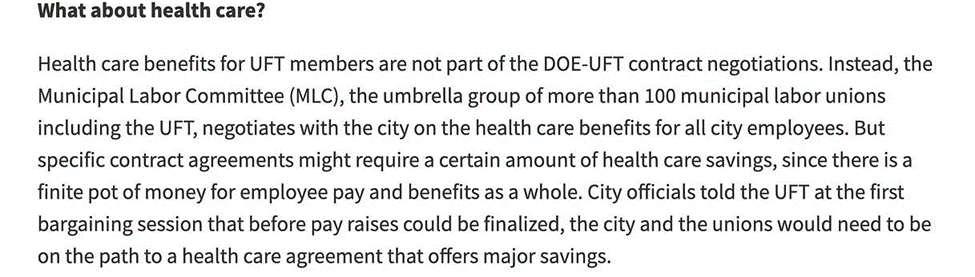
  • ‘Healthcare givebacks are not a part of this deal.’ Members are anxious that they might lose GHI or GHI SeniorCare as a result of negotiations. Anecdotally, this appears to be one of the major reasons people are currently opting to vote no. So, to mitigate the possibility of healthcare givebacks derailing a yes vote, Mulgrew has been claiming, on the basis of a technicality, that healthcare is not a part of this deal. To buttress this claim, existing MLC agreements committing us to healthcare savings have also not been listed alongside the MOA (I explain the implications of this more in the next bullet point). Nevertheless, healthcare is clearly a part of negotiations. Mulgrew’s sophistry is just to pretend medical coverage is a separate entity from contract negotiations. But, as the City knows well, these apples and oranges are in the same basket of rotting fruit. As described in the UFT’s official magazine, the NY Teacher:

And, indeed, as recently as late March, Mulgrew sent us terrifying updates about the specter of taking our GHI. UFT leadership also simultaneously approved massive guttings of GHI itself, keeping us on the popular health plan in name, but making it unrecognizable by allowing networks to diminish and copays to spiral out of control. Similarly, Unity led the charge to demolish our retirement healthcare, switching Medicare-eligible retirees to onto an inferior Medicare Advantage plan, which can be made progressively more inferior in time. Healthcare givebacks, in other words, are implicit to this tentative agreement, and have already begun to be realized. It would behoove us to vote no, in part, to show that we do not approve of these givebacks.

  • ‘Healthcare was a part of the 2018 deal but is not a part of this one.’ This argument has not been formally made, as UFT leadership frankly wants to distance itself from the terrible decision it made in 2018 to commit to $600 million in healthcare cost reductions in perpetuity. But the argument has been made implicitly by not including the famed appendix that committed us to this giveback on the MOA landing page. If that appendix is not there, doesn’t that mean it’s not a part of this deal – that healthcare givebacks were only a part of the last deal? No. If that were the case, we’d see a document with language crossing out that giveback, modifying that language, or—better yet—reversing that language to read that the City would reinvest money into our healthcare (rather than save on it). Indeed, Mulgrew would have announced all of this from the mountain top if it were the case. So, expect that the ongoing healthcare givebacks from the previous contract are still in effect. The proof is in the pudding, as shown in the previous bullet point.

Non-economic Gain Arguments:

  • ‘Even if wages aren’t great, that’s to be expected, and at least the rest of the contract is good.’ It appears to be true that the non-economic part of the contract is not worse than the 2018 agreement, but it’s also in no way a good contract. It doesn’t win us back what we lost in 2005, for instance, and therefore belongs to the same ‘giveback epoch’ wrought in during the aughts. The major gain that most UFT titles will see is being able to work remotely during parent engagement time. That’s not nothing, but it’s still part of the same extra 155 minutes that we shouldn’t be working in the first place.  And, it has red tape, like excessive paperwork to prove compliance and the ability for an abusive principal to revoke the right to work from home without due process. Moreover, most of the gains in this contract appear to be distracting ‘perks’ that do little to actually improve working life, while drawing attention away from major economic givebacks. One key area where there were few to no gains is special education. We had implicit leverage there, so it’s unclear why we didn’t really gain anything. Indeed, the fact that we didn’t is a bit of microcosm of the entire deal, demonstrating that other than a few peanuts here and there, we got little of substance in this negotiation.  

Temporal Arguments:

  • ‘Yes, we aren’t giving you much time to review the deal, but that’s because this is our last chance to get you a contract before summer.’ This argument is absurd in many ways. Ignoring, for a moment, that opposition has been predicting that UFT leadership might do this as a yes vote tactic for some time now, let’s look at why this is a bad argument to begin with. Timeliness of a contract is only a good argument if it is a good contract. But this contract, with its massive givebacks in salary and healthcare, and with its only minor increases in labor gains, does not meet that threshold. There is no point to timeliness if what’s timely isn’t good for labor.
  • Teachers all have access to the MOA, and it’s OK that no one had advanced access to it before voting to send it out to membership.’ Because the arbitrary summer deadline forces us to vote quickly, we end up not really being able to assess the contract’s fine print as well as we’d have been able to with a longer ratification process. That should worry us. And the situation is compounded exponentially by the fact that no access was provided to union leaders beforehand. Contract committee members, executive board members, chapter leaders, and delegates were not allowed any advance access to the contract, leading them precious little time to read up on the contract details and have conversations with members of their chapters. Busy as we are with end of year craziness, many teachers will be forced to make a decision before having a chance to read and understand the fine print.
  • ‘Because of the timing, if you don’t vote yes, you won’t be able to have an SBO or Prose Ballot.’  In effect, I cannot disprove this argument, because UFT leadership itself is the culprit. Unity has weaponized Summer by telling members that SBOs and PROSE ballots are conditional to the contract passing. In fact, I’m starting to wonder if the game of chicken Mulgrew entered into over reverting back to 37.5 was never with the City at all. At the very least, he’s kept that game going – but now it’s with the UFT rank-and-file. Despite the City having agreed to a version of the Pilot workday approved of by UFT leadership, Mulgrew is leveraging the specter of a reversion to 37.5 against members to vote yes. As he indicated in various meetings last week, if members don’t vote the contract in, we’ll be forced onto the unpopular 37.5 deal after all. With a contract vote this late in the game, we’d have nowhere to go but 37.5, after all, especially because Mulgrew didn’t consider a conditional Pilot Workday if the contract was voted down. All I can say is, if Mulgrew is correct that 37.5 is worse for the City than the Pilot Workday (due apparently to busing costs), then voting down the contract would, by his own estimate, keep our leverage at the bargaining table, albeit at the shared expense of membership. However, I am still disappointed that UFT leadership has effectively used ‘workday chicken’ as a yes-vote tactic, rather than a negotiating one.
  • ‘You will keep people, such as parents who are both UFT members, from being able to reap the gains of this contract, such as taking 12 weeks (combined) of parental leave.’ This is an unfair argument. It’s also easy to debunk, because the reverse is also true. Voting yes on this contract will keep people from realizing workplace gains and wages that meet the increasing cost of living.

Fear-Mongering Arguments:

  • ‘If you don’t vote yes, the City won’t negotiate with us.’ History has proven this wrong. In every no vote we’ve held in the past 30 years, we’ve gotten a better deal as a result. For a case study in what happened most recently when OT/PTs voted their contract down, see here.
  • ‘Voting no means that we strike.’ This is not true. While it would of course behoove the UFT to have a strike plan in case it ever needed to do so, a strike is not a necessary component of a ‘no vote.’ Indeed, we haven’t had a strike since 1975, but we’ve had several no votes, all of which have gotten us a better deal.

So, if paid UFT staffers and/or other Unity members try to pressure you into taking a bad deal, shoot back with dissections/debunkings of their arguments and propaganda. And for more New Action sources with criticisms of the contract, see the articles below:

UFT Contract Analysis: Zeroing in on Special Education. What went wrong? And what does that mean for the rest of the agreement?

If there’s any section of the contract that can help us understand if the UFT was successful in negotiations, it’s special education. The reason here is simple. It is one of the few places where UFT had some obvious leverage during this round of bargaining. Because of the many public failings around the City’s implementation of special education, it would have behooved them to make certain concessions that would be mutually advantageous. Instead, as we will see in the final analysis, we gained almost nothing in this contract draft.

In the spirit of full disclosure, I should note here that I was on the special education subcommittee for the UFT contract negotiations. In the spirit of full non-disclosure, I’ll err on the side of caution and simply analyze the tentative agreement as it pertains to special education without specifying anything about our official demands/negotiations themselves. Therefore, readers should neither assume that unmet needs for special education teachers were formally demanded by the UFT but rejected by the City, nor that they were left out of negotiations by the UFT entirely. I’m simply using this space to assess whether the language in our MOU stacks up to the changes that SPED teachers needed, speaking as a tenured special education teacher and unionist.

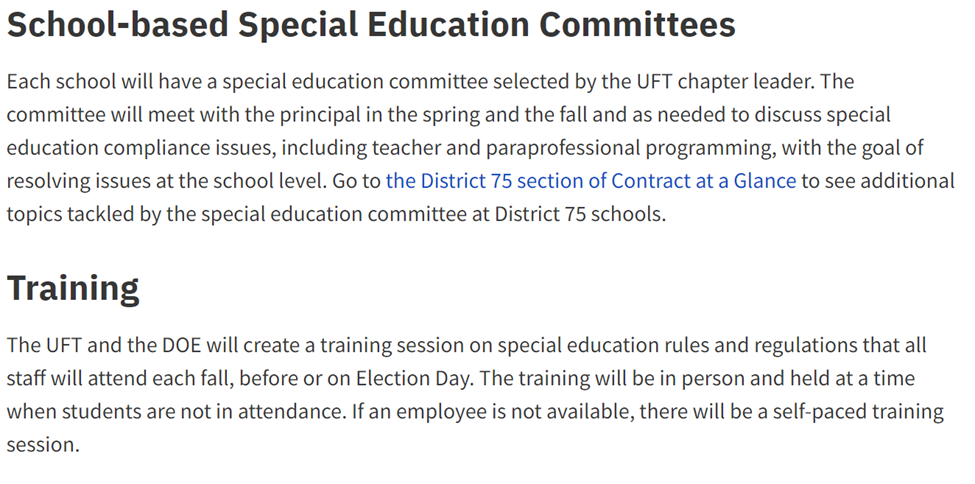
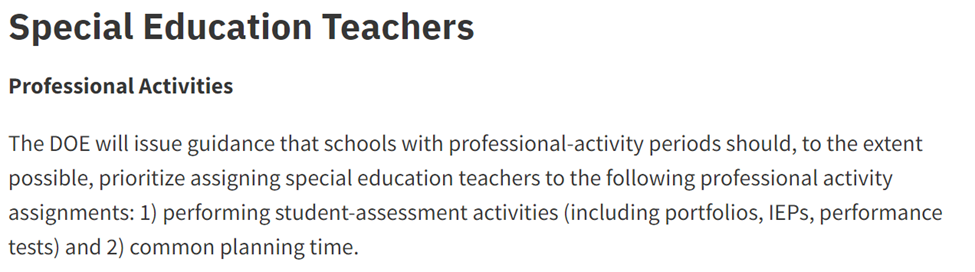
First, let’s look at what we did get. Here is how the UFT’s contract at a glance portrays it:

  • School-based education committees: This isn’t nothing. Principals will now be compelled to have union-driven conversations about special education compliance. In a field with a lot of turnover, that’s important, because in many districts, untenured teachers tend to dominate in special education roles. They are at a high risk of career-ending retaliation when they file special education complaints, but they’re also likely to get burnt out and leave if issues aren’t addressed. Chapter leaders and consultation committees, on the other hand, tend to be tenured and in a better position to fight. Now, twice a year, that fight has a designated space to happen. On the other hand, the power of this committee appears to be limited. If the goal is to resolve things at the school level, and there’s no language providing a designated ladder of escalation, as there is, for instance, for operational complaints, then in some schools, principals may just say ‘my hands are tied’ and leave it at that. That would leave untenured special education teachers back at square one, having to sign themselves onto special education complaints and hope they aren’t terminated as a result.
  • The training: I’m less rosy about this. UFT leadership tends to like training, especially when it aligns with their UFT Teacher Center(s), but I tend to think of training as another form of micromanagement. We already have M.Ed. degrees, experience, and proximity to other teachers with experience. Mandated trainings, as we all know, can be a pain. They’re a bigger pain though when they’re self-paced digital modules that principals expect us to get done during our preps and lunch breaks. To that end, I’m at least proud that the version negotiated here provides that the training must be in person, which will force these meetings to happen during PD time, with teachers alongside administrators (who frankly need the training far more than teachers do).

These two items are the only two listed under special education. Realistically though, there are also a few other things in the new contract that should be analyzed from the Contract at a Glance / MOA.

  • OPW time adjustment: This may sound like a win to some, and for some teachers in well-managed schools who are just looking for flexibility in when they can hold IEP meetings, perhaps it really is a win. But in some less well-managed schools, administrators will likely start to expect that IEP conferences happen exclusively or almost exclusively during OPW time. That may end up actually reducing the amount of IEP writing time that teachers get. Previously, OPW time was a somewhat protected IEP-writing space for SPED teachers, who could count on that time to write, and count on using C6 or prep periods to attend meetings (and generally getting coverages for doing so).
  • Professional Activities: Guidance is non-binding, a cop-out we use when both sides can’t agree to make something an actual part of the contract, so this provision is likely to have little to no effect. Teachers at multi-session schools will at least get a period of self-directed time if they don’t have a dedicated IEP writing period already, but teachers in most schools (single-session) will not get that time. In fact, even special education teachers with an IEP writing period overwhelmingly don’t have enough time to do them. I had hoped that special education teachers would have gotten more dedicated time, perhaps deducted from PD time, or (less realistically) in lieu of teaching a class, but neither of those options panned out. All that most SPED teachers will end up getting in terms of IEP time out of this deal is 5 extra minutes of OPW, much of which will be cannibalized by the new aforementioned stipulation to allow IEP conferences during that time (instead of providing coverage to do them during the school day).

What didn’t we get?

So that’s what we got: another PD, compliance committees without a dedicated escalation process, a minor adjustment to IEP-writing time that might actually lead to diminishments, and some unenforceable guidance. That, to be blunt, is not much. When tucked into a massive PowerPoint with all the other little things the 500-member negotiating committee achieved, it might not be clear how little we got. But when isolated, we can clearly see that special education gains were largely a bust.

Because here’s what we didn’t get:

  • Enforceable language that C6 periods must be IEP-writing and/or ICT co-planning periods for applicable special education teachers.
  • Time outside of C6 periods for special education teachers to conduct work on IEPs.
  • Caseload caps for IEP-writing special education teachers.
  • A dedicated escalation process on special education issues that can’t be resolved at the school level without untenured teachers having to risk retaliation for raising them.
  • A reduction of special-education related paperwork.
  • Stricter language ensuring that special education teachers aren’t programmed with too many co-teachers, subjects, or lesson preparations.
  • Hard-to-staff pay differentials for special education teachers, at least in programs that already have histories of giving similar differentials for other licenses like the Bronx Plan. (Note: not all unionists agree that there should be different pay for different licenses, but I’m still listing it here).

All of the above things that we didn’t get would have been mutually beneficial to special education teachers and special education students. Therefore, a city with much bad press on special education might have been expected to grant us some real gains on special education. Instead, they’re keeping the unreasonable paperwork demands, the lack of time to get one’s job done during contractual hours, the ability for untenured teachers to move to get compliance issues fixed without fear of retaliation, the possibility of teachers being overscheduled and thus less able to differentiate instruction for their students, etc, etc.

Again, this is an area of negotiations where we had obvious leverage. Looking at it while sifting through a PowerPoint, Contract at a Glance, or even the MOA itself, we might miss how little we got. There’s just so much in this contract, that it can be hard to keep track of individual areas, especially when voting will start after less than a week of having access to it. So, in the little time we have left before votes are due, don’t just read the materials about it, analyze each one separately and ask yourself, ‘does what we got hold up to what we should have realistically been able to get?’ In special education, the clear answer is no, we did not.   


Learn more about

our UFT Caucus

Content Policy

Content of signed articles and comments represents the opinions of their authors. The views expressed in signed articles are not necessarily the views of New Action/UFT.
Follow New Action – UFT on WordPress.com
December 2025
M T W T F S S
1234567
891011121314
15161718192021
22232425262728
293031  

Blog Stats

  • 401,259 hits