Archive Page 27

Retirees Sue to Halt Forced Switch to Medicare Advantage

Yesterday, the NYC Organization of Public Service Retirees initiated a new lawsuit against the City, as reported by the Daily News. Using a complicated mix of legal strategies, the goal of the legal action is ultimately to stop Mayor Adams from switching retired municipal workers—such as UFT members—off traditional Medicare and onto an Aetna-run Medicare Advantage Plan (MAP).

I of course am no legal scholar, but I did read through the 106-page official court filing,  and encourage others to do the same. The lawsuit makes an overarching claim that retired City workers took lower salaries and made irreversible financial, geographic, and medical decisions, both while working and once retired, in part because they were assured during and after their careers that in retirement the City would pay for their Medicare Part B premium plus their choice of a Medicare Supplemental plan. As good as any excerpt detailing the lawsuit’s primary claims can be found on pages 73-74. In this section, we see the facts/arguments tailored toward an ‘unjust enrichment’ claim, though other passages tailor those same facts/arguments toward other types of claims. That section is reproduced here:

“First, Respondents engaged in an unjust bait and switch. For 57 years, the City has promised municipal workers that a career in civil service – which pays wages substantially below those in the private sector – would entitle them to City-funded Medicare plus supplemental insurance in retirement. Retirees worked for the City for decades in reliance on this promise. When he was running for office, now-Mayor Adams agreed that eliminating Medicare plus supplemental insurance would be an unfair “bait and switch” that would “traumatize” these elderly and disabled Retirees. 50 He added: “You don’t become a civil servant to become a billionaire. You become a civil servant to have stable health care, a stable pension and a stable life, and we cannot destabilize it after they retire. Right now, after serving your city, we should not do any type of bait and switch. When you retire, you retire with an understanding, and we need to make sure we live up to that agreement.”

Second, Respondents are statutorily and contractually required to continue offering, and paying for, a choice of Medicare Supplemental plan.

Third, the vast majority of Retirees survive on meager pensions. Absent the City fulfilling its obligation to pay for Medicare plus supplemental insurance, most Retirees will be unable to afford the healthcare that they need and to which they are entitled.

By forcing Retirees to incur expenses that Respondents themselves owe, Respondents have been, and will continue to be, unjustly enriched. Equity and good conscience demand that Respondents’ unjust enrichment be enjoined and that any financial benefit they receive (including in the form of savings) be disgorged.”

Altogether, the legal filing presents an interesting case—really, cases, plural—to prevent the City from throwing retirees onto MAP. Whether the petitioners will be successful is another story, and—again—I  lack the legal expertise to make a valid prediction. The retirees do have a solid track record – one they’ve been building since they won their first big lawsuit. In that case, the City and official union leadership were stopped from throwing retirees onto a different version of MAP unless they paid up to stay on traditional Medicare (now they don’t even have that option). But Judge Frank’s decision in that case was made on the basis of a narrow reading of Administrative Code 12-126. Our own Unity-led UFT leadership misrepresented that precedent all over the place, suggesting that because of it, the City would be able to unilaterally throw all retirees onto whatever MAP plan they wanted without a pay up option. That of course wasn’t completely true. The City would only be able to do this if union leadership agreed to this ‘nuclear’ option. As we now know, most unions did not agree to this decision, but because of the outsized weight that UFT and DC-37 have in voting on healthcare bargaining decisions through the MLC, Mulgrew and Garrido were able to almost singlehandedly greenlight the MAP nuclear option, and without consulting their memberships either.  (Why? The most likely reason for Mulgrew/Garrido selling out the city’s retirees can be gleaned from Jonathan Rosenberg’s testimony on budgetary implications of moving retired municipal workers onto MAP. While the City is the respondent of the new lawsuit, the primary savings of MAP (and, by extension, changes to in-service healthcare) go not to the City exactly, but to our joint stabilization fund. But I digress – that’s a post for another day.)

Will Marianne Pizzitola’s group be able to use the law to stop the City from pushing retired municipal workers onto an inferior Medicare Advantage Plan? Their legal strategy worked the first time around. It also worked the second time around. But, with a nuclear option now activated—a nuclear option that was tailored precisely to legally circumvent Judge Frank’s previous decision—we’ll  have to see if the law will still be on our side. Still, let’s keep up hope.
UFT Contract 101: What makes a giveback a giveback?

Unless negotiations between the UFT and the City completely break down, all indications suggest that a tentative contractual agreement is near. United for Change, of which New Action Caucus is a member, published a combined list of five demands we need met before voting yes. I wrote a piece detailing the first demand, on wages. Unfortunately, we are almost positive that the first contract draft will concede to an inflation-adjusted pay cut. For many members, this is not just unacceptable – it is also a good example of what unionists call a ‘giveback.’

Defined loosely, ‘givebacks’ are “a previous gain (such as an increase in wages or benefits) given back to management by workers (as in a labor contract).” Based on that definition, the likely wage ‘increases’ in our next contract will be a ‘textbook’ example of a giveback. After all, if we ratify an agreement with roughly 3% wage hikes per year in a time of record inflation, that means doing the same work but for less. Others may counter that since ‘the pattern is the pattern,’ and since that pattern was set by DC-37 rather than by the UFT, our inflation-adjusted pay-cut is not a giveback, at least not per se. I disagree with that line of thinking, particularly since UFT leadership opted not to fight to set a better pattern than DC37’s, but I digress.   

So, what are some other types of givebacks that the UFT has seen over the years? Many of them were tallied in an infamous presentation made by some MORE members and linked to here by New Action. As the writers of the PowerPoint put it “By 1990, the UFT had won these contractual rights, and by 2020 we had given up all these rights:

  • An excessed teacher was placed and appointed to the closest vacant position in their license.
  • Teachers could transfer to vacant positions in other schools based on seniority, without the approval of any principal.
  • A member could grieve a disciplinary letter on grounds it was unfair and/or inaccurate.
  • The five-day workweek was 31 hours and 40 minutes (today, it is 34 hours and 10 minutes).
  • Teachers could take sabbaticals for travel.
  • There were no “professional activities” (C6 assignments). Most high school teachers had two prep periods a day.
  • We have made substantial concessions in health care via MLC.
  • We have made many non-contractual concessions like new pension tiers (Tier 6, changes to tenure rules).”

The Unity-led UFT leadership ended up hiring lawyers paid with our dues to try and scare opposition unionists into deleting the presentation under the pretense of ‘copyright infringement.’ But, when confronted with the question as to why UFT leadership had a problem with the PowerPoint, one prominent Borough Representative responded that “the UFT obviously doesn’t agree that we’ve had givebacks.” The UFT, you see, can’t admit to givebacks, even when they’re as plain as day.

And that should worry us, especially because covering up our losses is not a minority opinion. Indeed, at the most recent UFT Executive Board Meeting, a prominent District Representative suggested it would be a problem to allow delegates two weeks to review changes to contractual language before voting, because then opposition unionists might publicize negative things about the contract. To opposition unionists that’s precisely the point – if there are negative things in the contract, delegates deserve to know about them before we vote on them, no? But, to Unity, ignorance is apparently bliss.

We likely won’t have much of a chance to go over changes to the contract before we vote on it. Unity has made this very clear. That means that we’re likely to get givebacks we don’t notice, like the 2018 line in a hidden appendix that committed us to hundreds of millions of dollars in annual contract savings. That giveback, in the deal that Mulgrew told us had no givebacks, is now well known. But there are other lesser-known givebacks. And those lesser givebacks have the effect of combining to elicit a compounding effect over time, which means we need to see them, catch them, and prevent them from being signed into any new deals.

An example of a giveback that flies under the radar but shouldn’t is the 2018 change to requirements for obtaining the Masters +30 Salary Differential. Whereas previously, UFT members like myself could obtain a MA+30 through a number of avenues, including an additional (non-teaching) Master’s program or unlimited CLEP exams, this new change added something called ‘A+ credits’ to the mix. In theory, A+ credits could have just been one new option of many that made it faster and potentially cheaper to get a +30. And that’s what leadership made it seem like. Check out slide 27 of the PowerPoint that UFT leadership gave Chapter Leaders and Delegates at the fatefully rushed emergency DA at which we were sold the 2018 contract. A+ credits weren’t just framed as a ‘non-giveback’; they were framed as a new option for members – a contract ‘win’ that would give us “more freedom, more options.” But that wasn’t true. It turned out that after the 2018 contract was ratified, new teachers were obligated to get 18 of their MA+30 credits—more than half of them—through the A+ program. That means less freedom and fewer options. For many teachers, it also means less money. I meet newer teachers who came into the DOE with additional MA degrees all the time. They would have qualified for a MA+30 under the old model. Now, they must wait longer and go through pricey red tape to be paid the +30 differential. Despite already coming in with a Masters and 30 additional credits, they are nevertheless forced to spend new money and invest time which they might not have on classes that are limited in scope and which may not be of interest to them. For those teachers, the creation of the A+ process is an extremely expensive and bureaucratic give-back that makes it harder to reach top salary, even if it was potentially a win for patronage jobs at UFT Teacher Center.

So, when we finally see the new contract draft, as many of us expect we will later this month, look out for givebacks—not just the big ones, like pay-cuts or healthcare concessions, but the seemingly little ones, like A+ credits. Because these givebacks, which UFT leaders insist aren’t givebacks, add up. They compound to harm us, often falling hardest on new and future members. And look beyond the official UFT PowerPoint and summary, which are likely to obfuscate the negative ‘giveback’ aspects of changes in favor of getting a ‘yes’ vote. We just can’t vote to let our rights erode further, especially in the context of an assured pay cut.

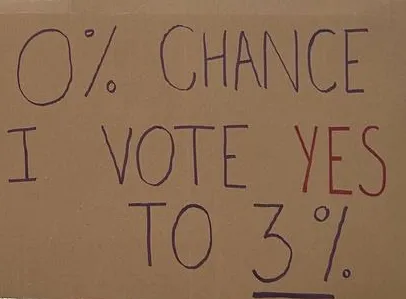
UFT Contract: There’s a 0% chance we vote yes to 3%!

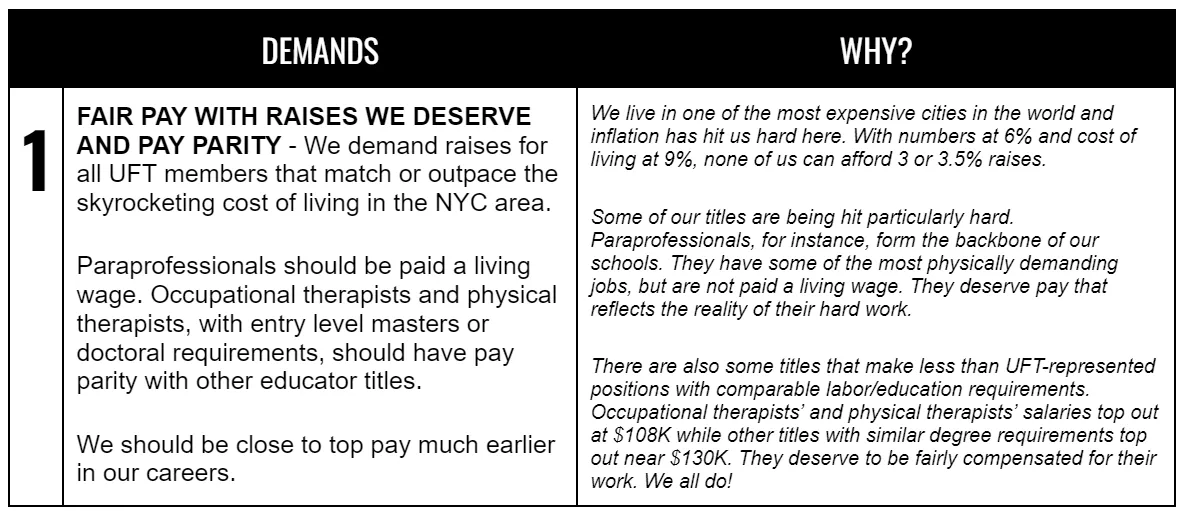
Inflation is out of control. Educators, who have never made enough to begin with, know this acutely. We feel it while stocking up at the grocery store and while searching for even the most modest apartments. We feel it while trying to buy a used car or while saving for the college education of our children. Everything costs more, except apparently the labor of educators. That’s why “fair pay with raises we deserve and pay parity” is the first of United for Change’s big 5 contract demands. 

We can turn to the mayor himself to paint a picture of the gravity of our financial situation. In 2007, when then NY-Senator Eric Adams gave his infamous “Show me the money” speech, he told an audience of New Yorkers that $79 thousand isn’t enough to live on. Flash forward almost two decades later and that same figure is worth $115,000 – almost the top salary for DOE teachers ($128,657 with a Masters +30). Starting teachers today make $61,847, worth only $42,271 in 2007 dollars. That’s about half the figure Adams was calling poverty wages. And, because it takes teachers twenty-two years to reach top salary—(police, in sharp contrast, make theirs after 5 ½)—it takes new teachers decades to make a reasonable wage. For paraprofessionals, the situation is even more bleak. With starting paras making $27,920 – but a fourth of Adams’s poverty figure in 2007 dollars ($19,083), and with senior paras never exceeding the wages of first year teachers, career-long paraprofessionals never make close to a living wage.

Today, Adams is on the other side of the negotiating table. While he and Chancellor Banks hire each other’s romantic partners to make absurd salaries of which New York UFT members could only dream, all Adams is likely to offer us is a measly 3% to 3.5% increase per year. 

Yet, Mulgrew’s Unity-led UFT has told us to accept the pattern. Indeed, when it was being set, they did nothing to stop it. At contract meetings, they’ve told us that asking for cost-of-living adjustments is ‘political’ – that it doesn’t necessarily match how unions negotiate salary increases. At the Brooklyn contract rally of May 24th, chants of ‘3% is not enough!’ were suppressed by union leaders making salaries of $200,000 and $300,000+. ‘Stay on message!’ they countered, redirecting rank-and-file unionists to demand vague changes to working conditions. 

Easy for them to say. Yes, we need changes to working conditions. But we also need to survive. Inflation is astronomical. Social Security adjusted their COLA increases at 5.9% for 2022 and 8.7% for 2023. And yet for New York City municipal workers, we’re likely to get a pay increase lower than the mostly non-unionized national average. But, in cities where unions fight, raises are far higher. Los Angeles, for instance, whose teacher union does not argue that its members should lack the right to strike, just got 21% increases over a three year period. We don’t have to accept 16.21% over five years (roughly 3% per year), because we know we’re worth more than that.

We can do better. We can vote no, regroup, use real union negotiating tactics to fight for the raises we deserve, and get a contract worth a yes vote. 


Learn more about

our UFT Caucus

Content Policy

Content of signed articles and comments represents the opinions of their authors. The views expressed in signed articles are not necessarily the views of New Action/UFT.
Follow New Action – UFT on WordPress.com
September 2026
M T W T F S S
 123456
78910111213
14151617181920
21222324252627
282930  

Blog Stats

  • 414,796 hits