If there’s any section of the contract that can help us understand if the UFT was successful in negotiations, it’s special education. The reason here is simple. It is one of the few places where UFT had some obvious leverage during this round of bargaining. Because of the many public failings around the City’s implementation of special education, it would have behooved them to make certain concessions that would be mutually advantageous. Instead, as we will see in the final analysis, we gained almost nothing in this contract draft.
In the spirit of full disclosure, I should note here that I was on the special education subcommittee for the UFT contract negotiations. In the spirit of full non-disclosure, I’ll err on the side of caution and simply analyze the tentative agreement as it pertains to special education without specifying anything about our official demands/negotiations themselves. Therefore, readers should neither assume that unmet needs for special education teachers were formally demanded by the UFT but rejected by the City, nor that they were left out of negotiations by the UFT entirely. I’m simply using this space to assess whether the language in our MOU stacks up to the changes that SPED teachers needed, speaking as a tenured special education teacher and unionist.
First, let’s look at what we did get. Here is how the UFT’s contract at a glance portrays it:
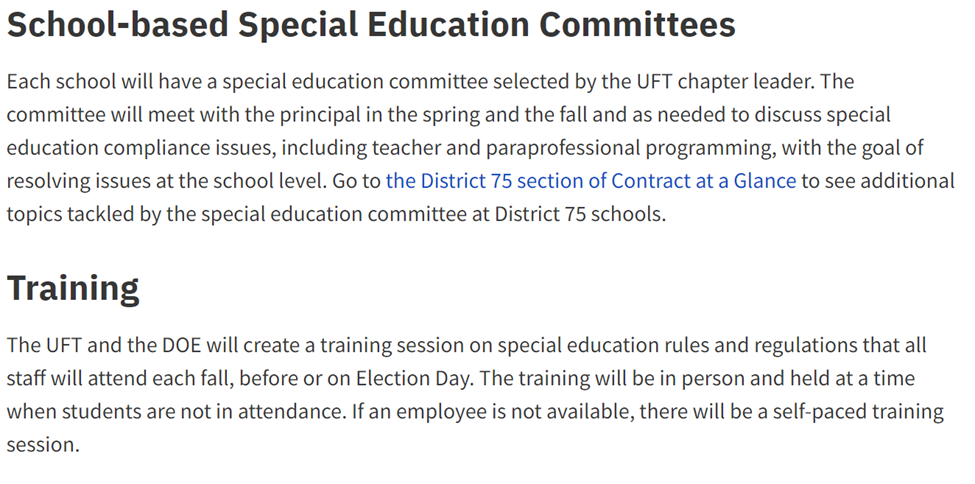
- School-based education committees: This isn’t nothing. Principals will now be compelled to have union-driven conversations about special education compliance. In a field with a lot of turnover, that’s important, because in many districts, untenured teachers tend to dominate in special education roles. They are at a high risk of career-ending retaliation when they file special education complaints, but they’re also likely to get burnt out and leave if issues aren’t addressed. Chapter leaders and consultation committees, on the other hand, tend to be tenured and in a better position to fight. Now, twice a year, that fight has a designated space to happen. On the other hand, the power of this committee appears to be limited. If the goal is to resolve things at the school level, and there’s no language providing a designated ladder of escalation, as there is, for instance, for operational complaints, then in some schools, principals may just say ‘my hands are tied’ and leave it at that. That would leave untenured special education teachers back at square one, having to sign themselves onto special education complaints and hope they aren’t terminated as a result.
- The training: I’m less rosy about this. UFT leadership tends to like training, especially when it aligns with their UFT Teacher Center(s), but I tend to think of training as another form of micromanagement. We already have M.Ed. degrees, experience, and proximity to other teachers with experience. Mandated trainings, as we all know, can be a pain. They’re a bigger pain though when they’re self-paced digital modules that principals expect us to get done during our preps and lunch breaks. To that end, I’m at least proud that the version negotiated here provides that the training must be in person, which will force these meetings to happen during PD time, with teachers alongside administrators (who frankly need the training far more than teachers do).
These two items are the only two listed under special education. Realistically though, there are also a few other things in the new contract that should be analyzed from the Contract at a Glance / MOA.

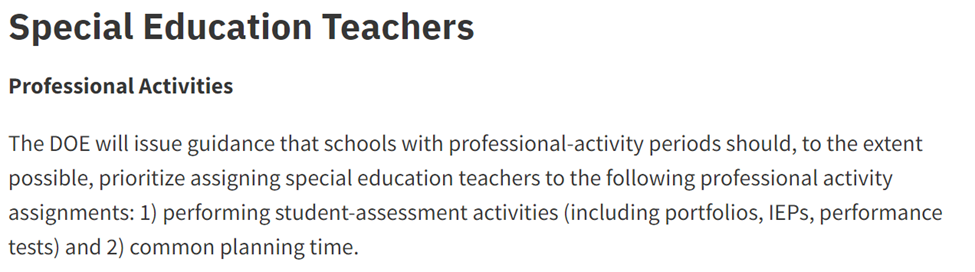
- OPW time adjustment: This may sound like a win to some, and for some teachers in well-managed schools who are just looking for flexibility in when they can hold IEP meetings, perhaps it really is a win. But in some less well-managed schools, administrators will likely start to expect that IEP conferences happen exclusively or almost exclusively during OPW time. That may end up actually reducing the amount of IEP writing time that teachers get. Previously, OPW time was a somewhat protected IEP-writing space for SPED teachers, who could count on that time to write, and count on using C6 or prep periods to attend meetings (and generally getting coverages for doing so).
- Professional Activities: Guidance is non-binding, a cop-out we use when both sides can’t agree to make something an actual part of the contract, so this provision is likely to have little to no effect. Teachers at multi-session schools will at least get a period of self-directed time if they don’t have a dedicated IEP writing period already, but teachers in most schools (single-session) will not get that time. In fact, even special education teachers with an IEP writing period overwhelmingly don’t have enough time to do them. I had hoped that special education teachers would have gotten more dedicated time, perhaps deducted from PD time, or (less realistically) in lieu of teaching a class, but neither of those options panned out. All that most SPED teachers will end up getting in terms of IEP time out of this deal is 5 extra minutes of OPW, much of which will be cannibalized by the new aforementioned stipulation to allow IEP conferences during that time (instead of providing coverage to do them during the school day).
What didn’t we get?
So that’s what we got: another PD, compliance committees without a dedicated escalation process, a minor adjustment to IEP-writing time that might actually lead to diminishments, and some unenforceable guidance. That, to be blunt, is not much. When tucked into a massive PowerPoint with all the other little things the 500-member negotiating committee achieved, it might not be clear how little we got. But when isolated, we can clearly see that special education gains were largely a bust.
Because here’s what we didn’t get:
- Enforceable language that C6 periods must be IEP-writing and/or ICT co-planning periods for applicable special education teachers.
- Time outside of C6 periods for special education teachers to conduct work on IEPs.
- Caseload caps for IEP-writing special education teachers.
- A dedicated escalation process on special education issues that can’t be resolved at the school level without untenured teachers having to risk retaliation for raising them.
- A reduction of special-education related paperwork.
- Stricter language ensuring that special education teachers aren’t programmed with too many co-teachers, subjects, or lesson preparations.
- Hard-to-staff pay differentials for special education teachers, at least in programs that already have histories of giving similar differentials for other licenses like the Bronx Plan. (Note: not all unionists agree that there should be different pay for different licenses, but I’m still listing it here).
All of the above things that we didn’t get would have been mutually beneficial to special education teachers and special education students. Therefore, a city with much bad press on special education might have been expected to grant us some real gains on special education. Instead, they’re keeping the unreasonable paperwork demands, the lack of time to get one’s job done during contractual hours, the ability for untenured teachers to move to get compliance issues fixed without fear of retaliation, the possibility of teachers being overscheduled and thus less able to differentiate instruction for their students, etc, etc.
Again, this is an area of negotiations where we had obvious leverage. Looking at it while sifting through a PowerPoint, Contract at a Glance, or even the MOA itself, we might miss how little we got. There’s just so much in this contract, that it can be hard to keep track of individual areas, especially when voting will start after less than a week of having access to it. So, in the little time we have left before votes are due, don’t just read the materials about it, analyze each one separately and ask yourself, ‘does what we got hold up to what we should have realistically been able to get?’ In special education, the clear answer is no, we did not.

 New Action - UFT