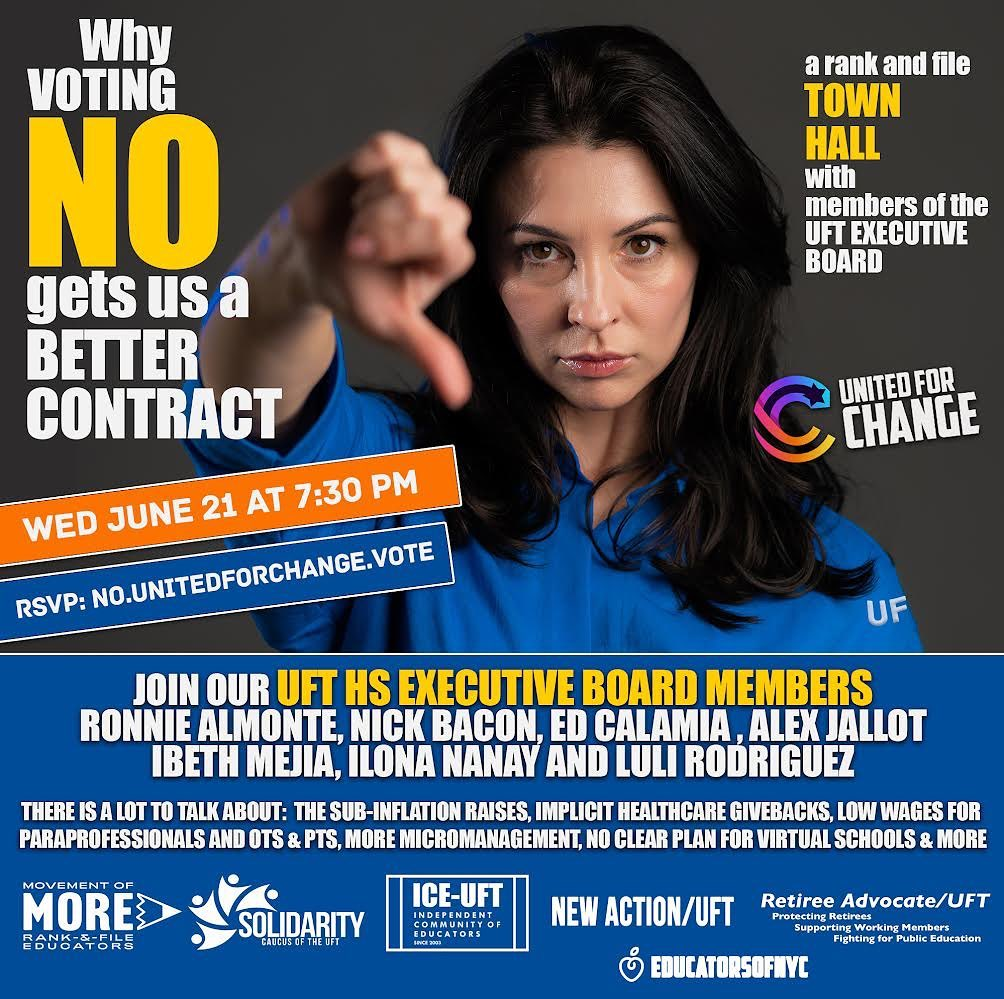
Join the UFT’s High School Executive Board, which includes members affiliated with New Action/UFT, Solidarity, MORE, and ICE-UFT, at 7:30 PM for a panel on why all of our caucuses agree/concur: voting no gets us a better deal. Register here.
Fighting for educators, building chapters, increasing democracy, with a progressive agenda
Join the UFT’s High School Executive Board, which includes members affiliated with New Action/UFT, Solidarity, MORE, and ICE-UFT, at 7:30 PM for a panel on why all of our caucuses agree/concur: voting no gets us a better deal. Register here.
New Action Caucus has gone over the good, bad, and middling parts of the 2022-2027 tentative UFT agreement. Ultimately, we agreed that this is a contract members would be better off voting ‘no’ on.
Largely, our decision came down to sub-inflation wage ‘increases,’ including a disappointing new precedent of converting a percentage of our pay into unpensionable bonuses, as well big unanswered questions on healthcare. But we also agreed that this contract draft is disappointing in other ways that could be corrected by going back to the negotiating table. It’s not just that we didn’t meet a single of the 5 demands released by New Action in collaboration with the rest of the United for Change coalition, not to mention the demands of our larger caucus-specific list. It’s that we don’t see improvements even in places that we expected – such as special education, where we had implicit leverage but inexplicitly failed to make any major gains. It’s that one of our only workplace wins–the ability for teachers/paraprofessionals to work from home for parent engagement time–is conditional on new micromanagement and the ability for principals to take that ‘privilege’ away at a moment’s notice, without due process (a troubling new precedent).
Sifting Through the Propaganda
Of course, members may or may not take New Action’s advice to vote no. But, it’s key that in making their own decision, chapters read through the actual MOU and have meaningful discussions on the language within. Be wary about trusting outside sources without fact checking. UFT-Unity has sent out tons of propaganda, sometimes misleading members in a way that can be dangerous in the context of a rushed vote. For instance, here, Unity falsely implies that all members will benefit from a new stipulation that “one professional period each week will be converted to OPW.” They omit a key detail: this is only true in multi-session schools (see page 4 of the TA). The majority of teachers, who work in single-session schools, will not get the contractual right to a self-directed C6 period. Multi-session schools probably only get this, by the way, because they get significantly less remote parental engagement time – just 80 minutes a month (single session schools would get 220). Additionally, the UFT PowerPoint, which is being turnkeyed throughout the City, leaves out key details, such as the aforementioned clause about the right for principals to take away remote privileges without due process.
Case Study: A Win that Probably Isn’t Really a Win at Most Schools
In discussing the contract together as a caucus, we’ve also been able to notice other problems we almost missed individually while rushing to read through the fine print during this arbitrarily brief ratification process. One of those problems, is the changing language for our professional period. Unity has called the updated C6 menu a win, and at first glance, it seems like that’s the case. Teachers now would have 14 new possible options in addition to what was there previously. There are some new options here that many teachers would probably love – such as office hours. Take a look:
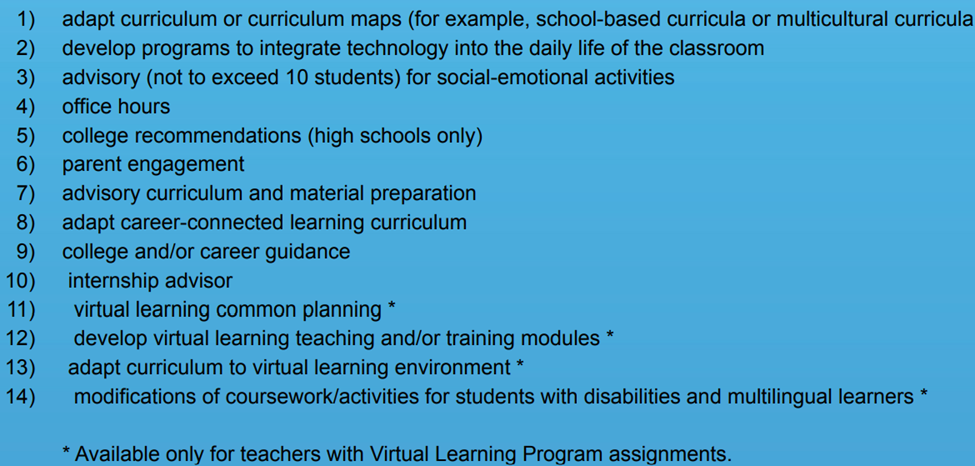
There’s just one problem: your principal doesn’t have to offer any of the options that you like. All they must do is let the UFT Chapter Leader ‘consult’ on what options should be offered along with how many slots should be available. And make no mistake: consult does not mean the same thing as approve. A principal may well end up vetoing your UFT chapter’s wishes. And that means we need to zero in on some of the options that give us pause:
This case study shows just one example of why it’s important to thoroughly analyze contractual details. In a rushed vote like this one, it’s easy to get lost in the promotional materials. We get thrown off by possibilities like ‘office hours,’ when we don’t look at the language in context. In context, our new C6 language is frankly more likely to do harm to teachers than to add any benefit. It’s something that we should renegotiate before approving.
Conclusion:
Indeed, with reduced inflation-adjusted pay and implicit but mysterious healthcare givebacks, the rest of the contract comes down to distracting perks that themselves have red tape or hidden givebacks. In short, this contract could be better. New Action advises: we should vote no and go back to the negotiating table.
New Action Caucus will meet today at 5:30 PM to discuss the 2022-2027 tentative agreement. Members who have not yet received an invitation should first make sure they’re signed up, then reach out to Nick Bacon.
Reading List:
 New Action - UFT